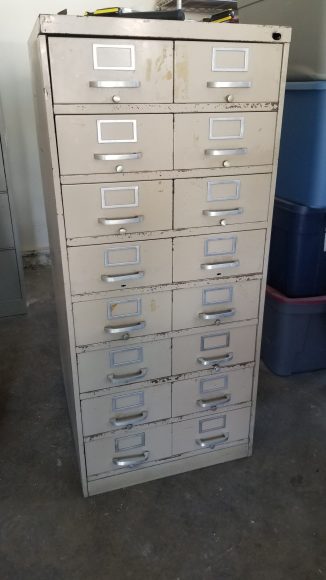
So today I took the plunge and picked up a Singer Business Furniture 20 gauge steel industrial index card filing cabinet. It’s the sort of thing that Niklas Luhmann or Roland Barthes may have only dreamt of.

The monster has 8 sliding platform chassis with 16 removable file drawers. I’ve done a little bit of clean up on it, but it has been well loved over time. Much like my prior furniture refurbishment projects, I expect I’ll bead blast off the original finish and rust and re-enamel it. I’m debating colors or potentially going brushed steel with heavy clear coat, though that’s a lot of work for the size and configuration. I’m initially thinking perhaps gunmetal grey with metallic blue flecked paint to match my desk, or perhaps a fun orange highlight color on the drawer fronts?
Specifications
Singer Business Furniture, Corry Jamestown index card filing cabinet (114 OB)
- 8 slider chassis with 16 individually (and easily) removeable drawers
- Exterior dimensions: 22 7/8″ wide x 52″ tall x 28 3/4″ deep
- Interior drawer dimensions: 9 3/8″ wide x 4 3/4″ tall x 27 3/8″ deep (or 26 1/8″ deep with the card stops installed)
- Fits cards: 3×5″, 4×6″, 7 3/8 x 3 1/4″ (Hollerinth cards)
- Removable metal slider card stops
- 13 removeable index card rods (3 missing)
- Aluminum drawer pulls
- Aluminum label frames
- Original industrial beige color, chipped and scratched
- 20 gauge steel
I thought about weighing it, but the thing is just too big for any of the nearby scales I’ve got access to. It’s definitely a bear to move even by sliding and required a heavy dolly and at least two people to maneuver. Three or more would be required to pick it up physically. One drawback to the size and weight is that it isn’t easily portable if there were an emergency, but the construction is so solid that it should definitely survive the most dire earthquakes or possibly nuclear bomb blasts. I suspect it’ll be a bit before I have multiple drawers full, so I can always individually remove active drawers.
A quick calculation on the front of an index card—no more backs of envelopes for me!—indicates that packs of relatively standard Oxford index cards should put the capacity of this monster at 55,700 index cards (with the drawer stops in place).
Photos
Features
The drawers should be nice and roomy for the 4×6″ index cards I’ve been using, but can also accommodate collections of smaller 3×5″ cards I’ve got.
While the drawers come with index card rods to hold the cards physically in their files, I suspect I won’t be using them. They seem to be of a design that would require custom cards for utilizing this feature anyway. I do quite like the rod design as the thumbscrews on the outside have small nubs on them with a key-like cut out on the drawer front with a compression washer. One then inserts the rod, fits it into the moveable card stop, and pushes it into the keyhole. A quarter or half turn of the rod and thumbscrew locks the rod into the cabinet.
The index card file stops are easily removable and have a simple springloaded clamp mechanism for moving them easily within the drawer.
While used, the entire thing is in generally excellent shape. Almost all the original hardware is still extant and the drawer mechanisms all slide smoothly, so those won’t require much, if any real work.
Because the filing cabinet is so massive and generally immovable, a fun and terrifically convenient feature is that each of the 16 file drawers are individually removable. This allows one to take a particular drawer or two to their desk and work on them before needing to return them to the cabinet when one is done. To make this drawer movement easier, in addition to the explicit handle on the front of each drawer, there’s an oval hole on the back of each drawer which functions as a handle on the other end. This is likely how I’ll use it, at least until I’ve refinished the cabinet and the drawers and move it into my office space permanently.

Because the files are wide and long enough, I might also profitably use the file for holding 8 1/2 x 11″ material stacked up in piles if necessary.
Naming
Some have talked about naming their zettelkasten. I’ve been considering calling the whole cabinet “The Ark of Studies” (Arca studiorum) after Thomas Harrison’s invention in the 1640s as it also contains a nod to Hugh of St. Victor’s mnemonic work relating to Noah’s Ark. Perhaps I’ll hame it Stonehenge II, because I’ll rely on it as a “forgetting machine” and it’s almost as big and heavy as a bluestone from the Preseli Hills in Wales—especially if I paint it that color. Beyond this perhaps I might give each individual drawer a name. This leaves sixteen slots, so I’m thinking about naming them after famous figures in the history of note taking and related spaces of intellectual history.
Right now it’ll likely be a subset of Aristotle, Cicero, Quintilian, Seneca, Boethius, Thomas Aquinas, Desiderius Erasmus, Rodolphus Agricola, Philip Melancthon, Konrad Gessner, John Locke, Carl Linnaeus, Thomas Harrison, Vincentius Placcius, Gottfried Wilhelm Leibniz, Niklas Luhmann, Beatrice Webb, Marcel Mauss, Claude Lévi-Strauss, Mortimer J. Adler, Niklas Luhmann, Roland Barthes, Vladimir Nabokov, George Carlin (I’ve got to have a drawer dedicated to comedy right?), Twyla Tharp, and Eminem. Who else am I missing? Who should I consider?
Oddities
Being a piece of used office furniture, it naturally came with some surplus junk inside. Most of this was of the paperclip and rubber band nature with plenty of dust and lint. There were a full collection of drawer labels with someone’s handwritten numbers for the files the card index once contained. Unexpected finds included some screws, nuts and bolts, part of a hacksaw blade, a rotary saw blade, some drill bits, a socket wrench fitting, and—most puzzling—a live round of ammunition! Every zettelkasten should have one of these right?

So go ahead and bite the bullet! Get your own cabinet, and start your analog zettelkasten today.
Picking up a massive slip box
Syndicated copies:
I suppose if you’re gonna goin “all-in” on having a zettelkasten (slip box) or index card-based commonplace book you may as well invest in some serious atomic-era heavy steel hardware…
So today I took the plunge and picked up a Singer Business Furniture 20 gauge steel industrial index card filing cabinet. It’s the sort of thing that Niklas Luhmann or Roland Barthes may have only dreamt of.
The monster has 8 sliding platform chassis with 16 removable file drawers. I’ve done a little bit of clean up on it, but it has been well loved over time. Much like my prior furniture refurbishment projects, I expect I’ll bead blast off the original finish and rust and re-enamel it. I’m debating colors or potentially going brushed steel with heavy clear coat, though that’s a lot of work for the size and configuration. I’m initially thinking perhaps gunmetal grey with metallic blue flecked paint to match my desk, or perhaps a fun orange highlight color on the drawer fronts?
Specifications
Singer Business Furniture, Corry Jamestown index card filing cabinet (114 OB)
8 slider chassis with 16 individually (and easily) removeable drawers
Exterior dimensions: 22 7/8″ wide x 52″ tall x 28 3/4″ deep
Interior drawer dimensions: 9 3/8″ wide x 4 3/4″ tall x 27 3/8″ deep (or 26 1/8″ deep with the card stops installed)
Fits cards: 3×5″, 4×6″, 7 3/8 x 3 1/4″ (Hollerinth cards)
Removable metal slider card stops- 13 removeable index card rods (3 missing)
Aluminum drawer pulls- Aluminum label frames
Original industrial beige color, chipped and scratched
20 gauge steel
I thought about weighing it, but the thing is just too big for any of the nearby scales I’ve got access to. It’s definitely a bear to move even by sliding and required a heavy dolly and at least two people to maneuver. Three or more would be required to pick it up physically. One drawback to the size and weight is that it isn’t easily portable if there were an emergency, but the construction is so solid that it should definitely survive the most dire earthquakes or possibly nuclear bomb blasts. I suspect it’ll be a bit before I have multiple drawers full, so I can always individually remove active drawers.
A quick calculation on the front of an index card—no more backs of envelopes for me!—indicates that packs of relatively standard Oxford index cards should put the capacity of this monster at 55,700 index cards (with the drawer stops in place).
Features
The drawers should be nice and roomy for the 4×6″ index cards I’ve been using, but can also accommodate collections of smaller 3×5″ cards I’ve got.
While the drawers come with index card rods to hold the cards physically in their files, I suspect I won’t be using them. They seem to be of a design that would require custom cards for utilizing this feature anyway. I do quite like the rod design as the thumbscrews on the outside have small nubs on them with a key-like cut out on the drawer front with a compression washer. One then inserts the rod, fits it into the moveable card stop, and pushes it into the keyhole. A quarter or half turn of the rod and thumbscrew locks the rod into the cabinet.
The index card file stops are easily removable and have a simple springloaded clamp mechanism for moving them easily within the drawer. While used, the entire thing is in generally excellent shape. Almost all the original hardware is still extant and the drawer mechanisms all slide smoothly, so those won’t require much, if any real work.
Because the filing cabinet is so massive and generally immovable, a fun and terrifically convenient feature is that each of the 16 file drawers are individually removable. This allows one to take a particular drawer or two to their desk and work on them before needing to return them to the cabinet when one is done. To make this drawer movement easier, in addition to the explicit handle on the front of each drawer, there’s an oval hole on the back of each drawer which functions as a handle on the other end. This is likely how I’ll use it, at least until I’ve refinished the cabinet and the drawers and move it into my office space permanently. Because the files are wide and long enough, I might also profitably use the file for holding 8 1/2 x 11″ material stacked up in piles if necessary.
Naming
Some have talked about naming their zettelkasten. I’ve been considering calling the whole cabinet “The Ark of Studies” (Arca studiorum) after Thomas Harrison’s invention in the 1640s as it also contains a nod to Hugh of St. Victor’s mnemonic work relating to Noah’s Ark. Perhaps I’ll name it Stonehenge II, because I’ll rely on it as a “forgetting machine” and it’s almost as big and heavy as a bluestone from the Preseli Hills in Wales—especially if I paint it that color. Beyond this perhaps I might give each individual drawer a name. This leaves sixteen slots, so I’m thinking about naming them after famous figures in the history of note taking and related spaces of intellectual history
.Right now it’ll likely be a subset of Aristotle, Cicero, Quintilian, Seneca, Boethius, Thomas Aquinas, Desiderius Erasmus, Rodolphus Agricola, Philip Melancthon, Konrad Gessner, John Locke, Carl Linnaeus, Thomas Harrison, Vincentius Placcius, Gottfried Wilhelm Leibniz, Niklas Luhmann, Beatrice Webb, Marcel Mauss, Claude Lévi-Strauss, Mortimer J. Adler, Niklas Luhmann, Roland Barthes, Vladimir Nabokov, George Carlin (I’ve got to have a drawer dedicated to comedy right?), Twyla Tharp, and Eminem. Who else am I missing? Who should I consider?
Oddities
Being a piece of used office furniture, it naturally came with some surplus junk inside. Most of this was of the paperclip and rubber band nature with plenty of dust and lint. There were a full collection of drawer labels with someone’s handwritten numbers for the files the card index once contained. Unexpected finds included some screws, nuts and bolts, part of a hacksaw blade, a rotary saw blade, some drill bits, a socket wrench fitting, and—most puzzling—a live round of ammunition! Every zettelkasten should have one of these right? So go ahead and bite the bullet! Get your own cabinet, and start your analog zettelkasten today.
(Original post with more photos and aggregated replies available at https://boffosocko.com/2022/08/08/55808119/)
That’s a big flash drive
anagora.org/zettelkasten
anagora.org/ToolsForThought
Metal af
You’ll have to let us know how you get on with it. 👍
Though is this you flexing @AllossoDan? 😉😂
️ I should hope that my well documented 20+ year romance with collecting and refinishing atomic era vintage 20 gauge steel (office) furniture might allay that charge. (Besides, it’s not really a “flex” until I finish refinishing it, which will take a while…)
It takes a bit to build up a paper collection to outgrow a single box or two to decide to put some effort into finding something larger. I’d started with a light green Acrimet 4×6 box in November 2021, in part to match the architect’s desk I had just started working on.
Of course if you want some more concrete “receipts”:
I have been heavily debating going the route of the stackable double card boxes that were common from roughly the 1960s on, but given their price versus larger files and the rest of my collection, the bigger vintage ones won out. For those interested in newer furniture Bisley has some of these stackable boxes, but older vintage versions are pretty common on Craigslist and e-Bay and generally less expensive, even with shipping.
Of course I have been enviously eyeing some vintage Gaylord Brothers wooden card catalogs, but the high price tags, the wooden mis-match with other furniture, mixed with the 3×5″ card limitations are just a bridge too far for me.
I would be interested in hearing the story of Dan’s research on card catalog files and his ultimate acquisition. It does make for a cozy and very functional reading nook as pictured on the cover of his new book though.
Who else has been looking at options outside of some of the usual ideas of cardboard boxes, cheap plastic, or smaller “Amazon” options?
Mine was just luck. I had mentioned to my wife a few months ago that I was thinking of switching to paper notes and I wished my college would let loose a couple of card files they have around the library purely as decorations. She noticed one on FB market and asked me if I was still interested. I almost lost it to one of the college librarians, who also wanted one and couldn’t shake loose one of the library’s.
Freudian typo de jour:
#FoolsForThought
cool
I just frowned at my cardboard boxes.
I’m aiming to build something similar out of wood soon.
But I also had an idea to build a bookshelf with drawers incorporated, a row of vertical draws on both sides of the shelf and/or one down the middle. Ideally creating book cubbies between the drawers where I could organize related books next to appropriate zettles. Not sure how attached to that idea I am though, seems like something I will like for the moment and find very novel in the future (pun certainly intended).
@chrisaldrich that looks like a lot of fun. any particular theme in mind for the content of this analog slip box?
Local libraries must be full of index card cabinets. Everything going digital, they might be willing to give them away or sell.
Love this! It’s beautiful as is but wow, it will look amazing if you clean it up and paint it to match your beautiful desk!
🤣🗃️ I should hope that my well documented 20+ year romance with collecting and refinishing atomic era vintage 20 gauge steel (office) furniture might allay that charge.
It takes a bit to build up a paper collection to outgrow… 👇🏼
boffosocko.com/2022/08/08/558…
This is great. Nice acquisition!
I’m currently outgrowing my cardboard boxes. While I do like the idea of a modular approach like Scott’s (which I could grow with need over time), going all-out and obtaining a whole cabinet like you is now suddenly back on my agenda!
Please do post some pics if you do overhaul it!
@heyjonathan I suspect it’ll continue along in the direction of topics like intellectual history, education, the art of memory, orality, mathematics, linguistics, history, economics, information theory, and linguistics. And of course continuing on in the tradition of the index of my digital one: boffosocko.com/about/ind…
I just weighed an individual file drawer at 7 pounds 3 ounces, so the drawers combined are 115 pounds just by themselves. The rest of the cabinet has to be at least another 75 – 100 pounds.
I finally had to dismantle my 22 drawer monster. Found out about 136 pounds of the ‘tank’ were in the drawer runners. 6.2 pounds EACH!
Hard to believe how much effort and metal were involved in card drawers. Pretty impressive build, especially given what passes for most drawers nowadays.
I finally had to dismantle my 22 drawer monster. Found out about 136 pounds of the ‘tank’ were in the drawer runners. 6.2 pounds EACH!
Hard to believe how much effort and metal were involved in card drawers. Pretty impressive build, especially given what passes for most drawers nowadays.
Legend
Well, I was referring to both your new filling cabinets.
Is this an indication? 🗃️😁
boffosocko.com/2022/08/08/558…
I remember when you posted that! I thought to myself: “I need to follow this journey” 😆😆. I have a digital slip box, but I’m so curious to hear how the physical one goes for you. It looks like quite the undertaking!
So you’ve taken the plunge and purchased an old school library card catalog, or maybe you want to but haven’t hit critical mass of cards to justify the purchase yet? Certainly you’ve found the traditional index card supplies still available at every office supply store on the planet, but did you know there’s still at least one company that supports libraries with custom card catalog supplies that you could use with your zettelkasten?
Brodart is a library services company based in Pennsylvania that supplies materials to institutional libraries that still has a variety of supplies not only for libraries and book lovers alike, but for amateur and professional zettelmacher(in) as well.
Most of their focus is on 3-by-5 inch index card sized material, but maybe with the re-popularization, they might add more support for the 4-by-6 inch card enthusiasts?
Perhaps if the demand for these older systems goes up, they’ll not only have more offerings, but the price will come down through economies of scale?
Let’s look at what they’ve got available.
Cards and Card Guides
On the card side, they’ve got a variety of options that aren’t as readily available at most office supply stores. If you’ve got an old school library card catalog with rods, you’re probably going to want cards with holes pre-punched. Of course they’ve got them in colors as well as without holes too.
With a sizeable card collection you’re likely to want some card guides, so they offer the traditional A-Z 1/5 Cut Card Guides as well as Blank Catalog Card Guides, with those holes pre-punched for convenience.
Dewey Decimal Catalog Card Guides
Most may already have an indexing system built into their system, but if you don’t and want to go with a classic Dewey Decimal set up, they’ve got you covered.
Perhaps you’ve got a sizeable digital card collection already, and have been jonesing to make the jump to analog? They’ve got printable card sheets so you can print out your digital cards relatively easily and continue without losing all that work. Or maybe you’re the mid century/ Umberto Eco purist who wants typewritten cards, but don’t want to retype them all? They’ve got both 4-up and 3-up versions as well.
4-Up Catalog Card Sheets for Laser Printers
Let’s say you’ve got a long standing practice of making bibliographic cards. You need some cards to hold not only your meta data about the materials you’re reading, but you want to add your fleeting notes to them the way Luhmann and others have. Brodart has a wide variety of pre-printed cards that could serve this purpose. Some have printed sections which say “Date Loaned” and “Borrowers’s Name”, with sections for data below, but these could just as easily stand for page number and lined space for your important notes.
Brodart White Book Cards with Author, Title, Date Loaned, and Borrower’s Name
There are also a number of other versions of this sort of card depending on what you want. Try these or search for the many others which may suit your fancy:
Brodart White Book Cards with Two Columns and Ruled Top
Brodart Book Cards with Author, Title, Date Due, and Borrower’s Name
Brodart Medium-Weight, White Book Cards with Ruled Top, Date, and Issued To
Slip Boxes
Maybe you haven’t made that slip box purchase yet, but want something shiny and new? Brodart has you covered here as well. They’ve got a few different options for a small desktop slip box or a fully modular system that you can add to over time.
Stand alone boxes
Brodart has at least two desktop boxes, with 12 and 9 drawers respectively.
Brodart 12-Tray Card Catalog Cabinet with Solid Oak Front
Brodart Nine-Tray Card Catalog Cabinet with Solid Oak Front
Modular Boxes
Want to design your own system that’s expandable with your card collection? They’ve got a five drawer wide system with options for 1, 2, or 3 row tall sections that you can build up to suit your needs. Start with their table and legs, add a one or more sections of card files, and then top it off with a cover. If you’d like, they’ve also got an interstitial piece with drawer pulls so that you’ve got a writing surface built into your zettelkasten. Build that system up to your ceiling!
Brodart Cabinet Bases for Card Catalog Sectional Cabinets
Brodart 15-Tray Unit for Card Catalog Sectional Cabinet
Brodart 10-Tray Unit for Card Catalog Sectional Cabinet
Brodart Five-Tray Unit for Card Catalog Sectional Cabinet
Brodart Cornice Top for Card Catalog Sectional Cabinet
Brodart Sliding Reference Shelves for Card Catalog Sectional Cabinet
4-by-6 inch Card Boxes
Brodart is a bit thin on the 4-by-6 inch category, but for the beginning zettelmacher(in), they do have some nice sized, portable, archive quality boxes you might like to start your collection. See their Postcard Boxes.
Other Options
Of course there are lots of other options in the space. Some of these box systems can become pretty expensive, and for the price you might be as well off purchasing a used card catalog which you can restore or you can find restored ones online. Some of them even go to the level of fine furniture and can quickly go for over $5,000.00.
If you prefer the vintage 20 gauge steel esthetic (you know I do!), you can find lots of used, but still great condition slip boxes online in places like eBay or on Craigslist.
I and others have written some advice about other card storage options on a Reddit community targeted at analog zettelkasten in the past.
What do you use? What do you want to use? Are you going to custom build your own? Have you seen other companies like Brodart that still support the manufacturing of these sorts of tools for thought? Please share your ideas and supplies below.
Syndicated copies:
If you prefer the vintage 20 gauge steel esthetic (you know I do!), you can find lots of used, but still great condition slip boxes online in places like eBay or on Craigslist.
Below I’ve aggregated a list of some of the longer articles and material I’ve written about these topics. The completist can find and search my…
Invariably, when one is starting out on their analog zettelkasten or index-card based commonplace book journey, one of the first questions besides what size and…
@chrisaldrich @natalie Thank you both for the info!I just spent some time creating the prototype of my Zettelkasten box. Still needs more tweaking. But it’s looking good so far.
On February 7th, I picked up a Shaw-Walker 4 drawer filing cabinet that someone had decided to leave for scrap. Despite some serious rust and a few physical holes on the bottom, most of the cabinet is in reasonable shape and functional. The locking mechanism is still mostly in place, though the piece is missing the locks and keys. Each of the drawers has one or more file stops, of a few different styles.
It contained a handful of paperclips, some sewing patterns, and some check stubs from 1976. I suspect it’s likely from the late 40s to early 60s, but it’ll require some research to track down a more specific manufacturing date as the interior has no immediate clues.
Given the general condition and rust, I think I’m going to fast track it for refinishing this month before I tackle the monster, which portends quite a bit more work and effort.
Top of the filing cabinet with an intact Shaw-Walker badging, but missing locks.
Drawer rollers in Shaw-Walker Filing Cabinet. The curved piece of metal at the end rotates to lock the drawers into the cabinet, but they can be switched to allow the entire drawer to be removed.
Many may recall that I’ve been refinishing vintage mid-century furniture for over a decade now. I’ve also been more cognizant of converting my commonplace book…
Maybe I didn’t have enough filing space for index cards yet? Maybe it was because the price was too alluring to resist? Maybe it was…
Finding that bullet in your new slip box is like Eminem’s “stacking ammo”
Goddamn I wish I was that big of a nerd to need one of those