Acquired 1971 Hermes 3000 (3rd Generation) Portable Typewriter (Paillard S.A. Yverdon Switzerland)
Serial Number: 7084044
Hermes Epoca typeface, 10 pitch, slugs: SNO, 6 lines/vertical inch, portable, bichrome, segment shift, tabulator, U.S. keyboard with 44 keys and 88 characters
light green plastic body, grey-ish cream colored plastic keys
Manufactured in France
Purchased from from Jan M. Macho in Pasadena, CA. This was the personal typewriter of his father John J. Macho, Sr., an émigré from Czechoslovakia who was in regional sales for Paillard in America and sold millions of Hermes typewriters. 

Jan Macho, Sr.’s grandson Chris Macho eulogized his grandfather on Instagram:

This is a Hermes 3000. My grandfather, Jan Macho, “Deda” to me, made a living and a small fortune as an exec at Hermes Typewriter Co., and he sold a million of these. I admit, I don’t think of him as often as I should, and it takes hints like these in the wild to remind me of him. Fuck me, he was just so legendarily amazing, kind, generous, and plain THE SHIT in how he carried himself (and now I’m tearing up as I write this). I mentioned him and the Hermes thing to the people at this place here and they gave me a beer. So here he is, still hooking me up from the other side. Love you, miss you Deda.

A greenish gray 1971 Hermes 3000 with a boxy plastic body sits on a library card catalog next to three gift bottles of Scotch.

Generally his typewriter is in solid condition aside from some cosmetic issues in the rear body plastic possibly due to heat exposure. It’ll need a full C/O/A and some new rubber, but will be resurrected to be a spectacular little portable typewriter for a few more generations.

I was so enamored of the provenance of the typewriter that I  barely managed to get through a preliminary check of the functionality before buying. I completely didn’t even notice the Epoca typeface until I got it home. Somehow I’ve always been the bridesmaid when it comes to Hermes machines, but it seems I’ve jumped right over the bride title straight to princess.

yellowish card tag featuring the san serif epoca typeface sample of a 1971 Hermes 3000 typewriter

Close up of the slugs on the left hand side of a 1971 Hermes 3000 featuring a san serif Epoca typeface. The foundry mark on the slugs is "S NO".

Resources

Oblique angle from above the left side of a green Hermes 3000 typewriter

Groups, Fields, and Galois: Part 1 | UCLA Extension

Dr. Michael Miller, a retired researcher at RAND, has been teaching upper level undergraduate/graduate level math courses for fun at UCLA Extension for over 50 years. This fall he’ll be introducing the areas of groups, fields, and Galois theory from abstract algebra to those interested in abstract math: Groups, Fields, and Galois: Part 1. His intention is to do a follow-on class on Galois theory in the Winter which will use this class as a foundation. If you’re in the Los Angeles area his class starts on September 22, 2026 at UCLA on Tuesday nights from 7-10PM. Register here: https://www.uclaextension.edu/sciences-math/math-statistics/course/groups-fields-and-galois-part-1-math-9001

His courses are thorough and rigorous, but geared toward lifelong learners and beginners in abstract mathematics to allow people better entry points into higher level mathematics. His classes are interesting and relatively informal, and most students who take one usually stay on for future courses. The vast majority of students in the class (from 16-90+ years old) take his classes for fun and regular exposure to mathematical thought, though there is an option to take it for a grade if you like. There are generally no prerequisites for his classes, and he makes an effort to meet the students at their current level of sophistication. For this particular class, if you’ve got some experience in high school algebra and know some preliminaries about mathematical proofs you’ll be ready to dive in.

There are regular commuters joining from as far out as Irvine, Ventura County and even Riverside. Most in the class are dedicated hobbyist and professional mathematicians, engineers, physicists, and others from all walks of life (I’ve seen actors, directors, doctors, artists, poets, retirees, and even house-husbands in his classes.)

If you’re unsure of what you’re getting into, I recommend visiting on the first class to consider joining us for the Fall quarter. Sadly, this is an in-person course. There isn’t an option to take this remotely or via streaming, and he doesn’t typically record his lectures. I hope to see all the Southern California math fans next month!

Course Description

Group theory is recognized as one of the great unifying mathematical disciplines, with far-reaching applications in virtually all scientific (and many non-scientific) fields. This course, the first of a two-quarter sequence that concludes in Winter 2027 with a course on fields and Galois Theory, is geared toward developing the tools of group theory needed to establish the Abel-Ruffini theorem on the insolvability by radicals of the general polynomial of degree five or greater. Results established along this journey will also be applied toward addressing the three classical ruler and compass construction problems of antiquity: trisecting the angle, duplication of the cube, and squaring the circle, as well as Gauss’ surprising characterization of constructible regular polygons.
September 22 – December 1
Tuesday 7:00PM – 10:00PM PT
REG# 410697
Fee: $450.00

Recommended textbook: TBD 

Dr. Miller provides enough background and thorough notes that if you’re taking notes on his lectures, you typically won’t need a textbook.

If you’ve never joined the class before (Dr. Miller has been teaching these for 53 years and some of us have been with him for nearly that long; I’m starting into my 20th year personally), I’ve written up some tips and hints.

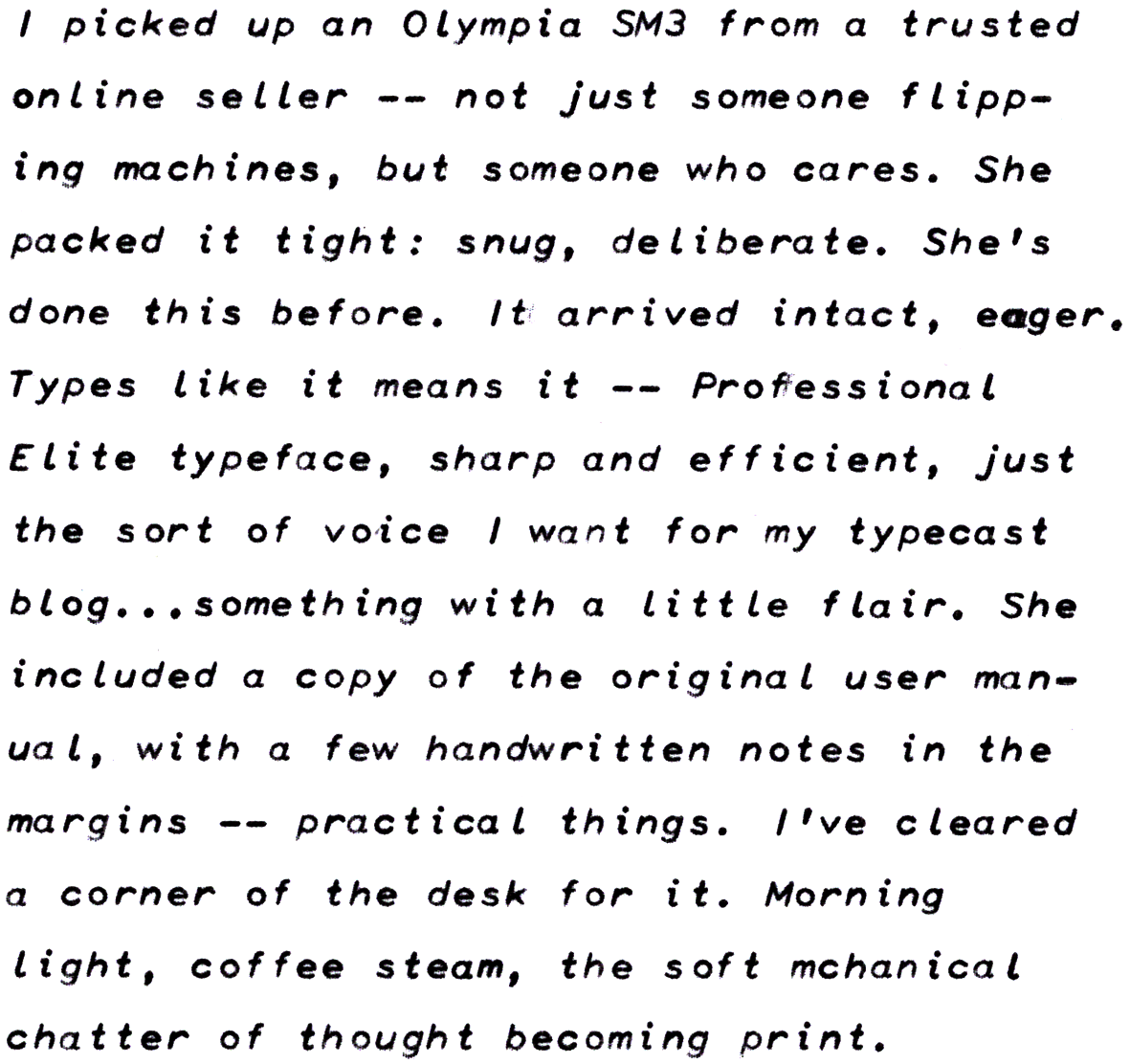
Acquired 1959 Olympia SM3 portable typewriter (Olympia-Werke AG)
Serial number: 1477358
Professional Elite No. 41 typeface, 11 pitch, 2.3m/m, 6 lines/inch, bichrome, carriage shift, tabulator
American keyboard, 44 keys, 88 characters
green crinkle paint, black plastic keys
Manufactured in Wilhelmshaven, Germany
Found at The Predecessors while typewriter hunting in Anacortes, WA. It was paired with another similar green Olympia SM3, but I immediately picked this one up because of its beautiful and uncommon typeface. 

It’ll need several new parts including rubber, but this portends to be a fantastic typewriter.

Typed manilla card with sample of a 1959 Olympia SM3 typewriter with a Professional Elite No. 41 typeface which is a small sans serif slightly italic face.

1959 Olympia SM3 portable typewriter in green crinkle paint on an oak library card catalog next to a silver plated cocktail shaker in the shape of a zeppelin.

A Stopgap Repair Solution for Impatient New Olympia SM3 Typewriter Owners

You just picked up a dusty, but somewhat functional Olympia SM3 and you know that you need to replace the rubber body bushings to prevent your carriage from hitting the body panels and scratching the paint job. The problem is that you’ve got a lovely new-to-you typewriter in front of you, and you don’t have the patience to not type on it until you’ve done this easy repair. 

I’ve never seen it mentioned anywhere, but I’ve got a quick, temporary solution that’ll get you typing in just a few minutes. (Incidentally squished, old rubber bushings is the number one issue with vintage Olympia SM3s, and if you’ve not come across it, I’ve written out the details for a permanent repair/replacement solution.)

One can remove the two front smashed bushings near the space bar on either side and pair/stack them up with the two smashed bushings in the rear. It may take a bit of removing some of the “proud” protrusions to smooth the bushing pairings, but it’ll work. In my case, I used an X-acto knife (though a pair of scissors might also suffice) to slim down portions of the bushings that were sticking out. This also helped to keep the bushing combination from being too tall and not allowing me to get the shoulder bolt back into the machine. 

Close up of the left rear of the bottom of an Olympia SM3 typewriter featuring a stacked pair of black rubber bushings in the corner of the machine.

The one issue you may encounter with this solution is potentially while typing with the shift lock engaged. This is because the front bushings help provide the proper clearance for the space bar while the shift lock is enabled. Typically one doesn’t type in all caps, so you might not notice this subtle issue at all.

Another possible solution depending on your particular machine is to swap the front bushings with the back ones as the rear ones typically carry more weight and are more squished than those in the front. Your mileage may vary based on your particular machine.

If nothing else, hopefully either the swap or the stack hack will help get you typing right away while you wait to pick up some replacement bushings from the local hardware store.

Good luck and happy typing.

Acquired Lit-Ning Model 1K Card Index for 2 x 3.5" Cards
Overall dimensions: 3.5 x 4.5 x 8"
I picked up this vintage card index meant for filing business cards on July 20th for a fantastic $1.50.  I hadn’t seen a card index this small before and suspected that it was designed as a sort of Rolodex for storing 2 x 3.5″ standard business cards. It makes an excellent storage for those as well as for the several dozen other old affinity cards and library cards I’ve got. Of course, my problem is that it only fits about half of the business cards I’ve got. 

There are a few places that still make card dividers for this size format, but I opted to make my own from 11 x 17″ card stock.

Acquired A-Z (1-25) Gray Pressboard 1/5 Cut Tab File Guides, Letter Sized (Oxford Pendaflex)
25/Set (PN 925)
I saw these while browsing through a thrift store and correctly clocked them as thick tabbed dividers though the person who rang them up for $1.50 thought they were folders because of their heft. 

I’ve been wanting some for use with 8.5 x 11″ index cards, but thought that most major stationers had quit manufacturing them decades ago. It turns out you can still get them from Tops via a variety of different office supply outlets, though closer to the range of $15-40 per pack. I’m sure these will work wonders in my Shaw-Walker filing cabinet

Interestingly, one outlet I saw was pitching them for dividing files within a single a folder, but I’m guessing they weren’t aware of how these were used historically. (The entire group of 25 would fill up a standard manilla folder all by itself!) It’s sort of a shame that they only count up to 25 instead of 31 so that one could also easily use them as a days-of-the-month tickler file. 

Oxford Pendaflex tabbed dividers 1/5 cut showing the letters/numbers on tabs A/1 up to E/5

I’ve been thinking about typewriter stationery and carbon copies lately, as has our friend Joe Van Cleave. Has anyone used or had NCR paper stationery made for themselves?

I tried some half-sheet stationery at the International Printing Museum not long ago and that seemed like a lovely way to write and keep copies of typewritten correspondence. 

Of course recommendations for designers and printers for personal stationery is welcome here too. 

Acquired 1971 Sears Newport Portable Typewriter (Messa Typewriter )
Serial number: 5124993
Sears Model No. 405-5295 (Pica)
carriage shift; bichrome; 3 touch select settings; tabulator; 13" wide carriage; key de-jammer; carriage lock; 44 keys & 88 characters
Manufactured in Portugal
How could I not pick up his avocado beauty at Acts Thrift for $17.36?! A day’s worth of cleaning ought to bring this bad boy up to snuff. I’m most shocked at the fantastic design of its case.

This is a re-branded Messa typewriter manufactured in Portugal with other known re-badgings as the ABC 3001 and the Brother XL-1016. These were made/advertised from 1971 to 1974, but based on the serial numbers in the Typewriter Database, I would suspect mine is from the early side of 1971. (It’s entirely possible they made the entire run in a year and sold them through 1974.) Including this one there are currently only seven exemplars in the database, but many of them are owned by some of the most prolific collectors.   

With my 52nd birthday coming up this may be one of the youngest machines I own, though it’s still a few years older than me. 

And how could you possibly not love the green typebar jam release key? The only thing that could be cooler would be to have versions in harvest yellow, burnt orange, and coppertone brown. I’ll have to get my old Tupperware set out to properly show this off.

Manual available on Richard Polt’s site.

I’ve already fixed/adjusted most of the primary issues and done a little bit of the work to clean this out. I should be able to finish up the rest of it over the long weekend with the exception of one or two screws that I can tell are missing and need replacements.  Portions of the case are going to require some attention as well.

oblique angle onto the front left corner of a Sears Newport typewriter there's a button on the corner of the hood that reads "TOUCH"

Typesample of a pica 1971 Sears Newport typewriter

Close up of about 12 slugs on a Sears Newport faturing what looks like a 95 and the mushed together "AR" stamp of Albert Rodrian of RaRo fame.

Close up of the right side of an avocado Sears Newport typewriter featuring a dark green key next to the @/¢ featuring what appears to be two typebars crossing each other

Bookmarked Bookmarklet for IndieBookClub.biz by Marty McGuireMarty McGuire (martymcgui.re)
I once offered gRegor to write up a bookmarklet for turning Bookshop.org book pages into want-to-read (or currently-reading or finished-reading) posts on your own site with Micropub courtest of IndieBookClub.biz.
I really ought to get back to bookmarking things on my own site again…

Clack! Analog Attitude for the Digital Age – Vol. 1 – Summer 2026

Yesterday at the QWERTY Typewriter Festival in Carson, CA, Bryan Mahoney of The Typin’ Pint released Issue 01 of his new zine Clack! 

Bryan Mahoney and his wife at a booth selling the first issue of Clack! Over their heads is a large sign that says "Newsstand" and the front of the stand is festooned with issue No. 1

I’ve just finished reading it this morning (from cover to cover, though I admit I haven’t finished the crossword yet) and it is truly fantastic! There’s so much to love inside its pages. My favorite parts were the poem (who doesn’t love a good clown story?!), numbers 9 and 11 of Tom Hanks’ “Eleven Reasons to Use a Typewriter” and  Sarah Everett‘s essay about Barbie typewriters which has the cleverest of titles.  

It’s so jam-packed with typewriter-y and analog goodness that the editor didn’t have the space to include a table of contents, so for those who need one, I’ve  typewritten one which I’m including below.

Typewritten index card with page numbers and contents next to a small sticker.

The limited zine release has 500 numbered copies. Brian got the first two copies, Tom Hanks snagged numbers 3, 4, and 5. First in line, I managed to get issue number 6. I saw Michael Hanttula swipe number 7, and Lyn, who had just purchased a lovely duo-toned gray Royal Royalite typewriter moments before, got number 8. Which number(s) will you collect?

Because there really ought to be an issue number 2 and 3, I’m already brainstorming things that I might type up for them. And if somehow that doesn’t happen, then they’ll just have to go into my own zine…

Close up of the front cover of Clack! Issue No. 1

Acquired Early 1900s Wooden Woodstock Standard Typewriter Shipping Crate (Woodstock Typewriter Company, Woodstock, ILL, U.S.A.)
I acquired this Woodstock Typewriter crate earlier this month to pair with my 1938 Woodstock No. 5 standard typewriter

A black enamel 1938 Woodstock No. 5 sitting on a desk next to a wooden Woodstock Standard Typewriter Crate.

Usually it’s only portable typewriters that come with cases. But often unseen and unsaved are the “cases” that came with the larger standard typewriters. These are usually unseen because they were heavy wooden crates that standard typewriters were originally shipped in, but which the dealer discarded or recycled once a customer bought their typewriter.

The crate has the company logo and some advertising as well as a typewriter stamped/embossed with ink into the larger front and back sides as well as some unpacking instructions and a handle with care admonishment on the top. The two short sides of the crate have “handles” carved into the wood to make it easier to carry. But “easy” is a tough word to use as unloaded, the crate itself weighs in at 15.9 pounds which is roughly what a portable typewriter might weigh by itself. If you add the 34.2 pounds of my Woodstock No. 5 typewriter to it, you’re looking at an overall weight of just over 50 pounds.

Oblique angle on a wooden crate sitting on a glass desktop. Semi-circular cut outs have been made to the slats of wood on the side so as to fabricate a handle.

Of interest, the top of the crate indicates that although it should be shipped “This side up”, to remove the typewriter, one should flip the crate over and remove the 12 wood screws holding the bottom of the crate on. This allows access to four cross braces that are locked into the crate by the bottom. The braces have four large screws in them which would have held the typewriter physically bolted into the case upside down. Presumably, one would have removed the typewriter and the cross braces as a unit and then removed the four bolts to allow the typewriter to be either placed onto or bolted into a desk depending on the desk type.

A view down onto the top of a stained an patina covered Woodstock Typewriter Crate which has a shipping label stained and mostly peeled off.

The inside of the crate featuring four cross braces held firmly into the bottom. The two braces across the long end of the box have two large screws drilled up through them which would have held the typewriter in place.

I’m unsure of the age of the crate and don’t have much in terms of provenance. The typewriter pictured on the case seems to be an early version of the Woodstock No. 5 between 1916 and 1931 when the typewriter had openings on the side of the machine. After 1931 these openings were supplied with covers and after 1936 they had removable hoods which covered the typebasket, a feature that isn’t depicted on this crate. 

My 1938 Woodstock only has two bolt holes on the bottom which presumably would have been used to bolt it into a desk (or in shipping). Looking at earlier models of Woodstock machines might help to narrow down the age range of this crate by finding machines which would have used all four bolts/screws in this crate to dovetail with the bottoms of those machines.

Close up of the front side of a Woodstock typewriter crate. It features the Woodstock stylized name over the words "The Typewriter" sandwiching an image of the typewriter itself.

Condition

The crate isn’t in bad shape given that it’s likely an antique at this point. There is some obvious wear to the wood as well as patina, but the writing and images are fairly clear. The shipping label on the top is nearly worn off and only partially legible. The edges of some of the wood are worn and the top is missing most of its original nails, but this allows one to easily open up the crate and use a portion of the top as a “lid”. Only four of the original wood screws are present to hold the bottom of the crate on and the cross-braces locked into place.

Angle on the top corner of the crate showing some of the wear and patina to the wood. One of the nails holding one plank of the lid on can be seen sticking out about an eighth of an inch.

Close up of one of the extant wood screws on the bottom of the crate. The edges of the wood show some heavy wear.

A close up of the very worn shipping label on the top of the crate. One can make out some words like "REPAID", "... Express Agency", Waybill Label", "5966", "BY SHIPPER" on different parts of the label.

Display in the collection

I’m not yet sure how I’ll use or display this crate with the rest of my typewriter collection. It has been sitting on the floor next to one of my reading chairs and it’s actually tall enough that it functions pretty well as a side table to hold a book, some notes, and the occasional glass of whisky. Once I’ve blown out the dirt and dust inside it and removed the four inconvenient packing screws, I might use the crate to store some books. It could probably also hold two or three 1970s era portable typewriters in their cases too… 

Do you have any crates in your collection? How do you display them? What alternate use cases do you employ them in?

Wooden typewriter crate sitting on a steel table in front of several card index filing cabinets and a bookcase.