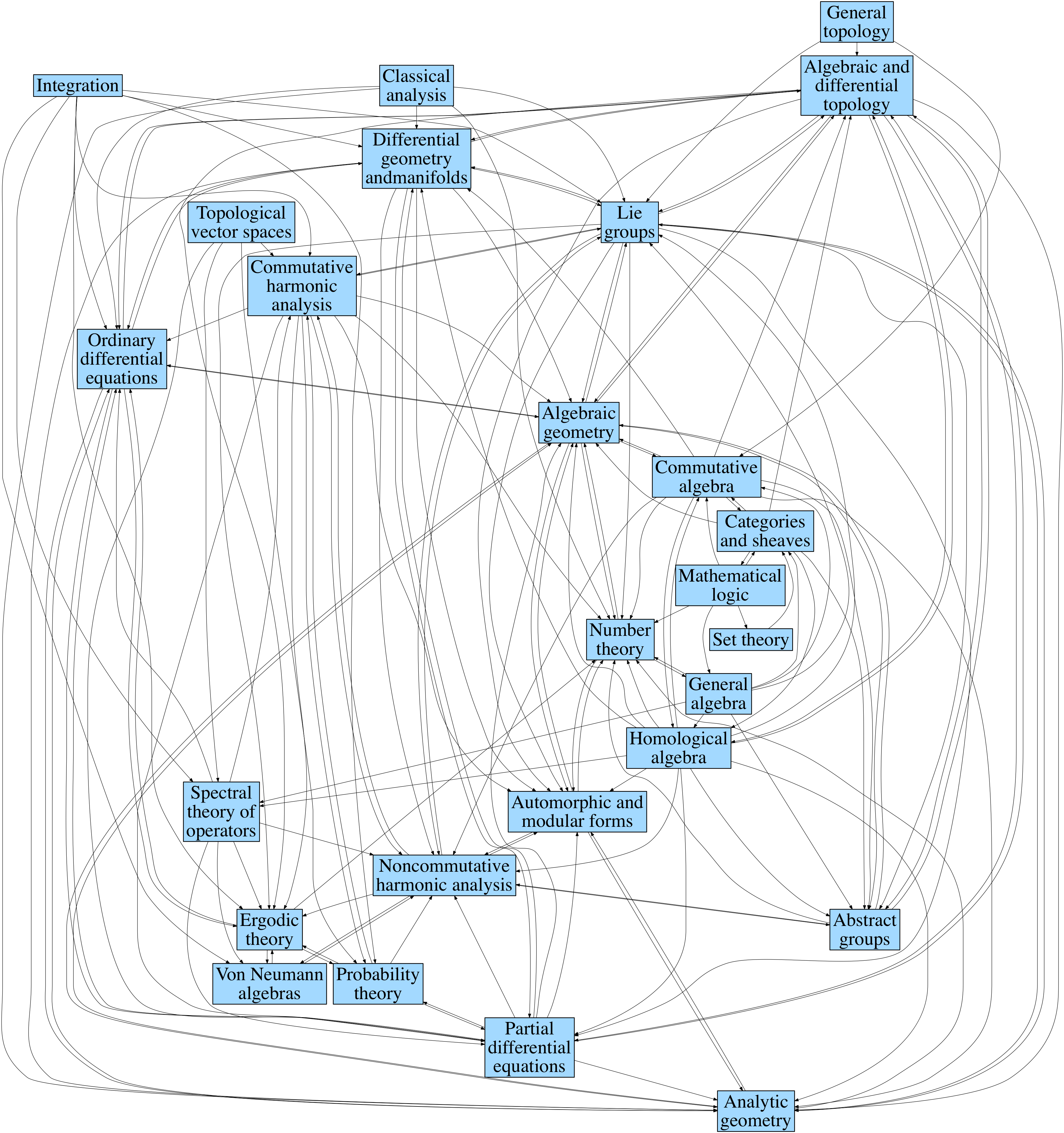
In my previous post, I discussed how number theory and topology relate to other areas of math. Part of that was to show a couple diagrams from Jean Dieudonné’s book Panorama of Pure Mathematics, as seen by N. Bourbaki. That book has only small star-shaped diagrams considering one area of math at a time. I’ve created a diagram that pastes these local views into one grand diagram. Along the way I’ve done a little editing because the original diagrams were not entirely consistent.
Here’s a condensed view of the graph. You can find the full image here.
Category: Mathematics
👓 Mathematical balance of trade: how areas of math connect | John D. Cook
Areas of math all draw on and contribute to each other. But there’s a sort of trade imbalance between areas. Some, like analytic number theory, are net importers. Others, like topology, are net exporters.
👓 4+1 Interview: Kate Owens | Robert Talbert
Kate Owens of the College of Charleston talks about mastery grading, innovative teaching in a historic institution, and more.
🎧 A Math Teacher’s Life Summed Up By The Gifted Students He Mentored | NPR
A biologist at Harvard was chatting with a colleague about a mentor who pushed him to do harder math problems. It turns out the colleague had the same mentor — and so did many others.
George Berzsenyi is a retired math professor living in Milwaukee County. Most people have never heard of him.
But Berzsenyi has had a remarkable impact on American science and mathematics. He has mentored thousands of high school students, including some who became among the best mathematicians and scientists in the country.
I also find myself thinking, yet again, what was it about the early 1900’s in Hungary that they turned out, not even so many great scientists, but so many fantastic mathematicians? What were they doing right that we seem to be missing now? Can it be replicated? Was it cultural? Was it a certain type of teaching method? Simple expectations?
New research explains how the shapes of neurons can be classified using mathematical methods from the field of algebraic topology. Neuroscientists can now start building a formal catalogue for all the types of cells in the brain. Onto this catalogue of cells, they can systematically map the function and role in disease of each type of neuron in the brain.
A while back I answered a question on Quora: Can people actually keep up with note-taking in Mathematics lectures with LaTeX . There, I explained…
If you didn’t get a chance to weigh in, feel free to email him directly, or respond here with your suggestions (in order of preference) and I’ll pass them along.
I keep a list of his past offerings (going back to 2006, but he’s been doing this since 1973) on my site for reference. He’s often willing to repeat courses that have been previously offered, particularly if there’s keen interest in those topics.
Some of the suggestions on last night’s list included:
combinatorics
combinatorial group theory
number theory
game theory
group theory
ring theory
field theory
Galois theory
real analysis
point set topology
differential equations
differential geometry
Feel free to vote for any of these or suggest your own topics. Keep in mind that many of the topics in the past decade have come about specifically because of lobbying on behalf of students.
👓 Karen Uhlenbeck Is First Woman to Win Abel Prize for Mathematics | New York Times
Dr. Uhlenbeck helped pioneer geometric analysis, developing techniques now commonly used by many mathematicians.
📖 Read pages 21-28 of 528 of Abstract and Concrete Categories: The Joy of Cats by Jirí Adámek, Horst Herrlich, George E. Strecker
Read while having dinner at UCLA before class. Covered categories, examples, and duality.
📖 Read pages 48-55 of 486 of Category Theory for the Sciences by David I. Spivak
👓 Proofs shown to be wrong after formalization with proof assistant | MathOverflow
Are there examples of originally widely accepted proofs that were later discovered to be wrong by attempting to formalize them using a proof assistant (e.g. Coq, Agda, Lean, Isabelle, HOL, Metamath,
👓 Flipping pancakes with mathematics | Simon Singh | The Guardian
Mathematical minds love a problem that's easy to pose but tough to solve
Reply to The Man Who Tried to Redeem the World with Logic | Nautilus
After all, it had been Wiener who discovered a precise mathematical definition of information: The higher the probability, the higher the entropy and the lower the information content.
In fact, it was Claude E. Shannon, one of Wiener’s colleagues, who wrote the influential A Mathematical Theory of Communication published in Bell System Technical Journal in 1948, almost 5 years after the 1943 part of the timeline the article is indicating. Not only did Wiener not write the paper, but it wouldn’t have existed yet to have been a factor in Pitts deciding to choose a school or adviser at the time. While Wiener may have been a tremendous polymath, I suspect that his mathematical area of expertise during those years would have been closer to analysis and not probability theory.
To put Pitts & McCulloch’s work into additional context, Claude Shannon’s stunning MIT master’s thesis A symbolic analysis of relay and switching circuits in 1940 applied Boolean algebra to electronic circuits for the first time and as a result largely allowed the digital age to blossom. It would be nice to know if Pitts & McCulloch were aware of it when they published their work three years later.
👓 About | Accuracy and Privacy by Mark Hansen
I will post regular updates about data publication plans for the 2020 Census. I won't be shy about statistics, include some history and, ultimately, address the implications of technical decisions on politics, planning, research... and journalism.
👓 Heather Harrington awarded the Adams Prize | Mathematical Institute
Oxford Mathematics' Heather Harrington is the joint winner of the 2019 Adams Prize. The prize is one of the University of Cambridge's oldest and most prestigious prizes. Named after the mathematician John Couch Adams and endowed by members of St John's College, it commemorates Adams's role in the discovery of the planet Neptune. Previous prize-winners include James Clerk Maxwell, Roger Penrose and Stephen Hawking.
This year's Prize has been awarded for achievements in the field of The Mathematics of Networks. Heather's work uses mathematical and statistical techniques including numerical algebraic geometry, Bayesian statistics, network science and optimisation, in order to solve interdisciplinary problems. She is the Co-Director of the recently established Centre for Topological Data Analysis.