
Wilson Memindex Co., Rochester, NY
It was fascinating to run across the Memindex, a productivity tool from the Wilson Memindex Co., advertised in a December 1906 issue of System: The Magazine of Business. Memindex seems to be an obvious portmanteau of the words memory and index.

Let YOUR MIND GO FREE
Do not tax your brain trying to remember. Get the MEMINDEX HABIT and you can FORGET WITH IMPUNITY. An ideal reminder and handy system for keeping all memoranda where they will appear at the right time. Saves time, money, opportunity. A brain saver. No other device answers its purpose. A Great Help for Busy Men, Used and recommended by Bankers, Manufacturers, Salesmen, Lawyers, Doctors, Merchants, Insurance Men, Architects, Educators, Contractors, Railway Managers Engineers, Ministers, etc., all over the world. Order now and get ready to Begin the New Year Right. Rest of ’06 free with each outfit. Express prepaid on receipt of price. Personal checks accepted.
Also a valuable card index for desk use. Dated cards from tray are carried in the handy pocket case, 2 to 4 weeks at a time. To-day’s card always at the front. No leaves to turn. Helps you to PLAN YOUR WORK WORK YOUR PLAN ACCOMPLISH MORE You need it. Three years’ sales show that most all business and professional men need it. GET IT NOW. WILSON MEMINDEX CO. 93 Mills St., Rochester, N. Y.
Early Computer Science Influence?
The Memindex product appears several decades prior to Vannevar Bush’s “coinage” of memex in As We May Think (The Atlantic, July 1945). While many credit Bush for an early instantiation of the internet using the model of a desk, microfiche, and a filing system, almost all of these moving parts had already existed in late 19th century networked office furniture and were just waiting for automation and computerization. The primary difference in this Memindex card system and Bush’s Memex is the higher information density made available through the use of microfiche. Now it turns out his coinage of memex appears to have been in the zeitgeist decades prior as well. I’ve got evidence that the Wilson Memindex was sold well into the early 1950s. (My current dating is to 1952, though later examples may exist.) Below I’ve pictured some cards from the same year as Bush’s now famous piece in the Atlantic.

Most people are more familiar with the popular 20th century magazine System than they realize. Created and published by A. W Shaw, one of the partners of Shaw-Walker, a major manufacturer of office furniture in the early 20th century, the popular magazine was sold to McGraw-Hill Company in 1927/8 and renamed Businessweek which was later sold again and renamed Bloomberg Businessweek.
Relationship to other modern productivity methods
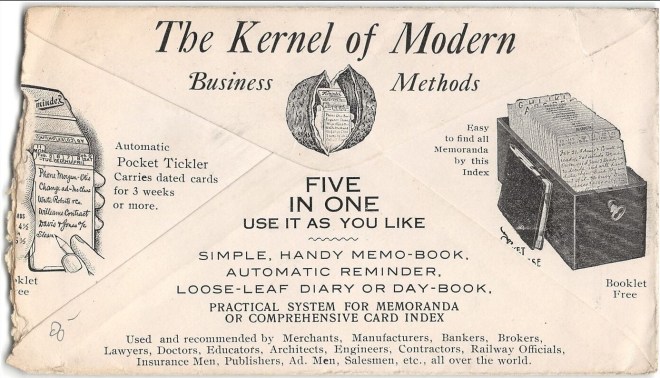
Some will certainly see close ties of this early product to the idea of the “hipster PDA” or Hawk Sugano’s Pile of Index Cards which appeared in 2006. It also doesn’t take much imagination for one to look at the back of a Wilson Memindex envelope from 1909 or an ad from the 1930s to see the similarity to the 43 folders system, bits of Getting Things Done (GTD), or the Bullet Journal methods in common use today. The 1909 envelope also appears to combine a predecessor to the 43 folders idea mixed with the hipster PDA in a coherent pocket and desk-based system.
With alphabetic tabs for the desktop version, one could easily have used this for “Building a Second Brain” as described by modern productivity gurus who almost exclusively suggest digital tools for maintaining their systems now. The 1909 envelop specifically recommends using the system as “comprehensive card index” which is essentially what most second brain or zettelkasten systems are, though there is a broad disconnect between some of this and the reimagining of the zettelkasten in current craze for using Niklas Luhmann-esque organization methods which have some different aims.
What’s interesting beyond the similarities of the systems is the means by which they were sold and spread. Older systems like the Memindex or related general office filing and indexing systems (Shaw-Walker), were primarily selling physical products/hardware like boxes, filing cabinets, holders, cards, and dividers as much as they were selling a process or idea. Mid- and late-century companies like Day-Timer or FranklinCovey also sold physical stationery products (calendars, planners, boxes, binders, books, ) but also began more heavily selling ideas like “productivity” and “leadership”. Modern productivity gurus are generally selling the ideas of the systems and making their money not on the physical items, software or programs which implement them, but with consulting fees, class fees, subscriptions, books which describe their systems, or even advertising against page or video views.
The 1906 version of the Memindex was popular enough to already be offered with the following options of materials for the distinguishing tastes of consumers:
- Cowhide Seal Leather Case and hardwood tray
- Am. Russia Leather Case and plain oak tray
- Genuine Morocco Case and quartered oak tray
What options is your current productivity guru or system offering? What are the differentiations and affordances it’s offering compared to similar systems in the early 1900s? Where is the “rich Corinthian leather“?

The Memindex Method
The basic Memindex method consists of using 2 3/4″ x 4 1/2″ (vest pocket sized) or 3 x 5 1/2″ cards depending on one’s size preference to jot down to do lists or tickler items on individually dated cards which are kept in a desk-based wooden card index with tabs for both months as well as alphabetic tabs in some systems. One then keeps a small pocket-sized card holder with the coming three weeks’ worth of cards on their person for active daily use and files them away as the days go by.

Apparently the truism “everything old is new again” is true yet again.
















Invariably, when one is starting out on their analog zettelkasten or index-card based commonplace book journey, one of the first questions besides what size and…
@chrisaldrich https://anagora.org/BaSBhttps://anagora.org/BulletJournalhttps://anagora.org/GTDhttps://anagora.org/HipsterPDAhttps://anagora.org/Memexhttps://anagora.org/productivityhttps://anagora.org/ToolsForThoughthttps://anagora.org/zettelkasten
Node [[basb]] in anagora.org
@chrisaldrich just when I thought I was out of the hPDA phase, you pull me back in! Lovely piece, Chris. I hadn’t heard of this before.
@annahavron, you don’t happen to have a Memindex on your desk do you? 😀🗃️
@chrisaldrich I want one BAD!! Bookmarked. At first I thought it was a proto-Rolodex.
this is top gangsta shit
Amazing
This is cool as fuck. Love the ad copy. Witness the unapologetic swagger of “FORGET WITH IMPUNITY” vs. its wimpy cousin Evernote’s “Remember Everything”.
@annahavron Proto-rolodexes?! What about pre-rolodexes?
Legit
Amazing piece of insight and history, awesome article! Well done 👍🏻
Just throwing it out there but ever heard about the Zettelkasten? Esp. the one Niklas Luhmann used gained notoriety and inspired modern apps such as logseq
Recommend reading up on it
https://en.wikipedia.org/wiki/Zettelkasten
Would cop
I’ve been watching the secondary market for used card indexes for a while and finally caved and purchased a vintage wooden desk top Shaw-Walker 11…
I’ve bought (yet another) card index on April 22nd. This must mean that I’m officially a collector, but if I keep this up I may have to start a museum soon.
This model is a Remington Rand Library Bureau Division 10 5/8″ x 5 5/8″ x 2″ dovetailed wooden box with steel follower and toothed sliding track. The sides of the box are 1/4″ thick and was designed for 3 x 5 inch index cards. The box has a softer brown color and wider grain typical of the mid-century Remington Rand Library Bureau Division products. Because it is short enough, it can fit inside my larger card catalog filing cabinet if necessary.
Given that Remington Rand used the Library Bureau Division brand name from its acquisition in 1927 into the 1950s and the materials and design used, I’m guessing that this model is likely from the late 40s to early 50s. This was likely used as a desktop card index or possibly as a charging tray in a library. Sadly it didn’t come with any information about provenance. With the follower all the way back it’s got 8 1/2 inches for cards which means space for about 1,200 standard index cards.
There are no nail holes on the bottom indicating that it had feet, but it does have the faint appearance that it may have either had felt feet or a felt sheet glued to the bottom to prevent it scratching one’s desktop. As I expect to use it on a glass top, I probably won’t modify it. Beyond this and a few small scuffs showing very moderate use, it’s in exceptionally fine shape.
I’d picked up an 11 inch Shaw-Walker card index recently, but I couldn’t help making a knee-jerk purchase of another vintage desktop card index. I got it used on eBay for the pittance of $16, which compared to some of the modern cardboard, plastic and metal options is honestly a steal, especially since it’s got a much nicer look and permanent feel compared to some of the more “modern” zettelkasten containers. Who wants a $20 cardboard box from Amazon when you can have a solid piece of history made of hard wood and steel on your desk?
Since my father worked in manufacturing for both Ingersoll Rand (no relation) and Remington at different points in his life, its quite a nice reminder of him sitting on my desk on a daily basis. Because it bears the name Library Bureau, it also harkens back to the early days of mass manufactured library card catalog equipment beginning with Melvil Dewey in 1876.
Of course, I ought to quit picking up these 3 x 5 inch card boxes and get some more 4 x 6 inch boxes since I primarily use those on a daily basis.
Any ideas what I ought to use this box for? Perhaps it ought to be an address card index/rolodex? I’ve already made the decision to do my “memindex” in 4 x 6″ cards and the Shaw-Walker is accumulating cards with jokes and humorous observations (jokerzettel anyone?).
Amazing. I always love seeing these old ads and realizing that things haven’t changed much. Everyone is trying to find ways to be more efficient with their time, and a lot of that is often misplacing the focus on doing more work. I like that I see a lot of BuJoers less focused on getting more done, and more focused on personal improvement.
Very cool. Thanks for sharing your find!
I’m just wrapping up a year of maintaining my bullet journal practice using index cards instead of the more popular notebook form factor. It’s heavily inspired by the century+ old Memindex method.
AMA
I see you don’t have quarter-sawn oak or rich Corinthian leather :-). It also looks like you don’t organise by year — what are the main cards you carry?
What are the benefits? Are you planning to continue?
Wow I love this, I use index cards frequently for notes and busy days
This is cool and interesting. The only thing I wonder is if you find it hard to look back and find notes you need? I use my Bujo for a lot of record keeping, and it seems like things would be harder to flip back and find when on index cards…
I read your article linked, I’m not sure I fully understand : does it work like a bujo but instead of having the whole notebook with you, the cards are like the pages of the notebook?
This is so fascinating ! I can see it’s benefits.
What pen is that?
I am very intrigued by this! 🧐😆
Omg this is genius!!
Is there anything you didn’t like about it? Would you like to change something?
How do you feel about archiving or finding information?
Also great questions in the other comments!
[deleted]
Very inspiring, very cool. THere’s something about the separate-ness of having an index card to jot down what you need that day, almost like being in the moment. I’ll often keep one clipped to the front cover of my BuJo as a reminder/checklist which makes me think why am I carrying around this notebook when the card and the pen are all I need. Thanks for sharing this!
How do you organize actual journaling and collections. How do you sort and them index them.
I’m just wrapping up a year of maintaining my bullet journal practice using index cards instead of the more popular notebook form factor. It’s heavily inspired by the century+ old Memindex method.
AMA
Syndicated copies:
I love this idea, and I can’t believe I never thought of it before. I end up getting overwhelmed with a big empty page, but hate tiny notebooks. A tiny index card tho. Easy to write on, easy to toss if I make a mistake. If I space on a day it doesn’t ruin the notebook for having blank pages of I predate cards etc.
Plus, best of all, it gives me an excuse to look into getting a card catalog cabinet cause I’ve always loved those when I went to the library as a kid
Thank you for posting this, it’s very helpful.
I have some gorgeous foglietto memo cards that I’ve been meaning to do something similar with.
Many may recall that I’ve been refinishing vintage mid-century furniture for over a decade now. I’ve also been more cognizant of converting my commonplace book…
https://ugmonk.com/
omg do you know these? When I saw the advertisement I was reminded of your post
Love it!!
What’s the system here? Kind of an index card diary?
Amidst my seemingly ever-growing collection of index card boxes and trays, I’ve been contemplating getting something that would store cards in a vertical orientation rather…
I did something like this. It’s kind of boju meets second brain. My life is extremely project heavy.
My work project box looks and works pretty much like the original image.
My personal cards are vertical. It’s a trade off.
Pros to vertical:
They work well with a “Field Notes” notebook as a place to capture an index/ goals/do last/ want to research lists, etc as a traditional, if tiny, boju.
The vertical 3×5 cards fit in a clear pocket protector as a mode of transportation, (although I often just clip the day’s cards to the front of the field notes notebook). The whole works fits into a cargo pocket in my slacks.
Vertical cards lay out nicely on my desk as a task list with the top line of each project card showing.
Cons: not a lot of pre-made resources exist for a vertical system. I’ve adapted.
I mostly use sticky tabs instead of pre-made dividers. Otherwise, my task/project cards are pretty much set up like Memidex/ Side Track Home Executives/ 43 Folders. I’m using a tall 4×6 card storage (Globe-Weis) box and have two rows of 3×5 cards side by side.
I’ve seen complicated ways that people index their knowledge cards. Zettelkasten, for example. I just use the Dewey Decimal System. I’m a librarian and professor, so I already know the Dewey System, but I can always quickly check to see where a subject should be filed by looking up a book on that topic in any library catalog. I just note at the bottom of the card if there are any connected notes filed elsewhere. I put book knowledge cards for fiction in 801 by author both read and to read.
I note in my bujo index where any card is filed (knowledge or project), and if it has a status. Task cards are rarely indexed and are often written on scrap paper that is trimmed 3×5. It works. I am not researching the same information repeatedly, stuff gets done, and I have an archive of completed projects.
My calendar is required to be digital at work, so that never figured into my system. If I have a busy day though, I write it out on a card with appointments and times in red and other reminders in pencil.
This system has saved my sanity. I literally had so many to-do list items and projects that no digital system could really handle it. And probably some undiagnosed ADHD, so getting away from checking things on a screen has been a game-changer. 🙂
I decided to collect these as a post to better track them….. Chris Aldrich: Continuing with Memindex practice in 2024 Chris Aldrich: A year of…
You’re right, I ought to have a collected segment on this sub-topic on my own site.
https://boffosocko.com/research/zettelkasten-commonplace-books-and-note-taking-collection/#Productivity
Ah, the good old hipster PDA and 43 folders. I’ve come full circle in my hunt for productivity.
I’m now a full two years into using my variation of the Memindex/Bullet Journal on index cards and starting a third. I still find 4…
The “Memindex Method” was a 1906 precursor to the Bullet Journal, Hipster PDA, GTD and related productivity systems. It preceded Vannevar Bush’s seminal “memex” essay by nearly a half-century.
That…
Thank you for sharing this. I love such old / new stories. What is good comes back!
Where you buy the pouch holder? It’s so cute
I was in a business meeting in 1967 with Memindex’s owner. We discussed marketing challenges for the low cost subscription cards via mail order. The product was in production yet that summer.
Thanks for the tip on recreating some of their historical timeline.
Very interesting
I am so thankful to have found your site. I’ve been trying the bullet journal method for a while now, but love the portability of the index card size.
Thanks. I hope some of the ideas help. If you’ve not found it yet, there’s a sort of table of contents around some of the topics here: https://boffosocko.com/research/zettelkasten-commonplace-books-and-note-taking-collection/#Productivity
There’s so much interesting to like in this post, but of particular interest to me is Gloria Steinem’s use of Wilson’s Memindex as her diary/to do list in 1960! Special thanks to my new friend Julian O’Shea who tipped me off to this little bit of history.
Watching people online chat, ask questions, and generally get excited about their planners for 2026, I thought I would spend a few minutes to set…
I love this! Thanks for sharing!
I would love to do this. I keep hoping to find printable templates for 4×6 cards but all I’ve found are 3×5. I’ll keep working on my own templates.
I started doing something like this in 2024- and I didn’t really think much of it – but the daily index card for daily reflection has been part of my end of the day ritual. I love notecards. I like my notebooks too and I treasure my bullet journal – but after getting tired of spreads and just even the minimalist approach which I still apply to my regular rapid logging book i guess some call it a Commonplace Book – I call it my Mind Space – but I come across systems and everyone just renaming things lol.
I get the cheapo Index Cards from the dollar store which Work fine with my fountain pens. I couldn’t justify paying 30$ any more for a bullet journal – worrying about trying to get everything in the book for the year because I liked to use it annually – and some days I wanted to write a LOT or I just had a heavy day in thoughts.
I got the Color Index Cards which i use one Color for each week and then circle back to the fourth color. And if I have a lot more left to get out or want to write more I use a white card to continue on that day. All cards are dated and put behind the last week. I keep a 4×6 for the like “Future Logs” so if an event comes up that i need to jot down or a bill date that changed – it goes there.
I still keep a regular notebook with me for Future Log Transfer to the Month at a Glance – and I use the book for habit tracking / score card that I implemented from the 12 Week year.
So I still use a note book – but its mostly for Time Tracking throughout the day to know where my time is going.
But the Index card is I made a diy ugMonk so my to do list sits in front me at my desk and its just like a mental cue of what I SHOULD Be doing versus.
But like september 2024 I saw the ugMonk online – and I being pogue – I just made one myself. No need for the fancy stuff just stuff that works. Made the stand out of an old scrap piece of pallet I had. one cut lol.
But really glad I came across this I like to see how other people use it.
Habit Tracker on an Index Card – feels like a squeeze for me – but looking to see others might do it. Again I do a scoring system each task gets 1 point some tasks require 3 or 5 Points total to be fully completed. “Measure Execution not just Results” and I get an Percentage each day and each week of completion.
Really glad I found this looking forward to reading more about it.
Pro’s Don’t have to triple think a spread or a lay out –
Easy to carry , I have an index notefolio thing that holds a pen and a stack of index cards I keep with me almost at all times. Sometimes I do forget it and if so Ill text myself whatever I was thinking and then transfer for it later on the Shutdown Rituals
Digital World and Analog still stands. I’ve tried digital journaling it’s not the same for me. I still do it sometimes, but it’s organized in Obsidian and I don’t really “flip through them” like I do my journals or a stack of cards.
So yea Index Cards 4×6 Future Logs
Weekly Color = Daily Index / Daily Review / Reflection + To Do List on the other side.
Extra White card for longer daily reflection.
OMGOSH!!!! I love all of this! I will be taking a look at your blog and researching the Memindex Method. I think this is something that I could totally get with because though I love planners and notebooks, they are not always portable. I should have waited to comment because as I continued to read through this thread, there was so much great information! I have bookmarked quite a few of your blog posts and definitely will be checking back to see if I need more guidance. Thank you so much for sharing clear and concise thoughts about your set up.