Replied to Background by Kate Bowles (Music for Deckchairs)
Make sure the background is clean and generic, and make sure to remove any family photographs, or anything that might be a distraction. I try not to write much about the place where I work, but thi…
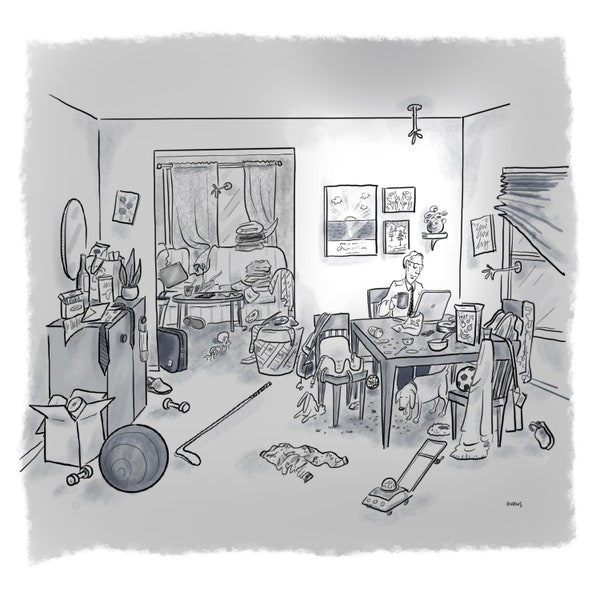
Kate’s excellent piece reminds of this apt New Yorker cartoon from a week or so back, although it features a well-dressed man in a tie.

New Yorker cartoon featuring a man neatly dressed in a cute corner on a computer conference call while chaos and mess reigns everywhere else in the room that the camera doesn't see.
Zoom in on reality.

We all know there’s mess everywhere for everyone, otherwise the “joke” wouldn’t land. The sad reality is that the “joke” is our daily harried existence. We definitely don’t need the added pressure of having to performatively pretend otherwise on top of it all.

Perhaps to help out with the nonsense we ought to all post the dual views of the “fantasy” and the “reality”?

Here’s mine which features an impromptu Ikea table crammed into the living room and just feet from the bathroom, the tiny laundry closet, and the kitchen because the “home office” is overly occupied. Notice the hats/shirts/sweaters for days on which self-care has been neglected and I need to throw on something vaguely presentable to appear on camera for a minute or two. (Note: munchkin removed for privacy, but you can see her work six inches from mine.)

A tidy and cutely arranged bookshelf and lamp in a bright corner. A messy impromptu desk thrown into a living room with piles of paper on the floor, clothes hanging on the couch, a kids doodles on a whiteboard, papers and books strewn everywhere, a laundry basket sitting out. mess on the counters in the background

Replied to a post by Bix Bix (bix.blog)
Has anyone gotten webmention set up on a WordPress blog solely for internal references? So that when you link to previous of your own posts, those posts will then also link back, creating a deeper contextual web on your blog?
Bix, this functionality is definitely built into the Webmention for WordPress plugin as a default. You may need to go to Webmention settings (/wp-admin/admin.php?page=webmention) and make sure your self-ping settings will allow it. 

If you wanted, you could also modify the Webmention type and/or the excerpt that shows in the comment section, though you’d need to do it manually.

I’m not aware of anyone using it “only” for this purpose. I think David Shanske also has built some whitelisting settings for Webmention moderation so that you can automatically approve ones from certain domains. I would suspect you could use some of those portions to reject any incoming webmentions from external URLs, but it may require a few lines of code to do it.</p

Replied to a thread (Twitter)
Niklas Luhmann’s idea of Zettelkasten impinges on some of this, but for a deep dive on how indigenous cultures all over the world did this in a pre-industrial setting look at Dr. Lynne Kelly‘s work. Specifically: Knowledge and Power in Prehistoric Societies: Orality, Memory, and the Transmission of Culture (Cambridge University Press, 2015) and When knowledge was power (2012, Latrobe University, PhD thesis). She’s got a fantastic bibliography on her website as well.

Her TED talk shows quickly how she did something similar, but with birds and bird identification. Her work has examples of how many other cultures did this as well.

Read Thinking about thinking about thinking by Neil MatherNeil Mather (doubleloop)
I have been doing a lot of metacognition, AKA “thinking about thinking”, AKA banging on about personal wikis, lately. I have really enjoyed reflecting on my wiki setup and how I can use it to learn and to create things. I also love a good bit of tinkering, so it’s been a lot of fun playing wit...
Listened to Waiting For a Game-Changer from On the Media | WNYC Studios
A silver bullet isn't coming—but the media and the public are running out of patience.

Over the past few weeks, the public has been introduced — by way of Gilead Science, and a leaked video of doctors discussing their preliminary trial data — to a new potential therapy for Covid-19. Remdesivir, a broad-spectrum antiviral medication, was cleared by the FDA this week to treat severely ill Covid-19 patients, despite limited preliminary results from a handful of clinical trials.

Some in the media initially touted the drug as a potential miracle cure. But as the mounting pressure to cope with an increasingly dire pandemic makes anything less than a silver bullet difficult to swallow, Derek Lowe, the organic chemist behind the science blog In the Pipeline, urges caution. He speaks with Bob about how to report on the so-called "game changer" drugs, and where he believes reporting on the "race for a cure" falls short.

Nice coverage about some of the drug process.
Watched "Bull" Wrecked from CBS
Directed by Dennis Smith. With Michael Weatherly, Freddy Rodríguez, Geneva Carr, Jaime Lee Kirchner. Bull and the team help Taylor bring a civil suit against the woman who killed Taylor's friend in a hit-and-run when the driver evades criminal charges by claiming diplomatic immunity.
Randomly watched when the prior online show ran out of episodes. Relatively engaging.
Bookmarked Hypothesify – Get this Extension for Firefox (en-US) by Jan Odstrcilik (addons.mozilla.org)
Hypothesify is a Firefox extension for the annotation tool Hypothes.is. It can start and close a selected webpage or a PDF document in Hypothes.is, it checks for public annotations and it generates codes in html, markup, :hiccup for Roam etc..

Thoughts on Wikity for WordPress

I spun up a new instance of Wikity today at http://wikity.chrisaldrich.net/ to test it out for potential use as a personal online wiki. My goal was also to test out how it may or may not work with IndieWeb-based WordPress pieces too.

Below are my initial thoughts and problems.

The /home/ page has a lot of errors and warnings. (Never a good sign.)

It took me a few minutes to figure out where the Wik-it! bookmarklet button was hiding. Ideally it would have been in the start card that described how the bookmarklet would work (in addition to its original spot).

The Wikity theme seems to have some issues when using for http vs. https.

  • Less seems to work out of the box with https
  • The main card for entering “Name of Concept or Data” didn’t work at all under https. It only showed the title and wouldn’t save. Switching to http seemed to fix it and show the editor bar.

I’ve tried copying over from Aaron DavisWikity instance, but the cardbox seems to fail on my end.

  • Nothing seemed to work at all when I had my site as https. In fact, it redirected to a URL that seemed like it wanted to run update.php for some bizarre reason.
  • On http I at least get a card saying that the process failed.
    • Not sure what may be causing this.
    • Doesn’t seem to matter how many cards it is.
    • Perhaps it’s the fact that Aaron’s site is https? I notice that his checkbox export functionality duplicates his entire URL including the https:// within the export box which seems to automatically prepend http://
    • Copying to my own wiki seems to vaguely work using http, but failed on https.

Multiple * in the markdown editor functionality within WordPress doesn’t seem to format the way I’d expect.

Sadly, the original Wikity.cc site is down, but the theme still includes a link to it front and center on my website.

The home screen quick new card has some wonky CSS that off centers it.

Toggling full screen editing mode in new cards from the home screen makes them too big and obscures the UI making things unusable.

The primary multi-card home display doesn’t work well with markup the way the individual posts do.

The custom theme seems to be hiding some of the IndieWeb pieces. It may also be hampering the issuance of webmention as I tried sending one to myself and it only showed up as a pingback. It didn’t feel worth the effort to give the system a full IndieWeb test drive beyond this.

Doing this set up as a theme and leveraging posts seems like a very odd choice. From my reading, Mike Caulfield was relatively new to WordPress development when he made this. Even if he was an intermediate developer, he should be proud of his effort, including his attention to some minute bits of UI that others wouldn’t have considered. To make this a more ubiquitous solution, it may have been a better choice to create it as a plugin, do a custom post type for wiki cards and create a separate section of the database for them instead of trying to leverage posts. This way it could have been installed on any pre-existing WordPress install and the user could choose their own favorite theme and still have a wiki built into it. In this incarnation it’s really only meant to be installed on a fresh stand-alone site.

I only used the Classic Editor and didn’t even open up the Gutenberg box of worms in any of my tests.

Summary

The Wikity theme hasn’t been maintained in four years and it looks like it’s going to take quite a bit of work (or a complete refactoring) to make it operate the way I’d want it to. Given the general conceptualization it may make much more sense to try to find a better maintained solution for a wiki.

The overarching idea of what he was trying to accomplish, particularly within the education space and the OER space, was awesome. I would love nothing more than to have wiki-like functionality built into my personal WordPress website, particularly if I could have different presentations for the two sides but still maintain public/private versions of pieces and still have site-wide tagging and search. Having the ability to port data from site to site is a particularly awesome idea.

Is anyone actively still using it? I’d love to hear others’ thoughts about problems/issues they’ve seen. Is it still working for you as expected? Is it worth upgrading the broken bits? Is it worth refactoring into a standalone plugin?

LikeWar – The Weaponization of Social Media

Read LikeWar (LikeWar)
Two defense experts explore the collision of war, politics, and social media, where the most important battles are now only a click away. Through the weaponization of social media, the internet is changing war and politics, just as war and politics are changing the internet. Terrorists livestream th...
An interesting looking book, but I’m worried that it’s the sort of thing I’d start reading only to realize I’ve read all the component pieces of it in other places.
Replied to a thread by Andy MatuschakAndy Matuschak (Twitter)
This thread makes me wonder when the Hypothes.is team will be allowed to build a layer onto e-reader platforms? Another great idea might be for e-readers and note taking tools to have built-in micropub clients so I can use them to publish to my website or other platforms.
Watched Thinking Historically: A Guide to Statecraft and Strategy from YouTube

Francis Gavin, the Giovanni Agnelli Distinguished Professor and the inaugural Director of the Henry A. Kissinger Center for Global Affairs at SAIS, argues that history can be employed to better understand and improve statecraft and strategy. It is not a history of a particular event, person, place, or process. Nor is it strictly a discussion about methodology, or how to do historical work effectively. Instead, he explores something he calls “historical sensibility.” Visit www.jhu.edu/hopkinsathome/ to see more lectures.

What a fascinating lecture with some questions and answers. I managed to catch it among many others in the JHU YouTube feed, but I’ll have to take a look at some of their other upcoming programs. 

There’s a lot of hope subtly hiding in this lecture.

I’m hoping that even once the crisis of the pandemic is over that Johns Hopkins will realize what an awesome program this is and continue it on afterwards. It manages to put together the ideas of blogging, vlogging, thought pieces in magazines, academic lectures, and even the idea of Public Television programming into an interesting and engaging format. I like that there are some fascinating broad ideas and themes to delve into. 

The broader themes of historical sensibility, chronological proportionality, and historical revisionism deserve a lot more attention and thought.

See also my wiki notes from the lecture.