Katie Benner, Justice Department reporter at The New York Times, joins with takeaways and the latest news from the release of the affidavit in the FBI search of former President Trump’s Mar-a-Lago estate.
Some interesting and useful depth here beyond a lot of the usual political rhetoric.
Quill and Fox Design illustrated the cute bookworm, squirrel, rabbit, owl, and, just for fun, a red fox and a beaver holding a quill for these Forest Friends magnetic bookmarks from Galison.
Someone special thought my slip box needed a little bit of whimsy. 🐰🦫
Next month’s allotment of index card supplies have arrived.
Part 1: Directed by W. Kamau Bell. With Bill Cosby, Gloria Allred, Eddie 'Rochester' Anderson, Harry Belafonte. In the 1960s Bill Cosby is collecting accolades for his comedy, breaking barriers for Black stunt performers and participating in the nation's sexual liberation and civil rights movement. He also allegedly begins exploiting his power.
Finally popped up on Netflix!
I hadn’t known about his history of promoting the underrepresented in the stunt space in entertainment.
I had forgotten about (?) or simply missed (based on my age and exposure) his history with “Spanish Fly”. I don’t recall any of these references during any of the news coverage of his trials or subsequent conviction.
The documentary is very well done and subtle so far, particularly with some snarky/clever images undergirding some of its political position. I appreciate that I’m just a year and change younger than W. Kamau Bell, so I’ve lived in roughly the same time frame he has. I have strong memories of having grown up with Picture Pages, The Electric Company, Fat Albert, et al. I’m curious to see how my experiences are similar and different to Bell’s perspective.
Monday on the NewsHour, the death toll rises and thousands are stranded after monsoons cause catastrophic flooding in Pakistan. Ukrainian forces launch a counteroffensive to retake a strategic southern city from Russian invaders. Plus, Serena Williams competes in what could be her final major tennis tournament. We examine her impact on the sport and her towering legacy.
I recently hit the 10,000+ annotations mark on the fantastic Hypothes.is platform, and in celebration, the kind team at Hypothesis sent me a care package with a lovely card, some sticky flags, some stickers, and some chocolate to see me through the next 10,000.
If I’m honest, I get so much value and joy out of annotating online, I should have been the one to send them the care package.
With the school year starting and a new slew of books to be purchased and read, I’ve been looking for books, particularly popular “classics” or “great books” that are published either with larger margins or even interleaved copies (books in which every other page is blank and meant for writing extensive notes).
Within the bible publishing space (and especially for study bibles), these features seem a lot more common as people want to write more significant marginalia or even full pages of text against or opposite of what they’re reading within the book itself. Given the encouragement many teachers give for students to actively annotate their books for class discussions as well as people commonly doing this, why isn’t it more common for them to recommend or require texts with ample margins?
Almost all of the published mass market paperbacks I see of series like Penguin Classics or Signet classics have the smallest possible margins and no interlinear space for writing notes directly in books. Often hard covers will have slightly larger margins, but generally most publishers are putting 1/2 inch or 3/4″ margins on their classics series (Penguin Classics, Everyman Library, Signet (a paltry 1/4 inch usually), Library of America, Norton Classics, Wordsworth Classics, Dover, etc.)
For those wanting ample margins for active “reading with a pen in hand” are there any publishers that do a great job of wider margins on classics? Which publishers or editions do others like or recommend for this sort of reading?
Are there any book sales platforms that actually list the size of margins of their books? (I never seen one myself.)
What can consumers do to encourage publishers to change these practices?
I’ve seen only a few select titles from very few publishers that do things like this. Examples include:
Gladius Books’ Huckleberry Finn
Annotate Books’ Marcus Aurelius, which has 1.8″ lined margins
The Folio Society has slightly better margins on their texts, but they’re generally larger hardcover collectors’ editions that are dramatically more expensive than is practicable for students on a budget. ($80+ versus $5-10)
If I can’t find anything useful, I’m tempted to self-publish custom versions of wide margin or interleaved books otherwise. Something in the inch to inch and a half margin size for commonly used texts in literature classes should be much more commonplace.
For those wanting ample margins for active “reading with a pen in hand” are there any publishers that do a great job of wider margins on “classics”/”great books”?
I’m tempted to self-publish custom versions of wide margin or interleaved books.
I’ve got an online note collection similar to @JerryMichalski, but mine is more textual and less visual than his: https://hypothes.is/users/chrisaldrich (9:19AM)
If there are folks that want to do collaborative note taking today, here’s a shared etherpad you can use for either raw text or generic wiki markdown if you like: https://etherpad.indieweb.org/ToolsForThinking (09:26AM)
How can companies like @readwise leverage some sort of standardization of text, images, data in the space to more easily provide their services to more platforms? (09:49AM)
“There’s also drinks (alcohol) over there, so another good tool for thinking!” #ClosingThoughts (02:55PM)
During the lunch break, I’ve been thinking more about progressive enhancement in the #ToolsForThinking affordances space. Here’s an example of text-based note taking evolving into commonplacing, and from there into a more complex zettelkasten.
Is it possible to annotate links in Hypothes.is that are in the Internet Archive? My browser bookmarklet for it doesn’t work on such archived pages. I can imagine that there are several javascript or iframe related technical reasons for it. An information related reason may be that bringing togeth...
The ability to annotate archived material on the Internet Archive with Hypothes.is is definitely possible, and I do it from time to time. I’m not sure which browser or annotation tool (via, browser extensions, other) you’re using, but it’s possible that one or more combinations may have issues allowing you to do it or not. The standard browser extension on Chrome has worked well for me in the past.
Hypothes.is has methods for establishing document equivalency which archive.org apparently conforms. I did an academic experiment a few years back with an NYT article about books where you’ll see equivalent annotations on the original, the archived version, and a copy on my own site that has a rel="canonical" link back to the original as well:
I don’t recommend doing the rel-canonical trick on your own site frequently as I have noticed a bug, which I don’t think has been fixed.
The careful technologist with one tool or another, will see that I and a couple others have been occasionally delving into the archive and annotating Manfred Kuehn’s work. (I see at least one annotation from 2016, which was probably native on his original site before it was shut down in 2018.) I’ve found some great gems and leads into some historical work from his old site. In particular, he’s got some translations from German texts that I haven’t seen in other places.
An unexpected gift from my friends at Hypothes.is
A surprise gift box from Hypothes.is with load of goodies!
I really ought to have gotten them the gift for the value that their fantastic tool has brought me.
I suppose if you’re gonna goin “all-in” on having a zettelkasten (slip box) or index card-based commonplace book you may as well invest in some serious atomic-era heavy steel hardware…
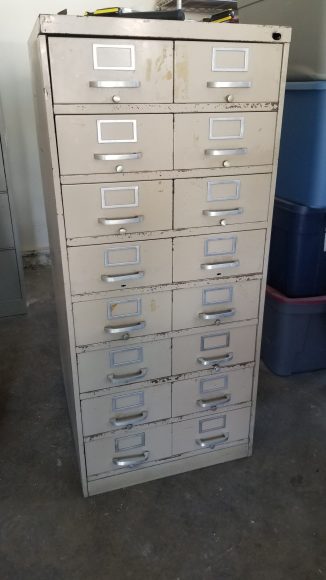
So today I took the plunge and picked up a Singer Business Furniture 20 gauge steel industrial index card filing cabinet. It’s the sort of thing that Niklas Luhmann or Roland Barthes may have only dreamt of.
One of the double drawers pulled out.
The monster has 8 sliding platform chassis with 16 removable file drawers. I’ve done a little bit of clean up on it, but it has been well loved over time. Much like my prior furniture refurbishment projects, I expect I’ll bead blast off the original finish and rust and re-enamel it. I’m debating colors or potentially going brushed steel with heavy clear coat, though that’s a lot of work for the size and configuration. I’m initially thinking perhaps gunmetal grey with metallic blue flecked paint to match my desk, or perhaps a fun orange highlight color on the drawer fronts?
Specifications
Singer Business Furniture, Corry Jamestown index card filing cabinet (114 OB)
8 slider chassis with 16 individually (and easily) removeable drawers
Exterior dimensions: 22 7/8″ wide x 52″ tall x 28 3/4″ deep
Interior drawer dimensions: 9 3/8″ wide x 4 3/4″ tall x 27 3/8″ deep (or 26 1/8″ deep with the card stops installed)
Original industrial beige color, chipped and scratched
20 gauge steel
I thought about weighing it, but the thing is just too big for any of the nearby scales I’ve got access to. It’s definitely a bear to move even by sliding and required a heavy dolly and at least two people to maneuver. Three or more would be required to pick it up physically. One drawback to the size and weight is that it isn’t easily portable if there were an emergency, but the construction is so solid that it should definitely survive the most dire earthquakes or possibly nuclear bomb blasts. I suspect it’ll be a bit before I have multiple drawers full, so I can always individually remove active drawers.
A quick calculation on the front of an index card—no more backs of envelopes for me!—indicates that packs of relatively standard Oxford index cards should put the capacity of this monster at 55,700 index cards (with the drawer stops in place).
Photos
It’s going to need some rehab work, but it’s quite magestic
Front view of the massive slip box
One of the double drawers pulled out.
View of one of the individual drawers from above
Almost all the drawers have their original index card rods
Some 4×6 index cards ready for action
One of the individual file drawers removed and sitting on its mate.
The original Singer sticker on the top inside drawer
Close up of the thumbscrew and notch on one of the index card file rods
Each index card file rod slots has a small “key” notch for securing it
Close up of the metal file card stop
A simple spring clip mechanism makes the card stops easy to move
It’s the small touches like the thumb indent on the card stop that really make the difference
An internal piece of the cabinet that wasn’t painted at the factory
Some of the trash that was cleaned out of the cabinet
Features
The drawers should be nice and roomy for the 4×6″ index cards I’ve been using, but can also accommodate collections of smaller 3×5″ cards I’ve got.
While the drawers come with index card rods to hold the cards physically in their files, I suspect I won’t be using them. They seem to be of a design that would require custom cards for utilizing this feature anyway. I do quite like the rod design as the thumbscrews on the outside have small nubs on them with a key-like cut out on the drawer front with a compression washer. One then inserts the rod, fits it into the moveable card stop, and pushes it into the keyhole. A quarter or half turn of the rod and thumbscrew locks the rod into the cabinet.
The index card file stops are easily removable and have a simple springloaded clamp mechanism for moving them easily within the drawer.
While used, the entire thing is in generally excellent shape. Almost all the original hardware is still extant and the drawer mechanisms all slide smoothly, so those won’t require much, if any real work.
Because the filing cabinet is so massive and generally immovable, a fun and terrifically convenient feature is that each of the 16 file drawers are individually removable. This allows one to take a particular drawer or two to their desk and work on them before needing to return them to the cabinet when one is done. To make this drawer movement easier, in addition to the explicit handle on the front of each drawer, there’s an oval hole on the back of each drawer which functions as a handle on the other end. This is likely how I’ll use it, at least until I’ve refinished the cabinet and the drawers and move it into my office space permanently.
One of the individual file drawers removed and sitting on its mate.
Because the files are wide and long enough, I might also profitably use the file for holding 8 1/2 x 11″ material stacked up in piles if necessary.
Naming
Some have talked about naming their zettelkasten. I’ve been considering calling the whole cabinet “The Ark of Studies” (Arca studiorum) after Thomas Harrison’s invention in the 1640s as it also contains a nod to Hugh of St. Victor’s mnemonic work relating to Noah’s Ark. Perhaps I’ll hame it Stonehenge II, because I’ll rely on it as a “forgetting machine” and it’s almost as big and heavy as a bluestone from the Preseli Hills in Wales—especially if I paint it that color. Beyond this perhaps I might give each individual drawer a name. This leaves sixteen slots, so I’m thinking about naming them after famous figures in the history of note taking and related spaces of intellectual history.
Right now it’ll likely be a subset of Aristotle, Cicero, Quintilian, Seneca, Boethius, Thomas Aquinas, Desiderius Erasmus, Rodolphus Agricola, Philip Melancthon, Konrad Gessner, John Locke, Carl Linnaeus, Thomas Harrison, Vincentius Placcius, Gottfried Wilhelm Leibniz, Niklas Luhmann, Beatrice Webb, Marcel Mauss, Claude Lévi-Strauss, Mortimer J. Adler, Niklas Luhmann, Roland Barthes, Vladimir Nabokov, George Carlin (I’ve got to have a drawer dedicated to comedy right?), Twyla Tharp, and Eminem. Who else am I missing? Who should I consider?
Oddities
Being a piece of used office furniture, it naturally came with some surplus junk inside. Most of this was of the paperclip and rubber band nature with plenty of dust and lint. There were a full collection of drawer labels with someone’s handwritten numbers for the files the card index once contained. Unexpected finds included some screws, nuts and bolts, part of a hacksaw blade, a rotary saw blade, some drill bits, a socket wrench fitting, and—most puzzling—a live round of ammunition! Every zettelkasten should have one of these right?
The oddest thing I found hiding in my new slip box.
So go ahead and bite the bullet! Get your own cabinet, and start your analog zettelkasten today.