
Cleaning up a new typewriter.
Cleaning up a new typewriter.

A full reel of 660 yards of black and red nylon bichrome typewriter ribbon just landed on my doorstep in the morning mail from . Who’s up for a type-in in the Los Angeles area?

Variable line spacer surgery and some clean up on the 1950 Remington All-New.


Digging into some typewriter pricing history, I found a copy of the 1949 Sears Spring/Summer Catalog, which lists a version of my (Sears SKU: 3 NM 4584T with Pica Type) for $95.08 on page 285.
Converting 1949 dollars to 2024 using an inflation calculator indicates this is now worth $1,247.75. Considering that I got it for less than the original sale price in 2024 (including shipping) and that it works as well now as it did then, I feel like I got a pretty solid deal.
For comparison the competing portable models in the catalog included:
They also listed the Tower, a standard size desk typewriter, for $99.00 saying it was just a few dollars more than the portables.
For further comparison, the prior year, the , was listed for $76.85. Adjusted for inflation this would be $995.96.
So toward this end I thought I’d brainstorm for a moment to make a few lists of potential ideas for both. If you’ve got ideas, please add them to the comments. There’s no need to try to come up with an “official” collective noun as use in daily life, writing, and throughout the typosphere will ultimately determine a winner through actual usage. Some words are double-listed as they could refer to either.
What do you call your collection?
What could we be? Are we a vibration of typists? Maybe we’re a thriving of typists? A Touch of Typewriter Collectors? Please add your ideas to the list below…

 Phoenix Typewriter from YouTube
Naturally the first stop was Richard Polt’s site, where he lists a handful of purveyors. I’ve heard good things in general about Baco both from Richard and Joe Van Cleave as well as others in the past few months, so I took the plunge and ordered a full reel of 660 yards of nylon black/red typewriter ribbon for $65. It should keep all my machines inked for quite a while.
Given that the typical standard/universal spool will accommodate 16 yards, this should be 41.25 spools. This also brings the price down to a far more economical $1.60 per spool versus the much higher level others are charging, particularly since I generally self-wind my own ribbon onto original metal spools and don’t need the additional plastic waste. It also has the added benefit of supporting the efforts of Charlene Oesch until she decides to retire.
If you’re in the market, here are the basic details to call and place an order (she specifically doesn’t have and doesn’t want a website), but she’s definitely still in business, carrying on in the tradition of her father since at least 1949:
1521 Carman Road
Ballwin, MO 63021 United States
bacoribbon@sbcglobal.net
+1 (314) 835-9300
+1 (536) 394-5475 (fax)
Baco takes both credit card and PayPal and ships within about a day via USPS in the United States.
Current offerings/pricing (subject to change):
With some lead time, she can do other colors if necessary, though she typically doesn’t keep those in stock all the time according to our conversation today. She has the option to pretty easily do blue, green, and purple in single colored reels.
I could be in for some blue/green or purple/green ribbon, which I imagine she could pull off if anyone wanted to go in on a reel or so to make it worth the time and effort to set it up. Let me know if you’re interested. Similarly if someone wanted to split an order for silk, I could be game for that too.
Have you tried other manufacturers? Who is your favorite bulk ribbon supplier?
Now I’m off to find some grommets and a custom pair of pliers for them…

Some photos in the process of cleaning up the black wooden case of my 1949 Smith-Corona Clipper which are suggestive of methods one might attempt at restoring their own versions.


Not factory perfect, but certainly acceptable for another 75 years of happy use.

More details when it arrives…


Three of the four sections are all similarly made out of oak and appear to be co-contemporaneous in terms of style and materials (solid wood and metal). The final section, a five drawer insert is obviously of later manufacture and while stained brown with what appears to potentially be a mahogany frontispiece, has plastic trays with metal fittings and what appear to be galvanized steel card stops. The other sections comprise a low level table-like support with four legs; a 5×3 drawer section; and a 2 inch thick top which covers the holes in the top of the modular drawer sections and provides a flat surface. The top section also features the traditional Gaylord Bros., Inc. name plate.

Given the subtle intricacies of the construction, I’ll provide some photos of how the pieces dovetail together as well as the smaller mechanics and features in a future post.
Fully assembled the piece is 33″ wide x 17 3/8″ deep and stands 36 1/2″ tall. With internal drawer space of 13 3/4″ for the 15 drawers and 14 1/2″ for the other 5, there should be space for approximately 38,715 index cards.
I’m thrilled that all the fittings seem to be original, and all the drawers have their original card catalog rods. The drawers on the 5×3 drawer section have a spring loaded mechanism under the front of the drawer which when pushed to the left side unlocks the card catalog rods which have beefy brass knobs. The 5×1 drawer section rods are unlocked by pulling up on them slightly from the bottom and then pulling them straight out.


I’ll have to do some more in-depth research of old Gaylord Bros. catalogs, but based on materials, manufacture, and style, I’m going to guess that the older portion of the card catalog dates from the mid-30s to the 1940s, while the newer section is likely late 60s. The overall size and standardized, modular structure allows the pieces to sit together in quite a clever way and were made over a long enough period of time that different pieces from disparate decades still work well together. While the wood grain, stain, and even fittings are all slightly different, the to different styles work fairly well together.
For those who appreciated my recent article Market analysis of library card catalogs in 2023, I’m thrilled to report that I purchased this stunning beauty—one of the prettiest, oldest, and best conditioned catalogs I’ve seen listed—for a very reasonable $250. I suspect the seller, who is a vintage collector, seasoned eBay seller, and is well aware of the market, may have gone even lower, but I was happy to overpay a little. Given the online market, something like this would usually list for between $1,200 and $1,600, but would likely sit unsold and unloved for years.

I love the style and the condition, and it does make for a fantastic little piece of fine furniture with a lovely patina. Unexpectedly, someone else in the house may be even more enamored of it than I, which bodes well for its actual long term care and use. Currently it will serve as an archive storage for some of my 3 x 5″ index card note collection in addition to storage of a partial library card cataloging for some of our physical books. I also have cards from an older rolodex and a small recipe collection that will take up residence. Other empty drawers will house a small wine selection along with several bottles of scotch until they’re pushed out by the growing collection of cards.


Other than general maintenance I don’t think I’ll be doing any other restoration work on it beyond the small fixes I’ve already made.
On the top of the catalog, in addition to space for writing notes, I’ll keep one of my two desktop card indexes and a 1948 Smith-Corona Clipper.
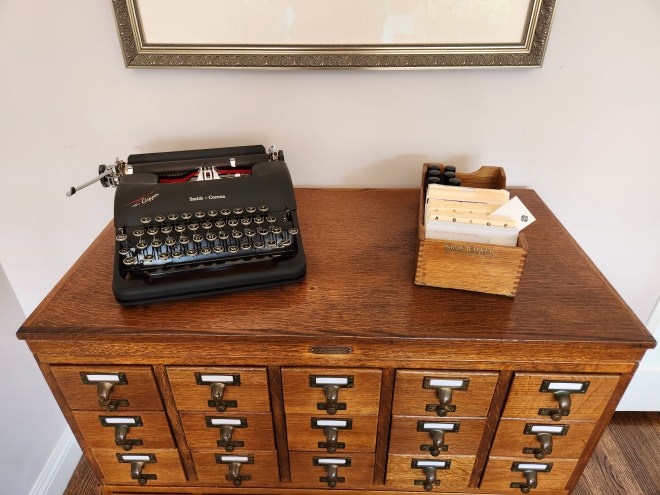
What would you do with a library card catalog?

I managed to clean out a lot of white somewhat sticky cruft, ostensibly from the correction ribbon this machine once had. I initially thought it would all blow out quickly with canned air, but it really needed some careful work with my typewriter brush and some Q-tips. The spots on the still supple rubber platen and rollers came off pretty quickly with some rubbing alcohol.
I quickly found the re-connected the spring that was preventing the margin release from working properly. I then tracked down the issue I was seeing with the vibrator assembly. It turns out someone had worked on this before and neglected to replace two small screws and nuts to hold the assembly down to the frame and at the appropriate distance from the platen. Without them it just sort of floats around between the basket and the platen. I’ll have to pick up a pair of them at the hardware store to be able to reattach it and then adjust it to the proper distance from the platen. Hopefully the rest of that assembly will operate properly once attached, particularly the bichrome lever which seems somewhat flimsy.

Beyond this the only outstanding thing I see, besides adding a new ribbon, is that the end of the backspace assembly isn’t attached to anything. It ends in a small question mark-like but very sturdy hook which I presume would have attached to either a spring or a metal wire, but I’m going to need to consult either another machine or find a service manual which details what the assembly is supposed to look like. If anyone has a helpful photo of the bottom of their Charger 11 from that hook to the escapement assembly, that would be most helpful.

The last couple of tweaks should have this back in perfectly serviced operating order. Its almost as clean and new as when it rolled off the assembly line 39 years and 4 months ago.
I received this machine on March 12th and just realized that I never really took any photos of it or played around with it at the time in part because that’s the day my car’s engine died. I’ll see what I can do to finish this up soon, so that I can do a proper acquisition post and include some photos of the exterior as well as a proper typeface sample.

Richard Polt (see below) has some interesting things to say about getting the writing out without worrying about editing or deleting when using a typewriter which makes for some interesting changes in my process.
Currently reading:

A photo of the burgeoning typewriter collection so far.


