I’ve been invited to participate in a panel discussion as part of an Intersession course by the Johns Hopkins Film and Media Studies Program. I hope fellow alumni in the entertainment and media sectors will come out and join us in Culver City on Thursday.
Join the Hopkins in Hollywood Affinity Group (AEME LA) as they welcome Linda DeLibero, Director of the JHU Film and Media Studies Program, and current students of the program for a dynamic evening of networking which features an alumni panel of industry experts.
Open to alumni, students, and friends of Hopkins, this event is sponsored by Donald Kurz (A&S ’77), Johns Hopkins University Emeritus Trustee and School of Arts and Sciences Advisory Board Member, and the Hopkins in Hollywood (AEME LA) Affinity Group.
Event Date: Thursday, January 12, 2017
Start Time: 6:30pm
End Time: 8:30pm
Panelists
Donald Kurz, A&S ’77
Moderator
Donald Kurz is Chairman and CEO of Omelet LLC, an innovative new media and marketing services firm based in Los Angeles. Previously, Mr. Kurz was co-founder and CEO of hedge fund Artemis Capital Partners. Between 1990 and 2005, Mr. Kurz was Chairman, President, and CEO of EMAK Worldwide, Inc, a global, NASDAQ-traded company providing Fortune 500 companies with strategic and marketing services internationally. Mr. Kurz’s 25 years’ experience in senior leadership includes management positions with Willis Towers Watson, PwC, and the J.C. Penney Company. Mr. Kurz is a Trustee Emeritus of the Johns Hopkins University, having served for 12 years on the Hopkins board. He received an MBA from the Columbia University Graduate School of Business and a BA from Johns Hopkins University.
Jason Altman, A&S ’99
Jason Altman is an Executive Producer at Activision working on the Skylanders franchise and new development projects. Prior to Activision, he spent the past 5 years at Ubisoft Paris in different leadership roles, most recently as the Executive Producer of Just Dance, the #1 music video game franchise. He is a veteran game producer who loves the industry, and is a proud graduate of the media studies program at Johns Hopkins.
Paul Harris Boardman, A&S ’89
Paul Boardman wrote The Exorcism of Emily Rose (2005) and Devil’s Knot (2014), both of which he also produced, and Deliver Us From Evil (2014), which he also executive produced. In 2008, Paul produced The Day the Earth Stood Still for Fox, and he did production rewrites on Poltergeist,Scream 4, The Messengers, and Dracula 2000, as well as writing and directing the second unit for Hellraiser: Inferno (2000) and writing Urban Legends: Final Cut (2000). Paul has written screenplays for various studios and production companies, including Trimark, TriStar, Phoenix Pictures, Miramax/Dimension, Disney, Bruckheimer Films, IEG, APG, Sony, Lakeshore, Screen Gems, Universal and MGM.
Devon Chivvis, A&S ’96
Devon Chivvis is a showrunner/director/producer of narrative and non-fiction television and film. Inspired by a life-long passion for visual storytelling combined with a love of adventure and the exploration of other cultures, Devon has made travel a priority through her work in film and television. Devon holds a B.A. from Johns Hopkins University in International Relations and French, with a minor in Italian.
Chris Aldrich, Engr ’96
Chris started his career at Hopkins while running several movie groups on campus and was responsible for over $200,000 of renovations in Shriver Hall including installing a new screen, sound system, and 35mm projection while also running the 29th Annual Milton S. Eisenhower Symposium “Framing Society: A Century of Cinema” on the 100th anniversary of the moving picture.
Following Hopkins he joined Creative Artists Agency where he worked in Motion Picture Talent and also did work in music-crossover. He later joined Davis Entertainment with a deal at 20th Century Fox where he worked on the productions of Heartbreakers, Dr. Dolittle 2, Behind Enemy Lines as well as acquisition and development of Alien v. Predator, Paycheck, Flight of the Phoenix, Garfield, The Man from U.N.C.L.E., I, Robot and countless others.
Missing the faster pace of representation, he later joined Writers & Artists Agency for several years working in their talent, literary, and book departments. Since that time he’s had his own management company focusing on actors, writers, authors, and directors. Last year he started Boffo Socko Books, an independent publishing company and recently put out the book Amerikan Krazy.
Students will have the opportunity to spend one week in Los Angeles with Film and Media Studies Director Linda DeLibero. Students will meet and network with JHU alums in the entertainment industry, as well as heads of studios and talent agencies, screenwriters, directors, producers, and various other individuals in film and television. Associated fee with this intersession course is $1400 (financial support is available for those who qualify). Permission of Linda DeLibero is required. Film and Media Studies seniors and juniors will be given preference for the eight available slots, followed by senior minors.Students are expected to arrive in Los Angeles on January 8. The actual course runs January 9-13 with lodging check-in on January 8 and check-out on January 14.
My friend (and brilliant writer) Kevin Smokler will be appearing tonight and tomorrow here in Los Angeles as part of the tour for his new book Brat Pack America: A Love Letter to 80s Teen Movies published by Rare Bird Books, based right here, downtown, around the corner from the Last Book Store.
Special guest Daniel Waters, screenwriter of Heathers
Kevin will be appearing at Stories Books & Cafe with special guest Daniel Waters. 80s trivia, games and fruit roll ups included.
(1716 W. Sunset just east of Glendale Blvd in Echo Park)
Event #2 Culver City, Thursday, November 17th, 7:30-9:30 pm
Kevin will be part of an event called “Romantic Comedy” at The Ripped Bodice Bookstore at 3806 Main Street (Corner of Main and Venice Blvd) in downtown Culver City. “Romantic Comedy” is great comedians riffing on romance novels. He’s on the bill with Laurie Kilmartin, who is a writer for Conan O’Brien.
Here’s how they lay it out…
Funny people. Sexy books. Free wine.
This month we’re grateful for 80s movies, instagram superstars, and the return of one of our all-time faves, Laurie Kilmartin!
All at the best venue imaginable: the Ripped Bodice, America’s first romance-only bookstore, in Culver City.
Festivities begin when seating opens at 7:30. Come early, drink up, and get 10% off everything in the store. Comedy starts at 8pm, but come early to reserve your spot!!!
This month’s guests:
Laurie Kilmartin
Gaby Dunn
Toby Muresianu
Alison Lieby
+ Kevin Smokler, author of Brat Pack America
About two years ago, I registered Little Free Library #8424 and a year and three months ago it opened up with a just a few books to serve the Adams Hill neighborhood in Glendale, CA. Along the way during the intervening time, we’ve had almost 500 donated books go through our humble metal doors. In addition to our local library, some of our donated books also go to help seed several dozen similar libraries in surrounding communities, many of which are considered book deserts, meaning that there are few outlets (public libraries, school libraries, or bookstores, etc.) for books or reading available to people in those communities. As a result, and unsurprisingly, the literacy rates in these neighborhoods are not as high as they should be.
A Surprise Invitation
Several weeks ago I was pleasantly surprised to receive an invitation from Little Free Library stewards and founders of The Literacy Club, Doug and Jean Chadwick, who said they would be hosting a steward meet-up for people running Little Free Libraries in the Los Angeles area.
Little Free Library & The Literacy Club Presents: An evening with Todd Bol
Come meet Todd and your fellow stewards for an evening of fun! You’ll get to talk Little Libraries and books, enjoy snacks, beer, wine and soft drinks, and swap stories with everyone in attendance.
Part of the motivation for the event was because Todd Bol, co-founder and executive director of the Little Free Library movement was coming to Los Angeles on Thursday, November 3rd.
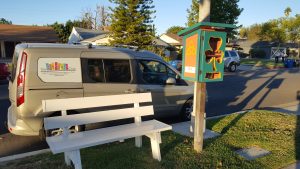
The Little Free Library outside of the Chadwick’s home with The Literacy Club’s van behind it.
It seemed like a great excuse to meet some of my fellow library stewards in the area and swap stories, and exchange advice.
Little Free Library #50,000
At the time I didn’t know that Todd was coming out to the West coast from Wisconsin in part to celebrate the unveiling of Little Free Library charter number 50,000 in Santa Ana, California, the day after he met with us. To help put the growth of the movement into perspective, remember that I registered library #8424 about two years ago.
Chris Aldrich, steward of LFL #8424, meets Todd Bol (right), steward of LFL #1.
The Literacy Club
As I was to discover when I arrived, Todd came not only to meet several library stewards in the Los Angeles area but to help honor all our efforts. In particular to honor the efforts of the Literacy Club which has helped to set up and run over 50 Little Free Libraries in the Los Angeles area including in hospitals, various neighborhoods, and every police station in the city (except two, which are on their to-do list). They’ve also built and host libraries in Ohio and Wisconsin as well.
I was very impressed with their efforts and even a tad jealous that I hadn’t thought to set up dozens of libraries like this, though trust me, the amount of work involved is no small potatoes–it’s obviously a full time hobby and then some.
As a small comparison, I opened up Little Free Library charter #8424 a year and three months ago, and we’ve had almost 500 books move through our library; the Literacy Club is moving thousands of books a month!
Awards
Paul Krekorian, Councilmember of the Second District of the City of Los Angeles, had sent a Certificate of Appreciation to present to The Literacy Club for all of their fantastic work in the city. Our little soiree included a lovely presentation by Field Deputy Sahag Yedalian (who was representing Krekorian’s office) to the Chadwicks for their work on The Literacy Club’s behalf.
Sahag Yedalian representing Paul Krekorian’s office presents a certificate of appreciation from the City of Los Angeles to Jean and Doug Chadwick for their work on The Literacy Club’s behalf.
After catching my breath, I was a bit sad that the certificate wasn’t made out to the Little Free Library #8424, which is really the true recipient of the honor. While I did do a good bit of work to put the library together and erect it in front of my house, it really is the neighborhood and community that do all of the work in supporting and using our Adams Hill treasure. So I’ll take a moment to say thank you to all my neighbors and friends in and beyond Adams Hill in Glendale for supporting our neighborhood Little Free Library.
On behalf of the City of Los Angeles, thank you for your tremendous support and commitment to eliminating book deserts and promoting literacy throughout our communities.
Paul Krekorian, Councilmember, Second District, City of Los Angeles
in Certificate of Appreciation presented to Chris Aldrich on behalf of Little Free Library #8424 on November 3, 2016
Many other LFL stewards in attendance were also presented with certificates of appreciation for their help in seeding book deserts in the surrounding Los Angeles areas.
Sahag Yedalian representing Paul Krekorian’s office (left) presents a certificate of appreciation from the City of Los Angeles to Executive Director Todd Bol on behalf of the Little Free Library organization.
Swapping stories
During the evening it was great hearing some stories and ideas from many in the room. In particular it was nice to hear the story of Little Free Library #1 that Todd built and thereby started the growing movement of book exchanges.
It was also interesting to hear his philosophy of treating the Little Free Library organization as a “reverse franchise” set up. Most franchise operations perfect the concept of their business before spinning it out into thousands of locations. He prefers to have a few interesting ideas to put out into the community, which is likely to be wildly more creative and perfect those ideas or come up with incarnations and offshoots that the small staff at headquarters couldn’t have possibly created. Then, once perfected, headquarters can help disseminate the ideas to everyone and everywhere else. I though this was great advice for non-profit organizations like this.
Also at the party, I also got to meet the President of the Burbank noon Kiwanis Charles Chavoor who was present to show support for The Literacy Club and their efforts. The Kiwanis there are funding a large Little Free Library to be dedicated shortly.
We also got to hear advance news about a major pending announcement for which we were all embargoed until November 14th, so you’ll have to wait until then for more details.
Todd also shared some of his work in growing the Little Free Library movement in Indonesia as well as several partnerships including the U.S. Army which is stewarding a large number of libraries.
Little Free Library Stewards from the Los Angeles area enjoy several stories at the party. (Photo courtesy of The Literacy Club.)
Doug Chadwick shared a somewhat heartbreaking story based on his volunteer experience. He said that an unintended consequence and benefit of putting Little Free Libraries into police stations around the city is that police stations are often the site of court mandated child exchanges between divorced parents who don’t always get along or respect each other. At least while waiting during drop offs and pick ups, the children who are caught in the middle are able to sit down and not only read a book or two while they wait, but they can take them home with them as well.
Doug also shared a previous story of receiving the Little Free Library’s “Master Builder Award” and Todd indicated how rare these original Amish planes were to be able to establish such an award.
The Little Free Library Master Builder Award which had previously been presented to Doug Chadwick.
The Book Room
When I came to the party, I thought it would be a nice gesture to bring a book or two from my own library for the hosts or to swap with some of the other stewards. I noticed that a few other attendees did the same. Our gracious hosts also had the same idea, but, like the Literacy Club with its grand mission, they managed to pull their version off in even grander style.
As I was leaving, I was invited into The Book Room. Now, I’ll preface this with the fact that I’ve been into the offices and stock rooms over more than a dozen nice sized specialty book shops. The book room in the Chadwick’s home handily put most of them to shame. I was immediately surrounded by shelves with hundreds of stacks of books each with a dozen or more copies of the same book all waiting to be pulled off to create restocking boxes for any of the various Little Free Libraries around town that The Literacy Club stewards.
While I often try to have lightly worn or like new books in my library, every book in this room was brand new and sure to make a proud treasure for the thousands of children who were soon to receive them. It’s exactly the kind of room every library steward dreams of having in their own house.
I was thrilled to be sent home with not just one box full of books, but three boxes. Thus Little Free Library #8424 will soon have some new children’s selections, and, much like an early Santa Claus, I’ll be dropping off many books at some of the surrounding LFLs in the Eagle Rock, Glendale, South Pasadena, and Pasadena areas to spread the wealth and cheer and help continue seeding libraries nearby.
In the meanwhile, I’m dreaming about how I might be able to add on an additional room to the house for books…
Thanks
Thanks again to The Literacy Club and to Doug and Jean Chadwick, who have impossibly edged me out as the #2 most enthusiastic Little Free Library steward after Todd Bol. And thanks again for hosting such a lovely little party to bring us all closer together. I’m glad to know I’m not alone in my love for what we’re all doing. I’ll be in touch shortly about volunteering some of my time to The Literacy Club’s efforts.
Thanks also to The Little Free Library organization which provided guests with lots of great items like The Little Free Library book, buttons, book marks and more.
And finally, thanks yet again to all my friends, family, and neighbors who help to support Little Free Library #8424.
You too can make a donation to The Literacy Club. On the table: bookmarks, pins, and magnets supporting the Little Free Library movement.
The certificate for the Literacy Club
Little Free Library enthusiasts swap stories and experiences.
A close up of the beautiful header on the certificates of appreciation.
Would you like to help?
You can help in a variety of ways from donating your lightly used books, volunteering your time, starting your own library, or even making a financial contribution. We welcome your help and know that it will help make our communities better one book at a time. After seeing some of the excellent work that The Literacy Club is doing, you could also help support their GoFundMe campaign.
After having spent the weekend at IndieWebCamp Los Angeles, it somehow seems appropriate to have a “Voted post type” for the election today†. To do it I’m proposing the following microformats, an example of which can be found in the mark up of the post above. This post type is somewhat similar to both a note/status update and an RSVP post type with a soupçon of checkin.
Basic markup
<div class="h-entry">

<span class="p-voted">I voted</span>

in the <a href="http://example.com/election" class="u-voted-in">November 8th, 2016 Election</a>

</div>
Possible Voted values: I voted, I didn’t vote, I was disenfranchised, I was intimidated, I was apathetic, I pathetically didn’t bother to register
Send a Webmention to the election post of your municipality’s Registrar/Clerk/Records office as you would for a reply to any post.
You should include author information in your Voted post so the registrar knows who voted (and then send another Webmention so the voting page gets the update).
Here’s another example with explicit author name and icon, in case your site or blog does not already provide that on the page.
The Santa Fe Institute, in New Mexico, is a place for studying complex systems. I’ve never been there! Next week I’ll go there to give a colloquium on network theory, and also to participate in this workshop.
I just found out about this from John Carlos Baez and wish I could go! How have I not managed to have heard about it?
November 16, 2016 – November 18, 2016
9:00 AM
Noyce Conference Room
Abstract.
This workshop will address a fundamental question in theoretical biology: Does the relationship between statistical physics and the need of biological systems to process information underpin some of their deepest features? It recognizes that a core feature of biological systems is that they acquire, store and process information (i.e., perform computation). However to manipulate information in this way they require a steady flux of free energy from their environments. These two, inter-related attributes of biological systems are often taken for granted; they are not part of standard analyses of either the homeostasis or the evolution of biological systems. In this workshop we aim to fill in this major gap in our understanding of biological systems, by gaining deeper insight in the relation between the need for biological systems to process information and the free energy they need to pay for that processing.
The goal of this workshop is to address these issues by focusing on a set three specific question:
How has the fraction of free energy flux on earth that is used by biological computation changed with time?;
What is the free energy cost of biological computation / function?;
What is the free energy cost of the evolution of biological computation / function.
In all of these cases we are interested in the fundamental limits that the laws of physics impose on various aspects of living systems as expressed by these three questions.
Purpose: Research Collaboration
SFI Host: David Krakauer, Michael Lachmann, Manfred Laubichler, Peter Stadler, and David Wolpert
Dodging The Memory Hole is an action-oriented conference and event series that brings together journalists, technologists, and information specialists to strategize solutions for organizing and preserving born-digital news.
A summary/recap of the Dodging the Memory Hole 2016 conference held at UCLA's Charles Young Research Library in Los Angeles, California over two days in October to discuss and highlight potential solutions to the issue of preserving born-digital news.
“Hi there Tiiiigggggrrr!” Edward McCain, digital curator of journalism, Donald W. Reynolds Journalism Institute (RJI) and University of Missouri Libraries warmly greets the participants of DtMH2016
Slide from Technology and community: Why we need partners, collaborators, and friends Kate Zwaard, Library of Congress
Greetings from Ginny Steel, university librarian, UCLA
Presentation: Technology and community: Why we need partners, collaborators, and friends Kate Zwaard, Library of Congress
What does Peter Arnett, the most daring journalist of the past century, do to unwind? He reads comic books of course.
Architectural detail in Powell Library at UCLA
Panel: Why save online news? Chris Freeland, Washington University; Matt Weber, Ph.D., Rutgers, The State University of New Jersey; Laura Wrubel, The George Washington University; moderator Ana Krahmer, Ph.D., University of North Texas
Conduits for Action
Lanyard and ID badge from DtMH2016
Keynote speaker: Digital salvage operations — what’s worth saving? Hjalmar Gislason, vice president of data, Qlik and Deaf Teddy
What Have We Heard?
Presentation: Summarizing archival collections using storytelling techniques Michael Nelson, Ph.D., Old Dominion University
Special guest speaker: Saving the first draft of history: The unlikely rescue of the AP’s Vietnam War files Peter Arnett, winner of the Pulitzer Prize for journalism
It may take me a week or so to finish putting some general thoughts and additional resources together based on the two day conference so that I might give a more thorough accounting of my opinions as well as next steps. Until then, I hope that the details and mini-archive of content below may help others who attended, or provide a resource for those who couldn’t make the conference.
Overall, it was an incredibly well programmed and run conference, so kudos to all those involved who kept things moving along. I’m now certainly much more aware at the gaping memory hole the internet is facing despite the heroic efforts of a small handful of people and institutions attempting to improve the situation. I’ll try to go into more detail later about a handful of specific topics and next steps as well as a listing of resources I came across which may provide to be useful tools for both those in the archiving/preserving and IndieWeb communities.
Archive of materials for Day 2
Audio Files
Below are the recorded audio files embedded in .m4a format (using a Livescribe Pulse Pen) for several sessions held throughout the day. To my knowledge, none of the breakout sessions were recorded except for the one which appears below.
Summarizing archival collections using storytelling techniques
Presentation: Summarizing archival collections using storytelling techniques by Michael Nelson, Ph.D., Old Dominion University
Saving the first draft of history
Special guest speaker: Saving the first draft of history: The unlikely rescue of the AP’s Vietnam War files by Peter Arnett, winner of the Pulitzer Prize for journalism
Kiss your app goodbye: the fragility of data journalism
Panel: Kiss your app goodbye: the fragility of data journalism
Featuring Meredith Broussard, New York University; Regina Lee Roberts, Stanford University; Ben Welsh, The Los Angeles Times; moderator Martin Klein, Ph.D., Los Alamos National Laboratory
The future of the past: modernizing The New York Times archive
Panel: The future of the past: modernizing The New York Times archive
Featuring The New York Times Technology Team: Evan Sandhaus, Jane Cotler and Sophia Van Valkenburg; moderated by Edward McCain, RJI and MU Libraries
Lightning Rounds: Six Presenters
Lightning rounds (in two parts)
Six + one presenters: Jefferson Bailey, Terry Britt, Katherine Boss (and team), Cynthia Joyce, Mark Graham, Jennifer Younger and Kalev Leetaru
1: Jefferson Bailey, Internet Archive, “Supporting Data-Driven Research using News-Related Web Archives” 2: Terry Britt, University of Missouri, “News archives as cornerstones of collective memory” 3: Katherine Boss, Meredith Broussard and Eva Revear, New York University: “Challenges facing preservation of born-digital news applications” 4: Cynthia Joyce, University of Mississippi, “Keyword ‘Katrina’: Re-collecting the unsearchable past” 5: Mark Graham, Internet Archive/The Wayback Machine, “Archiving news at the Internet Archive” 6: Jennifer Younger, Catholic Research Resources Alliance: “Digital Preservation, Aggregated, Collaborative, Catholic” 7. Kalev Leetaru, senior fellow, The George Washington University and founder of the GDELT Project: A Look Inside The World’s Largest Initiative To Understand And Archive The World’s News
Technology and Community
Presentation: Technology and community: Why we need partners, collaborators, and friends by Kate Zwaard, Library of Congress
Breakout: Working with CMS
Working with CMS, led by Eric Weig, University of Kentucky
Alignment and reciprocity
Alignment & reciprocity by Katherine Skinner, Ph.D., executive director, the Educopia Institute
Closing remarks
Closing remarks by Edward McCain, RJI and MU Libraries and Todd Grappone, associate university librarian, UCLA
Live Tweet Archive
Reminder: In many cases my tweets don’t reflect direct quotes of the attributed speaker, but are often slightly modified for clarity and length for posting to Twitter. I have made a reasonable attempt in all cases to capture the overall sentiment of individual statements while using as many original words of the participant as possible. Typically, for speed, there wasn’t much editing of these notes. Below I’ve changed the attribution of one or two tweets to reflect the proper person(s). Fore convenience, I’ve also added a few hyperlinks to useful resources after the fact that didn’t have time to make the original tweets. I’ve attached .m4a audio files of most of the audio for the day (apologies for shaky quality as it’s unedited) which can be used for more direct attribution if desired. The Reynolds Journalism Institute videotaped the entire day and livestreamed it. Presumably they will release the video on their website for a more immersive experience.
Peter Arnett:
Condoms were required issue in Vietnam–we used them to waterproof film containers in the field.
Do not stay close to the head of a column, medics, or radiomen. #warreportingadvice
I told the AP I would undertake the task of destroying all the reporters’ files from the war.
Instead the AP files moved around with me.
Eventually the 10 trunks of material went back to the AP when they hired a brilliant archivist.
“The negatives can outweigh the positives when you’re in trouble.”
Today I spent most of the majority of the day attending the first of a two day conference at UCLA’s Charles Young Research Library entitled “Dodging the Memory Hole: Saving Online News.” While I knew mostly what I was getting into, it hadn’t really occurred to me how much of what is on the web is not backed up or archived in any meaningful way. As a part of human nature, people neglect to back up any of their data, but huge swaths of really important data with newsworthy and historic value is being heavily neglected. Fortunately it’s an interesting enough problem to draw the 100 or so scholars, researchers, technologists, and journalists who showed up for the start of an interesting group being conglomerated through the Reynolds Journalism Institute and several sponsors of the event.
What particularly strikes me is how many of the philosophies of the IndieWeb movement and tools developed by it are applicable to some of the problems that online news faces. I suspect that if more journalists were practicing members of the IndieWeb and used their sites not only for collecting and storing the underlying data upon which they base their stories, but to publish them as well, then some of the (future) archival process may be easier to accomplish. I’ve got so many disparate thoughts running around my mind after the first day that it’ll take a bit of time to process before I write out some more detailed thoughts.
Twitter List for the Conference
As a reminder to those attending, I’ve accumulated a list of everyone who’s tweeted with the hashtag #DtMH2016, so that attendees can more easily follow each other as well as communicate online following our few days together in Los Angeles. Twitter also allows subscribing to entire lists too if that’s something in which people have interest.
Archiving the day
It seems only fitting that an attendee of a conference about saving and archiving digital news, would make a reasonable attempt to archive some of his experience right?! Toward that end, below is an archive of my tweetstorm during the day marked up with microformats and including hovercards for the speakers with appropriate available metadata. For those interested, I used a fantastic web app called Noter Live to capture, tweet, and more easily archive the stream.
Note that in many cases my tweets don’t reflect direct quotes of the attributed speaker, but are often slightly modified for clarity and length for posting to Twitter. I have made a reasonable attempt in all cases to capture the overall sentiment of individual statements while using as many original words of the participant as possible. Typically, for speed, there wasn’t much editing of these notes. I’m also attaching .m4a audio files of most of the audio for the day (apologies for shaky quality as it’s unedited) which can be used for more direct attribution if desired. The Reynolds Journalism Institute videotaped the entire day and livestreamed it. Presumably they will release the video on their website for a more immersive experience.
If you prefer to read the stream of notes in the original Twitter format, so that you can like/retweet/comment on individual pieces, this link should give you the entire stream. Naturally, comments are also welcome below.
Audio Files
Below are the audio files for several sessions held throughout the day.
Greetings and Keynote
Greetings: Edward McCain, digital curator of journalism, Donald W. Reynolds Journalism Institute (RJI) and University of Missouri Libraries and Ginny Steel, university librarian, UCLA
Keynote: Digital salvage operations — what’s worth saving? given by Hjalmar Gislason, vice president of data, Qlik
Why save online news? and NewsScape
Panel: “Why save online news?” featuring Chris Freeland, Washington University; Matt Weber, Ph.D., Rutgers, The State University of New Jersey; Laura Wrubel, The George Washington University; moderator Ana Krahmer, Ph.D., University of North Texas
Presentation: “NewsScape: preserving TV news” given by Tim Groeling, Ph.D., UCLA Communication Studies Department
Born-digital news preservation in perspective
Speaker: Clifford Lynch, Ph.D., executive director, Coalition for Networked Information on “Born-digital news preservation in perspective”
While attending the upcoming conference Dodging the Memory Hole 2016: Saving Online News later this week, I’ll make an attempt to live Tweet as much as possible. (If you’re following me on Twitter on Thursday and Friday and find me too noisy, try using QuietTime.xyz to mute me on Twitter temporarily.) I’ll be using Kevin Marks‘ excellent Noter Live web app to both send out the tweets as well as to store and archive them here on this site thereafter (kind of like my own version of Storify.)
In getting ramped up to live Tweet it, it helps significantly to have a pre-existing list of attendees (and remote participants) talking about #DtMH2016 on Twitter, so I started creating a Twitter list by hand. I realized that it would be nice to have a little bot to catch others as the week progresses. Ever lazy, I turned to IFTTT.com to see if something already existed, and sure enough there’s a Twitter search with a trigger that will allow one to add people who mention a particular hashtag to a Twitter list automatically.
Feel free to follow or subscribe to the list as necessary. Hopefully this will make attending the conference more fruitful for those there live as well as remote.
Not on the list? Just tweet a (non-private) message with the conference hashtag: #DTMH2016 and you should be added to the list shortly.
Lazy like me? Click the bird to tweet: “I’m attending #DtMH2016 @rji | Dodging the Memory Hole 2016: Saving Online News http://ctt.ec/5RKt2+”
IFTTT Recipe for Creating Twitter Lists of Conference Attendees
For those interested in creating their own Twitter lists for future conferences (and honestly the hosts of all conferences should do this as they set up their conference hashtag and announce the conference), below is a link to the ifttt.com recipe I created for this, but which can be modified for use by others.
Naturally, it would also be nice if, as people registered for conferences, they were asked for their Twitter handles and websites so that the information could be used to create such online lists to help create longer lasting relationships both during the event and afterwards as well. (Naturally providing these details should be optional so that people who wish to maintain their privacy could do so.)
Jacob gave a nice and humanizing presentation on some of the philosophy behind his startup. Though he didn’t get very deep into the topic indicated by the title of his talk, he was very engaging in exactly the manner you’d expect that a dude with a truck could be.




 After catching my breath, I was a bit sad that the certificate wasn’t made out to the Little Free Library


 NPR Research, Archives, & Data Strategy
 John Berlin


