Tiago, I’ve started into an advanced copy of your forthcoming book and at the end of the introduction you have a footnote:

Other popular terms for such a system include Zettelkasten (meaning “slipbox” in German, coined by influential sociologist Niklas Luhmann), Memex (a word invented by American inventor Vannevar Bush), and digital garden (named by popular online creator Anne-Laure Le Cunff)

Please know that the zettelkasten and its traditions existed prior to Niklas Luhmann. He neither invented them nor coined their name. It’s a commonly repeated myth on the internet that he did and there’s ample evidence of their extensive use prior to his well known example. I’ve documented some brief history on Wikipedia to this effect should you need it: https://en.wikipedia.org/wiki/Zettelkasten

The earliest concept of a digital garden stems from Mark Bernstein’s essay Hypertext Gardens: Delightful Vistas in 1998. This torch was picked up by academic Mike Caulfield in a 2015 keynote/article The Garden and The Stream: A Technopastoral.

Anne-Laure Le Cunff’s first mention of “digital garden” was on April 21, 2020

Which occurred just after Maggie Appleton’s mention on 2020-04-15

And several days after Justin Tadlock’s article on 2020-04-17 

Before this there was Joel Hooks by at least 2020-02-04 , though he had been thinking about it in late 2019.

He was predated by Tom Critchlow on 2018-10-18 who credits Mike Caulfield’s article from 2015-10-17 as an influence.

Archive.org has versions of the phrase going back into the early 2000’s: https://web.archive.org/web/*/%22digital%20garden%22

Hopefully you’re able to make the edits prior to publication, or at least in an available errata.

The Zettelkasten Method of Note Taking Mirrors Most of the Levels of Bloom’s Taxonomy

Between zettels (the space where new ideas often occur) this morning I realized that there is a high correlation to Bloom’s Taxonomy and the refined methods of keeping a zettelkasten, particularly as delineated by Dr. Sönke Ahrens in his book How to Take Smart Notes. As a result, even if one’s primary goal isn’t writing or creating as framed by Ahrens’, the use of the system as a pedagogical tool can be highly effective for a variety of learning environments.

Recall briefly that Bloom’s Taxonomy levels can be summarized as: remember, understand, apply, analyze, evaluate, and create.

Outlining the similarities

One needs to be able to generally understand an idea(s) to be able to write it down clearly in one’s own words. This is parallel to creating literature notes as one reads. Gaps in one’s understanding will be readily apparent when one realizes that they’re not able to explain an idea simply and clearly.

Regular work within a zettelkasten helps to reinforce memory of ideas for understanding, long term retention, and the ability to easily remember them. Many forms of zettelkasten software have functionality for direct spaced repetition if not dovetails for spaced repetition software like Anki or Mnemosyne.

Applying the knowledge to other situations happens almost naturally with the combinatorial creativity that occurs within a zettelkasten. Raymundus Llullus would be highly jealous here I think.

Analysis is heavily encouraged as one takes new information and actively links it to prior knowledge and ideas; this is also concurrent with the application of knowledge.

Being able to compare and contrast two ideas on separate cards is also part of the analysis portions of Bloom’s taxonomy which also leads into the evaluation phase. Is one idea better than another? How do they dovetail? How might they create new knowledge? Juxtaposed ideas cry out for evaluation.

Finally, as argued by Ahrens, one of the most important reasons for keeping a zettelkasten is to use it to generate or create new ideas and thoughts and then use the zettelkasten as a tool to synthesize them in articles, books, or other media in a clear and justified manner. 

Other examples?

I’m curious to hear if any educators have used the zettelkasten framing specifically for scaffolding the learning process for their students? There are some seeds of this in the social annotation space with tools like Diigo and Hypothes.is, but has anyone specifically brought the framing into their classes?

I’ve seen a few examples of people thinking in this direction and even @CalHistorian specifically framing things this way, but I’m curious to hear about other actual experiences in the field. 

The history of the recommendation and use of commonplace books in education is long and rich (Erasmus, Melanchthon, Agricola, et al.), until it began disappearing in the early 20th century. I’ve seen a few modern teachers suggesting commonplaces, but have yet to run across others suggesting zettelkasten until Ahrens’ book, which isn’t yet widespread, at least in the English speaking world. And even in Ahrens’ case, his framing is geared specifically to writing more so than general learning and education.

Featured image courtesy of Vanderbilt University Center for Teaching (CC BY 2.0

Contextualizing Cornell Notes in the Note Taking Traditions

Have we lost too much of the contextual value of what Cornell notes were originally designed for by Walter Pauk in the 1950’s? Or are we not taking the idea far enough into the writing realm?

Cornell notes come from a time closer to the traditional space of commonplace books, academic thinking, and note taking that was more prevalent in the early 1900’s and from which also sprang the zettelkasten tradition. I can’t help but be reminded that the 10th edition of Pauk’s book How to Study in College (Wadsworth, 2011, p.394), which helped to popularize the idea of Cornell notes with the first edition in 1962, literally ends the book with the relationship of the word ‘topic’ by way of Greek to the Latin ‘loci communes‘ (commonplaces), though it’s worth bearing in mind that it contains no discussion of the commonplace book or its long tradition in our intellectual history.

One was meant to use Cornell notes to capture broad basic ideas and facts (fleeting notes) and things to follow up on for additional research or work. Then they were meant to be revisited to focus on creating questions that might be used for spaced repetition, a research space that has seen tremendous growth and advancement since the simpler times in which the Cornell note taking method was designed.

Additionally one was meant to revisit their notes to draw out the most salient points and ideas. This is part of the practice of taking the original ideas and writing them out clearly in one’s own words to improve one’s understanding of the material. Within a zettelkasten framing, this secondary review is part of the process of creating future useful literature notes or permanent notes that one might also re-use in their future writing and thinking.

Missing from the Cornell notes practice but more directly centered in the zettelkasten practice is taking one’s notes and directly linking them to other related thoughts in one’s system. This places this method closer to the commonplace book tradition than the zettelkasten tradition.

While a more basic and naïve understanding of Cornell notes in current academic environments still works on many levels, students and active researchers might be better advised to look at their practices in view of broader framings like that of Sönke Ahrens’s book How to Take Smart Notes: One Simple Technique to Boost Writing, Learning and Thinking.

It also bears noting that one could view the first stage of Cornell notes in light of the practice of keeping a waste book and then later transferring their more permanent and better formed ideas into their commonplace book.

Similarly one might also view full sheets of finished Cornell notes as permanent notes mixed in amidst fleeting notes and held together on pages rather than individual cards. This practice sounds somewhat similar in structure to Sönke Ahrens’s use of Roam Research to compile multiple related ideas in individually linked blocks on a single page holding them together in a pseudo-project page for more immediate and potentially specific future use.

I’m excited to join Dan Allosso‘s book club on How to Take Smart Notes as a means of turning my active reading, annotating, and note taking into papers, articles and books using Obsidian.md and Hypothes.is

Details: 

cc: Ian O’Byrne, Remi Kalir

Replied to a tweet (Twitter)
If you’re curious about doing this from digital to print, you’ll find some interesting pointers/ideas at these two links:

Replied to a thread by AGWilsonn (Twitter)
For academics, a range of sources and spaces may be best from books, articles on down to tweets. The Garden and Stream may be a useful metaphor with respect to your Twitter (stream) use: https://hapgood.us/2015/10/17/the-garden-and-the-stream-a-technopastoral/

For ideas on implementing this (under various names) try: https://indieweb.org/commonplace_book. Micro.blog may be one of the online platforms that does a lot of this with IndieWeb building blocks, allows syndication to twitter, has a low barrier, and a reasonable subscription cost. It’s a social reader that also includes

Examples specific to religious studies I’ve seen, include those considered “florilegia”, Philip Melanchthon, and Jonathan Edwards, just to name a few.

I’m always curious about which methods and tools people use to take best advantage of these knowledge ideas, particularly for collecting, curating, reusing, and ultimately creating. Have you written about your overall experience with Knovigator and how you use it in this context?

Different types of notes and use cases

In taking notes and making annotations recently, I’ve started a list of some of the broad semantic types I’ve come across. 

Ideas

New ideas spurred by reading, potentially for future expansion and refinement.

Questions

Questions relating to the the text. What’s missing? What should have been asked or addressed? What biases exist that should be addressed?

Paraphrases

Paraphrases and [[progressive summaries]] of articles or portions of articles. Restatements of ideas which may be reused in other contexts.

Facts

Basic, usually new, facts highlighted for future use and/or [[spaced repetition]]

Quotes

Old school sententiae, aphorisms, and quotes for use in the future

Replies

Direct communication with others

Phatic notes and Reactions

Reactions, exhortations (Ha!, funny, ROFL, LOL, etc.), reacji, !, ?, ⭐, basic signs of life while reading

Others?

Are there any big holes I’m missing based on your experiences?

Replied to a tweet by @jmeowmeow (Twitter)
@jmeowmeow @miniver @dobbse Build your own?? Lots of ideas and other alternatives for thought here: https://indieweb.org/commonplace_book

Does Spirit hide in the filing cabinet?

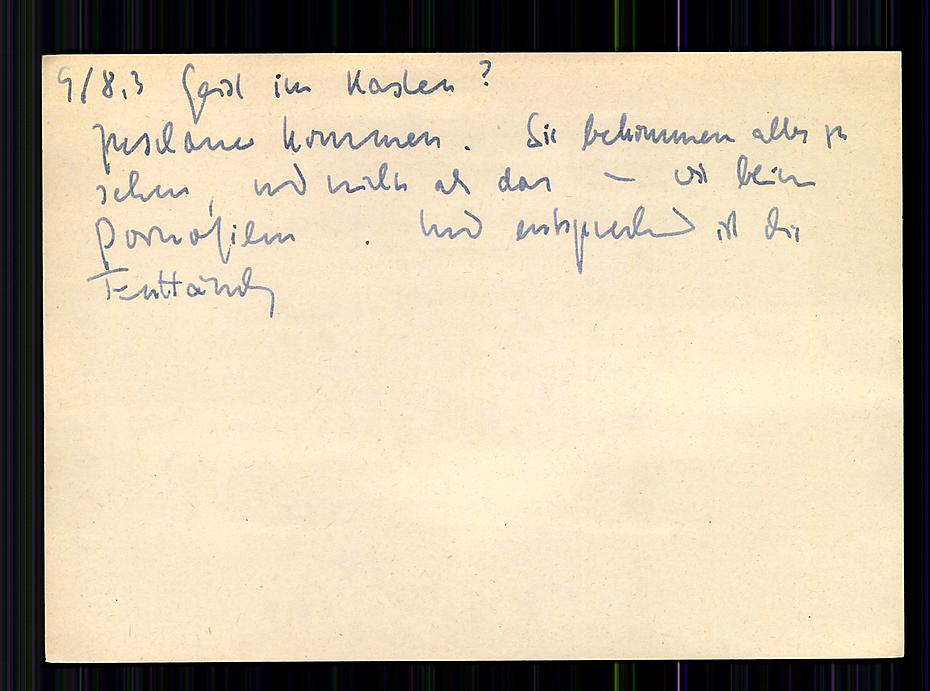
On a slip in his zettelkasten (a card catalog or filing cabinet of personal notes), entitled “Does Spirit hide in the filing cabinet?”, Niklas Luhmann wrote a note about people who came to see his system:

“People come, they see everything and nothing more than that, just like in porn movies; consequently, they leave disappointed.”

This is a telling story about people’s perception of the simplicity of the idea of a slip box (zettelkasten, card catalog, commonplace book or whatever you want to call your note taking system).

yellowed index card with the identifier 9/8,3 with almost illegible handwriting in German Niklas Luhmann, Zettelkasten II, index card no. 9/8,3

It’s also a testament to the fact that the value of a zettelkasten is in the upfront work that is required in making valuable notes and linking them. Many people end up trying out the simple looking system and then wonder why it isn’t working for them. The answer is that they’re not working for it.

Just as sex can be fun, working with a system of notes can be fun. (“Just” can be a problematic word, n’cest pas?)  In either framing, both partners need to do some work—neither necessarily the same work. The end result can be magic.

As Potter Stewart might have said, “I may not be able to define proper note taking, but I know it when I see it.”

Liked a tweet by Dr. Matthew Everhard (Twitter)
Requesting my copy now…
Replied to a tweet by krish (Twitter)
@krishkhubchand Why not (also) scribble them down for your future self and place them in your commonplace book/zettelkasten/notebook/other? If you want to be interactive and get feedback, post them to a website or digital garden…
Watched Field Notes: Reporter's Notebook by Coudal PartnersCoudal Partners from Vimeo

Field Notes: Reporter's Notebook from Coudal Partners on Vimeo.

John Dickerson of “Face the Nation” talks about how he uses a Reporter’s Notebook and how he helped Field Notes make one.

Reporter John Dickerson talking about his notebook.

While he doesn’t mention it, he’s capturing the spirit of the commonplace book and the zettelkasten.

[…] I see my job as basically helping people see and to grab ahold of what’s going on.

You can decide to do that the minute you sit down to start writing or you can just do it all the time. And by the time you get to writing you have a notebook full of stuff that can be used.

And it’s not just about the thing you’re writing about at that moment or the question you’re going to ask that has to do with that week’s event on Face the Nation on Sunday.

If you’ve been collecting all week long and wondering why a thing happens or making an observation about something and using that as a piece of color to explain the political process to somebody, then you’ve been doing your work before you ever sat down to do your work.

I’d love to interview him about his process as well as keeping track of his notes after-the-fact. Does he index them? Collate them? How does he archive them? What role do they play in his book writing processes? Is his system something that he was taught, something which he created and refined over time, or a little bit of both?

Zettelkasten History Prior to Niklas Luhmann: Antonin Sertillanges

Antonin Sertillanges’ book The Intellectual Life is published in 1921 in which he outlines in chapter 7 the broad strokes a version of the zettelkasten method, though writing in French he doesn’t use the German name or give the method a specific name.[1]

The book was published in French, Italian, and English in more than 50 editions over the span of 40 years. In it, Sertillanges recommends taking notes on slips of “strong paper of a uniform size” either self made with a paper cutter or by “special firms that will spare you the trouble, providing slips of every size and color as well as the necessary boxes and accessories.” He also recommends a “certain number of tagged slips, guide-cards, so as to number each category visibly after having numbered each slip, in the corner or in the middle.” He goes on to suggest creating a catalog or index of subjects with division and subdivisions and recommends the “very ingenious system”, the decimal system, for organizing one’s research. For the details of this refers the reader to Organization of intellectual work: practical recipes for use by students of all faculties and workers by Paul Chavigny.[2]

Sertillanges recommends against the previous patterns seen with commonplace books where one does note taking in books or on slips of paper which might be pasted into books as they don’t “easily allow classification” or “readily lend themselves to use at the moment of writing.”


[1] Antonin, Sertillanges (1960). The Intellectual Life: Its Sprit, Conditions, Methods. Translated by Ryan, Mary (fifth printing ed.). Westminster, Maryland: The Newman Press. pp. 186–198.

[2] Chavigny, Paul (1918). Organisation du travail intellectuel: recettes pratiques à l’usage des étudiants de toutes les facultés et de tous les travailleurs (in French). Delagrave.


Featured Image: zettelkasten flickr photo by x28x28de shared under a Creative Commons (BY-SA) license

Replied to a tweet by CatoMinor3 (Twitter)
A few of us have been keeping lists of some of these tools for thought at https://indieweb.org/commonplace_book#Platforms so one can test, try, or compare user interfaces for building one’s own custom version. Contributions to this public wiki welcome.