I am wholly unsurprised that Harold Innis (1894-1952) maintained a card index (zettelkasten) through his research life, but I am pleased to have found that his literary estate has done some work on it and published it as The Idea File of Harold Adams Innis (University of Toronto Press, 1980). The introduction seems to have some fascinating material on the form and structure as well as decisions on how they decided to present and publish it.
For those unaware of his work, primarily as a political economist, he wrote extensively on media and communication theory including the influential works Empire and Communications (1950) and The Bias of Communication (1951).
While I appreciate the published book nature of the work, it would be quite something to have it excerpted back down to index card form as a piece of material culture to purchase and play around with. Perhaps something in honor of the coming 75th anniversary of his passing?
But lo! men have become the tools of their tools. The man who independently plucked the fruits when he was hungry is become a farmer; and he who stood under a tree for shelter, a housekeeper.
—Henry David Thoreau, Walden; or, Life in the Woods (Ticknor and Fields, 1854, p. 41)
This quote from Walden becomes even more fascinating when one realizes that the Thoreau family business was manufacturing pencils at John Thoreau & Co., one of the first major pencil companies in the United States. Thoreau’s father was the titular John and Henry David worked in the factory and improved upon the hardness of their graphite.
One might also then say that the man who manufactured pencils naturally should become a writer!
This quote also bears some interesting resemblance to quotes about tools which shape us by Winston Churchill and John M. Culkin. see: https://hypothes.is/a/6Znx6MiMEeu3ljcVBsKNOw
I saw a sign on April 2nd next to a cash register at local mom and pop restaurant El Matador in Pasadena, CA that read, “$0.75 per (credit) card transaction”.
It reminded me of the growing number of stores, vendors, and service providers that are passing credit and debit card transaction fees back to the consumer. In my past experience credit card companies like Visa, American Express, and AmEx all vehemently insisted that their credit card fees, usually amounting to 2.0-3.9+% of a transaction would be borne by the company accepting their cards. The fine print in their agreements all indicated that their agreements would end and companies would be cut off if they didn’t swallow the fees themselves as a basic cost of doing business.
But it would seem that sometime during the pandemic and the financial turmoil that has ensued that a growing number of businesses, presumably feeling the squeeze of the economy, have begun passing these fees directly back to the consumer.
I first began noticing it when paying for our daughter’s ballet school tuition which charged us an extra 3% credit card fee for using our credit card instead of paying by cash or check. Then her private school tuition processor began charging a 3% credit card fee. Now it seems like every small company is taking the cue and passing along credit card fees to the consumer, including the local Mexican food restaurant.
What effects does this seemingly small, yet somehow massive shift in the economy have on consumers, businesses, and the country? How does it effect inflation and its impact on consumers? How does it effect the overall banking sector? Much the same way austerity measures within the economy ordinarily have an outsized, but “unseen” impact on women, does this additional tax on consumers hit everyone equally? What effects does this have on an increasingly cashless society that has normalized credit cards? What will potential long term changes in credit card processing will this foment? Will the tide change as interest rates decrease?
A common outlier to this pattern before the pandemic was gasoline chain ARCO which only accepted debit cards or cash and charged an automatic $0.35 fee for any debit card transactions to cover the single use banking fee that the bank charged them (though generally the debit card fee most banks charge companies has been in the $0.22 – $0.30 range; research should confirm the specific number). Sometime during the pandemic, the shift in competition/pricing apparently led ARCO to begin accepting major credit cards. However, in their case, they post different gas pricing for cash/debit transactions versus credit card transactions, typically an extra $0.10/gallon, which at about 2.0% of $4.80/gallon of regular gas at my local station in Pasadena represents a rough breakeven point for charging back the overall credit card fee, presuming they’re operating at high enough volume to get a 2% fee. What happens when gas prices go up though? Will their per gallon fee also go up to cover the credit card differential?
I’d love to see some on-the-ground economics reportage on this growing trend. Perhaps it’s something that Marketplace might take up?
As Prince of Wales, Charles was always ready with an opinion. Now, with his coronation at hand, his job is to have none.
https://www.newyorker.com/magazine/2023/05/08/can-charles-keep-quiet-as-king-coronation
I’ve decided it’s time to up my pastry 🥐 and bread 🍞 game, and I’ve found some local Los Angeles suppliers for whole grain. Anyone with experience have recommendations for their favorite grain mills?
I recently watched the documentary Aby Warburg: Metamorphosis and Memory (Wechsler, 2016) via Kanopy (for free using my local library’s gateway) and thought that others here interested in the ideas of memory in culture, history, and art history may appreciate it. While a broad biography of a seminal figure in the development of art history in the early 20th century, there are some interesting bits relating to art and memory as well as a mention of Frances A. Yates whose research on memory was influenced by Warburg’s library.
Of specific “note” is the fact that Aby Warburg (1866-1929) had a significant zettelkasten-based note taking practice and portions of his collection (both written as well as images) are featured within the hour long documentary. You’ll see it in the opening scenes in the background during many of the interviews, but there’s also a portion featured at the 30 minute mark which looks at a few of his zettels. Like several other zettelkasten practitioners he had a significant zettelkasten practice but did not publish much, but did lecture quite a lot and had outsized influence both during his life as well as posthumously and his zettelkasten and research remain as an archive for scholars who still study and extend his work.
Sadly, I’m unable to catch any screenshots from the film due to technical glitches, but if folks can figure out how to pull some out, I’d appreciate them.
Aby Warburg’s extant zettelkasten at the Warburg Institute’s Archive consists of ninety-six surviving boxes (of 104 or possibly more) which contain between 200-800 individually numbered index cards. Dividers and envelopes are used within the boxes to separate the cards into thematic sections.
It was fascinating to run across the Memindex, a productivity tool from the Wilson Memindex Co., advertised in a December 1906 issue of System: The Magazine of Business. Memindex seems to be an obvious portmanteau of the words memory and index.
Let YOUR MIND GO FREE
Do not tax your brain trying to remember. Get the MEMINDEX HABIT and you can FORGET WITH IMPUNITY. An ideal reminder and handy system for keeping all memoranda where they will appear at the right time. Saves time, money, opportunity. A brain saver. No other device answers its purpose. A Great Help for Busy Men, Used and recommended by Bankers, Manufacturers, Salesmen, Lawyers, Doctors, Merchants, Insurance Men, Architects, Educators, Contractors, Railway Managers Engineers, Ministers, etc., all over the world. Order now and get ready to Begin the New Year Right. Rest of ’06 free with each outfit. Express prepaid on receipt of price. Personal checks accepted.
Also a valuable card index for desk use. Dated cards from tray are carried in the handy pocket case, 2 to 4 weeks at a time. To-day’s card always at the front. No leaves to turn. Helps you to PLAN YOUR WORK WORK YOUR PLAN ACCOMPLISH MORE You need it. Three years’ sales show that most all business and professional men need it. GET IT NOW. WILSON MEMINDEX CO. 93 Mills St., Rochester, N. Y.
Early Computer Science Influence?
The Memindex product appears several decades prior to Vannevar Bush’s “coinage” of memex in As We May Think (The Atlantic, July 1945). While many credit Bush for an early instantiation of the internet using the model of a desk, microfiche, and a filing system, almost all of these moving parts had already existed in late 19th century networked office furniture and were just waiting for automation and computerization. The primary difference in this Memindex card system and Bush’s Memex is the higher information density made available through the use of microfiche. Now it turns out his coinage of memex appears to have been in the zeitgeist decades prior as well. I’ve got evidence that the Wilson Memindex was sold well into the early 1950s. (My current dating is to 1952, though later examples may exist.) Below I’ve pictured some cards from the same year as Bush’s now famous piece in the Atlantic.
Six different cards from a 1945 set of Memindex featuring cards for automobile expenses; a list of orderable supplies including cards, guide cards, and leather cases; an advertisement for Griptite Bands for holding cards; a pocket calendar for 1945, and a small instruction card on how the cards and system should be used.
Most people are more familiar with the popular 20th century magazine System than they realize. Created and published by A. W Shaw, one of the partners of Shaw-Walker, a major manufacturer of office furniture in the early 20th century, the popular magazine was sold to McGraw-Hill Company in 1927/8 and renamed Businessweek which was later sold again and renamed Bloomberg Businessweek.
Relationship to other modern productivity methods
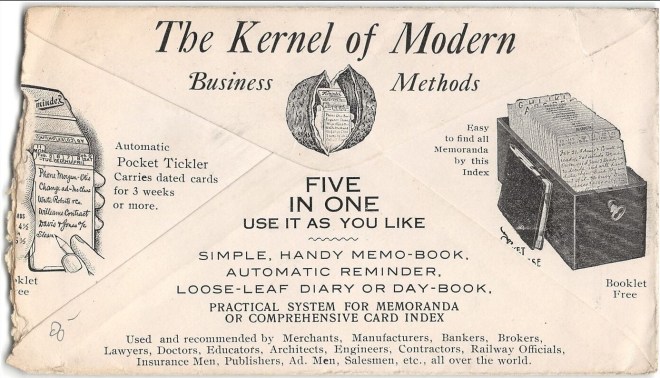
Some will certainly see close ties of this early product to the idea of the “hipster PDA” or Hawk Sugano’s Pile of Index Cards which appeared in 2006. It also doesn’t take much imagination for one to look at the back of a Wilson Memindex envelope from 1909 or an ad from the 1930s to see the similarity to the 43 folders system, bits of Getting Things Done (GTD), or the Bullet Journal methods in common use today. The 1909 envelope also appears to combine a predecessor to the 43 folders idea mixed with the hipster PDA in a coherent pocket and desk-based system.
With alphabetic tabs for the desktop version, one could easily have used this for “Building a Second Brain” as described by modern productivity gurus who almost exclusively suggest digital tools for maintaining their systems now. The 1909 envelop specifically recommends using the system as “comprehensive card index” which is essentially what most second brain or zettelkasten systems are, though there is a broad disconnect between some of this and the reimagining of the zettelkasten in current craze for using Niklas Luhmann-esque organization methods which have some different aims.
What’s interesting beyond the similarities of the systems is the means by which they were sold and spread. Older systems like the Memindex or related general office filing and indexing systems (Shaw-Walker), were primarily selling physical products/hardware like boxes, filing cabinets, holders, cards, and dividers as much as they were selling a process or idea. Mid- and late-century companies like Day-Timer or FranklinCovey also sold physical stationery products (calendars, planners, boxes, binders, books, ) but also began more heavily selling ideas like “productivity” and “leadership”. Modern productivity gurus are generally selling the ideas of the systems and making their money not on the physical items, software or programs which implement them, but with consulting fees, class fees, subscriptions, books which describe their systems, or even advertising against page or video views.
The 1906 version of the Memindex was popular enough to already be offered with the following options of materials for the distinguishing tastes of consumers:
Cowhide Seal Leather Case and hardwood tray
Am. Russia Leather Case and plain oak tray
Genuine Morocco Case and quartered oak tray
What options is your current productivity guru or system offering? What are the differentiations and affordances it’s offering compared to similar systems in the early 1900s? Where is the “rich Corinthian leather“?
Memindex envelope from 19091930’s Memindex advertisement featuring a pedestal based system with a pocket card holder.
The Memindex Method
The basic Memindex method consists of using 2 3/4″ x 4 1/2″ (vest pocket sized) or 3 x 5 1/2″ cards depending on one’s size preference to jot down to do lists or tickler items on individually dated cards which are kept in a desk-based wooden card index with tabs for both months as well as alphabetic tabs in some systems. One then keeps a small pocket-sized card holder with the coming three weeks’ worth of cards on their person for active daily use and files them away as the days go by.
1930’s advertisement for the Memindex Jr.
Apparently the truism “everything old is new again” is true yet again.
Time: Sunday, May 7, 2023, 12:00 noon Eastern Time (US and Canada)
9 AM Pacific Time
Zoom link for the meetup: https://us02web.zoom.us/j/8850659900?pwd=ZE9ROUs1czNiK2FTTStjTUJuVkIydz09 4
Agenda
This one is going to be fun! Sönke Ahrens, the author of How to Take Smart Notes 12 will join our meetup on May 7th. Let’s start a thread on what we’d like to review with him. The meetup is not for a couple of weeks. If you have the time, I highly suggest you grab a copy and give it a read.
The Tinderbox crowd has been doing lots of solid zettelkasten related material recently.
If you use 5 x 8 inch index cards and are looking to upgrade your filing storage, this restored quartersawn oak #zettelkasten / card index file on eBay is a real beauty. I’m mentioning it because they’re rare and this one from 1914 looks to be in exceptional shape.
A lot of discussion in the Zettelkasten space has taken place on the debate between digital and analog with handwriting being the default analog option. Why not split some of the differences and opt for the mechanical typewriter option? Where’s the subreddit for that? It can’t just be me and Umberto Eco, right? 🗃️




 Zinzy Waleson Geene