This box of 600+ specimen cards holds a complete snapshot of the last metal type foundries in Germany. Produced 1958–1971, the Schriftenkartei (Typeface Index) represents the final effort to catalog all the country’s typefaces in production at the time. The cards are useful for researchers and designers as they share a common format and show complete glyph sets. Thanks to Michael Wörgötter, a set of these cards is now in our collection, and his high-res scans are online. https://letterformarchive.org/news/schriftenkartei-german-font-index/
This Schriftenkartei represents a fascinating example of a card index (#zettelkasten) as a database. This one obviously had a very narrow range of topics.
There’s something incredibly important to learn in studying two very similar photographs of Mortimer J. Adler from the middle of the last century. I’ll present them here for reference:
Adler was a proponent of educational reforms in the form of building on John Erskine’s Great Books programs and went so far as to teach us to read properly before editing and presenting a fantastic collection of books in the form of the Great Books of the Western World by way of the Encyclopedia Britannica.
Adler most often suggested consuming a book in increasing levels by marking it up with highlights, annotations and even scaffolding a book’s important material on its end covers. However, when it came to the Great Books project, he and 25 of his colleagues used notes on index cards to index 102 great ideas across a large swath of classical Western literature.
You can see the majority of this indexed collection of knowledge splayed around him in the first photo. These index cards became the raw materials by which he and his team compiled and wrote the impressive Syntopicon which comprised volumes 2 and 3 of the 54 books in the Great Books of the Western World series (1952). Upon its release, the second photo was used extensively in marketing materials to sell the set to the general public over the ensuing decades and several editions of the books.
Even if one doesn’t look very closely at the photos, once juxtaposed they will probably have already noticed that the photos of Adler himself are the same. The second photo has obviously had the set of books superimposed around a cropped photo of him from the first photo. While it is a great advertising gimmick, it belies a lot of the serious work involved in building the Syntopicon which hides a tremendous amount of value.
Even Adler’s co-editor extolls the immense value of the Syntopicon:
But I would do less than justice to Mr. Adler’s achievement if I left the matter there. The Syntopicon is, in addition to all this, and in addition to being a monument to the industry, devotion, and intelligence of Mr. Adler and his staff, a step forward in the thought of the West. It indicates where we are: where the agreements and disagreements lie; where the problems are; where the work has to be done. It thus helps to keep us from wasting our time through misunderstanding and points to the issues that must be attacked. When the history of the intellectual life of this century is written, the Syntopicon will be regarded as one of the landmarks in it.
—Robert M. Hutchins, p xxvi The Great Conversation: The Substance of a Liberal Education. 1952.
However, while the Syntopicon as an end product holds great value, knowing how it was created is potentially even more important. The second photo does a huge disservice to the entire enterprise by way of erasure of the true nature of the Syntopicon. While the first photo may seem dull and esoteric, it holds a huge amount of hidden value for both students and teachers. It is photographic evidence of how the knowledge of the incredibly valuable Syntopicon was actually built. If properly scaffolded for students, following their lead of indexing their ideas, students could have their own personal Syntopicons for learning and exploring.
Imagine, if you will, the majesty and awe inspired by the Pyramids of Giza to the people viewing them from the ground. The Great Pyramid itself is significantly taller than both Big Ben and the Statue of Liberty, and at approximately 45 stories tall is almost half the height of the Eiffel Tower, though obviously with a much more massive base. The entire structure of the Pyramid of Giza is estimated to weigh 5.9 million metric tons comprising 2.3 million blocks of stone averaging weights of about 3 tons each. These rocks were cut and moved only by humans across vast distances of sand. Anyone who has done the intense labor of dragging a cooler and pop up tent across even a few hundred feet of sand to spend a day at the beach will marvel at moving such massive blocks, even with thousands of people to help drag it. Yet they managed to lay 1,764,000 pounds of stone every day for nearly 20 years. How did the ancient Egyptians manage this feat? Curious people have tried for centuries to imagine how they managed to build such spectacular monuments from scratch. But because there is little in the historical record and no remains of scaffolding, anyone who might want to build their own monumental pyramid is left to start their process from scratch. But what if you had a picture of the method or the scaffolding? Perhaps even set of plans, diagrams, or description? That might make all the difference, wouldn’t it?
I’ll give you a head start and suggest you begin with this image from c. 1880 BCE which was painted on the wall of the tomb of Djehutihotep:
The idea that the statue is being pulled by a large host of people on a sled is relatively obvious. But even if you can’t read the writing, you’ll probably know that that number of people isn’t nearly enough for what must be a tremendous weight. How about the image of the guy almost in the center of the painting? The one standing at the front of the sled who appears to be pouring liquid out? What is he doing? Could we try some experiments to learn what his purpose was? (In some literature he is often called a tribologist.)
Fall, Weber, Pakpour, et. al tried just that and found some surprising results. Pouring water onto sand decreases friction for objects pulled over it, meaning that its much easier for fewer men to pull large weights over sand. Their paper also contains a transcribed picture of the original painting prior to damage which has occurred since the early 1900s.
Just as the painting of our new tribologist friend scaffolds the “secret” behind how one moves large weights over sand in ancient Egypt, the photograph of Adler with his card index provides the answer to the secret behind how one writes a paper, article, thesis, or even a book. It certainly provides a lot more information to the viewer and potential reader of the Syntopicon than the second picture which excerpts Adler’s photo and simply surrounds him with books.
Teachers, including Adler, should prefer to show their work or scaffold their knowledge more often so that students can see how they they did their trick. Too often, like a magician, they perform their prestidigitation and leave out the secret of how it was performed. This certainly impresses the audience temporarily, but it doesn’t provide them with any actual knowledge they can apply for themselves. Teaching patently isn’t meant to be held to the secrecy of the “Magician’s Code”. It should be much more like the techniques of magicians Penn & Teller who frequently not only perform their magic, but then go on to reveal the actual method by which they produced it. It’s nice to enthrall students, but then show them how they might enthrall others. But let’s also not do it to the level of amateur magicians who will only practice a trick until they get it right once, let’s help them move to the level of professional magicians who continue to practice every day until they never make any mistakes.
Too often in our writing courses we don’t reveal any useful methods by which one might produce interesting research and writing. Simply reading an encyclopedia article, a few beginner magazine articles, and a book or two might be a small enough project for a sixth grader to miraculously produce a three page essay and remember most of what they need to do so. But what is a high schooler or a college student to do when they need to produce theses of 20 pages or longer that go beyond the idea of simply regurgitating the data they’ve read over several months’ time? It’s much harder to remember and maintain the information of dozens of books and journal articles over such a time span. How might they better generate new insights into what their doing? Create new knowledge? And things compound dramatically if a student decides to become a professional researcher, writer, or even academician.
The better course would be to have a teacher scaffolding how to practice these methods in class with the students as they try their own hand at it. I’ve seen well educated adults struggle with these methods, so I know it’s going to take some practice.
Of course, not every teacher knows how to do these things themselves(to pass along the secrets, the magician must actually know how to perform the magic first), much less to do them in the most efficient ways. In fact, much like this story of teachers in the “Reading Wars” who weren’t taught concrete methods of teaching reading, many teachers were never taught how to teach writing at higher technical and creative levels and were never forced to practice it themselves. Some who were forced just muddled their way through as best they could. As a result they teach their students to take the same long and arduous road involving the most work and often some of the worst results. At least in regard to writing, there is a royal road that one might take.
The photo of Adler’s index cards is the tip of the iceberg that suggests a potential method. I suspect that for some, simply knowing about the index cards and seeing the final form of the two volumes of the Syntopicon could allow one to puzzle out the intervening steps with some minor experimentation. For those who’d like to jump ahead without experimentation or the need to read the hieroglyphs might make the next step with learning about methods shown in an excellent video of Victor Margolin explaining his method of research and writing. Or by reading a short article by Keith Thomas in the London Review of Books. They can then move onto Adler’s introductory How to Mark a Book.
For those who appreciated the analogy of quarrying and dragging stone to make the pyramids, Gerald Weinberg’s 2005 book on The Fieldstone Method is sure to be a crowd pleaser. Overwise, similar more advanced methods are spelled out in Umberto Eco’s How to Write a Thesis and Sönke Ahrens’ How to Take Smart Notes. One might place the finishing touches with Adler and van Doren’s How to Read a Book (1972, 2011) and C. Wright Mills’ short paper On Intellectual Craftsmanship.
Conclusion
If you must for the exercise, allow students to drag their building blocks over the sand so they can see how difficult it is. But then reveal the secrets of the tribologists and the prestidigitators so that they can go on to build their own pyramids and make their own magic in life. Be sure not to have them use the method for just one project, but allow it to span several projects or to be used across their lives much the way many greats of history have leveraged the value of commonplace books which falls into a very similar tradition of knowledge management.
Show students how to take small ideas written on index cards and use them as proverbial building blocks to slowly and creatively build up larger arguments, create paragraphs, papers, and books with with them. While it may not seem obvious, variations on these methods were the secrets behind almost every great thinker or writer in history including Boethius, Thomas Aquinas, Desiderius Erasmus, Konrad Gessner, John Locke, Carl Linnaeus, Gottfried Wilhelm Leibniz, Niklas Luhmann, Beatrice Webb, Marcel Mauss, Claude Lévi-Strauss, Mortimer J. Adler, Niklas Luhmann, Roland Barthes, Vladimir Nabokov, George Carlin, Phyllis Diller, Twyla Tharp, and yes, even Eminem and Taylor Swift.
References
Adler, Mortimer J. “How to Mark a Book.” Saturday Review of Literature, July 6, 1941.
Adler, Mortimer J., and Charles Van Doren. How to Read a Book: The Classic Guide to Intelligent Reading. Revised and Updated edition. 1940. Reprint, New York: Simon & Schuster, 1972.
Fall, A., B. Weber, M. Pakpour, N. Lenoir, N. Shahidzadeh, J. Fiscina, C. Wagner, and D. Bonn. “Sliding Friction on Wet and Dry Sand.” Physical Review Letters 112, no. 17 (April 29, 2014): 175502. https://doi.org/10.1103/PhysRevLett.112.175502.
For those who have a significant paper-based zettelkasten practice, have you considered commissioning custom made cards? There are a variety of stationers who do custom work and one could also purchase directly from Chinese manufacturers to get costs down by buying in bulk.
Ryan Holliday is one of the few I’ve seen in the wild who has mentioned custom making cards, usually done on a per-project (book) basis where he’ll put a header title at the top of his note cards. Example: https://www.instagram.com/p/CeWV6xBuZUN/?hl=en
Other options could include doing custom/personalized stamps. (I have a date stamp handy for quickly stamping the dates of creation/updating in the corner of cards.)
I’m curious what suppliers/manufacturers folks have researched/used? What were your experiences? What sort of templates or printing did you use on them? Paper weight? Did you go Grid, blank, dot, lined, or all of the above? If you were looking to purchase something for yourself, what would you want?
Robert Hutchins, former dean of Yale Law School (1927–1929), president (1929–1945) and chancellor (1945–1951) of the University of Chicago, closes his preface to his grand project with Mortimer J. Adler by giving pride of place to Adler’s Syntopicon. It touches on the unreasonable value of building and maintaining a zettelkasten:
But I would do less than justice to Mr. Adler’s achievement if I left the matter there. The Syntopicon is, in addition to all this, and in addition to being a monument to the industry, devotion, and intelligence of Mr. Adler and his staff, a step forward in the thought of the West. It indicates where we are: where the agreements and disagreements lie; where the problems are; where the work has to be done. It thus helps to keep us from wasting our time through misunderstanding and points to the issues that must be attacked. When the history of the intellectual life of this century is written, the Syntopicon will be regarded as one of the landmarks in it.
—Robert M. Hutchins, p xxvi The Great Conversation: The Substance of a Liberal Education. Volume 1 of The Great Books of the Western World. 1952.
Adler’s Syntopicon has been briefly discussed in the forum.zettelkasten.de space before. However it isn’t just an index compiled into two books which were volumes 2 and 3 of The Great Books of the Western World, it’s physically a topically indexed card index or a grand zettelkasten surveying Western culture. Its value to readers and users is immeasurable and it stands as a fascinating example of what a well-constructed card index might allow one to do even when they don’t have their own yet. For those who have only seen the Syntopicon in book form, you might better appreciate pictures of it in slipbox form prior to being published as two books covering 2,428 pages:
Adler spoke of practicing syntopical reading, but anyone who compiles their own card index (in either analog or digital form) will realize the ultimate value in creating their own syntopical writing or what Robert Hutchins calls participating in “The Great Conversation” across twenty-five centuries of documented human communication. Adler’s version may not have had the internal structure of Luhmann’s zettelkasten, but it definitely served similar sorts of purposes for those who worked on it and published from it.
Hutchins, Robert M. The Great Conversation: The Substance of a Liberal Education. Edited by Robert M. Hutchins and Mortimer J. Adler. 1st ed. Vol. 1. 54 vols. Great Books of the Western World. Chicago, IL: Encyclopedia Britannica, Inc., 1952.
Originally published on July 13, 2023 at 11:24PM
🗃️ I just did a quick calculation and I’ve purchased 2 large card index cabinets, and 5 small indexes (which includes some small desktop trays and a 2 drawer wooden index) for a total of $636.52. It gives me about 65 linear feet of index card space which should hold approximately 108,000 index cards. In physical storage cost (just for the cabinet, not for the square footage), it comes out to spending about 6/10 of a cent per card.
Buying cards in bulk groups of a 1,000 for the going rate of about 2 cents each, I’m looking at a lifetime index card bill of around $1,700 to fill it all up.
If I look at a 30 year time span, I’m all in for about $2,500 (I’m adding a bit for pens/pencils/ink) versus an annual subscription to Roam Research (currently $165/year) or for Evernote (currently $170/year) both of which would put me at about $5,000 (presuming either is around in 30 years.)
I really ought to be set for a while, but I do have my eye on one or two other stunning pieces…. #ZKLife
The good news is that I’ve traded my expensive notebook/journal habit for a somewhat less expensive card index habit. Now I can spend the difference on more books and fountain pens. 😁
Merchants and traders have a waste book (Sudelbuch, Klitterbuch in German I believe) in which they enter daily everything they purchase and sell, messily, without order. From this, it is transferred to their journal, where everything appears more systematic, and finally to a ledger, in double entry after the Italian manner of bookkeeping, where one settles accounts with each man, once as debtor and then as creditor. This deserves to be imitated by scholars. First it should be entered in a book in which I record everything as I see it or as it is given to me in my thoughts; then it may be entered in another book in which the material is more separated and ordered, and the ledger might then contain, in an ordered expression, the connection sand explanations of the material that flow from it. [46]
—Georg Christoph Lichtenberg, Notebook E, #46, 1775–1776, as translated in Georg Christoph Lichtenberg: Philosophical Writings
In this single paragraph quote from his own notebook, Lichtenberg, using the model of Italian bookkeepers of the 18th century, broadly outlines almost all of the note taking technique suggested by Sönke Ahrens in How to Take Smart Notes.
While he doesn’t use the same terms, he encourages writing down and keeping fleeting notes as well as literature notes. (Keeping academic references would have been commonplace by this time.) He follows up with rewriting and expanding on the original note to create additional “explanations” and even “connections” (links) to create what Ahrens describes as permanent notes or which some would call evergreen notes.
Lichtenberg’s version calls for the permanent notes to be “separated and ordered” and while he may have kept them in book format himself, it’s easy to see from Konrad Gessner’s suggestion at the use of slips centuries before, that one could easily put their permanent notes on index cards (“separated”) and then number and index or categorize them (“ordered”).
The only serious missing piece of Luhmann’s version of a zettelkasten then are:
the ideas of filing related ideas nearby to each other, though the idea of creating connections between notes is immediately adjacent to this, and
his numbering system, which was broadly based on the popularity of Melvil Dewey’s decimal system and early 20th Century German filing practices (Aktenzeichen).
It may bear noticing that John Locke’s indexing system for commonplace books was suggested originally in French in 1685, and later in English in 1706. Given it’s popularity, it is not unlikely that Lichtenberg would have been aware of it.
Further, given that Lichtenberg’s very popular published waste books were known to have influenced Leo Tolstoy, Albert Einstein, Andre Breton, Friedrich Nietzsche, and Ludwig Wittgenstein, it would not be hard to imagine that Niklas Luhmann would have also been aware of them.
This short paragraph certainly says something interesting about the note taking methods of Lichtenberg’s time.
References
Lichtenberg, Georg Christoph. Georg Christoph Lichtenberg: Philosophical Writings. Edited and translated by Steven Tester. SUNY Series in Contemporary Continental Philosophy, 1.0. State University of New York Press, 2012
Lichtenberg, Georg Christoph (2000). The Waste Books. New York: New York Review Books Classics. ISBN 978-0940322509.)
Open questions
Did Lichtenberg number the entries in his own (original) waste books? This would be early evidence toward the practice of numbering notes for future reference. Based on this text, it’s obvious that the editor numbered the translated notes for this edition, were they also Lichtenberg’s numbering, or added later by other scholars/editors?
Is there evidence that Lichtenberg knew of Locke’s indexing system? Did his waste books have an index?
A photo in which I reveal the generative creativity drawers that Niklas Luhmann’s #zettelkasten was missing… (content warning: Alcohol) 🗃️🥃
In a quest to expand on my analog office practices, last Saturday, I drove out to Rancho Cucamonga to purchase a spectacular midcentury Gaylord Bros., Inc. modular library card catalog. I spent parts of the week making some minor tweaks (gluing some broken wood rails) and cleaning it up in the garage. Last night, as a present and to celebrate the start of Autumn, I brought it into the house to reassemble it. It now lives in the dining room adjacent to the the office and near both the bar as well as the library that others in the household prefer to call our formal living room. I honestly didn’t pre-plan it this way, but given our floorplan, it is sitting in the “heart” of our home.
Three of the four sections are all similarly made out of oak and appear to be co-contemporaneous in terms of style and materials (solid wood and metal). The final section, a five drawer insert is obviously of later manufacture and while stained brown with what appears to potentially be a mahogany frontispiece, has plastic trays with metal fittings and what appear to be galvanized steel card stops. The other sections comprise a low level table-like support with four legs; a 5×3 drawer section; and a 2 inch thick top which covers the holes in the top of the modular drawer sections and provides a flat surface. The top section also features the traditional Gaylord Bros., Inc. name plate.
Given the subtle intricacies of the construction, I’ll provide some photos of how the pieces dovetail together as well as the smaller mechanics and features in a future post.
Fully assembled the piece is 33″ wide x 17 3/8″ deep and stands 36 1/2″ tall. With internal drawer space of 13 3/4″ for the 15 drawers and 14 1/2″ for the other 5, there should be space for approximately 38,715 index cards.
I’m thrilled that all the fittings seem to be original, and all the drawers have their original card catalog rods. The drawers on the 5×3 drawer section have a spring loaded mechanism under the front of the drawer which when pushed to the left side unlocks the card catalog rods which have beefy brass knobs. The 5×1 drawer section rods are unlocked by pulling up on them slightly from the bottom and then pulling them straight out.
I’ll have to do some more in-depth research of old Gaylord Bros. catalogs, but based on materials, manufacture, and style, I’m going to guess that the older portion of the card catalog dates from the mid-30s to the 1940s, while the newer section is likely late 60s. The overall size and standardized, modular structure allows the pieces to sit together in quite a clever way and were made over a long enough period of time that different pieces from disparate decades still work well together. While the wood grain, stain, and even fittings are all slightly different, the to different styles work fairly well together.
For those who appreciated my recent article Market analysis of library card catalogs in 2023, I’m thrilled to report that I purchased this stunning beauty—one of the prettiest, oldest, and best conditioned catalogs I’ve seen listed—for a very reasonable $250. I suspect the seller, who is a vintage collector, seasoned eBay seller, and is well aware of the market, may have gone even lower, but I was happy to overpay a little. Given the online market, something like this would usually list for between $1,200 and $1,600, but would likely sit unsold and unloved for years.
I love the style and the condition, and it does make for a fantastic little piece of fine furniture with a lovely patina. Unexpectedly, someone else in the house may be even more enamored of it than I, which bodes well for its actual long term care and use. Currently it will serve as an archive storage for some of my 3 x 5″ index card note collection in addition to storage of a partial library card cataloging for some of our physical books. I also have cards from an older rolodex and a small recipe collection that will take up residence. Other empty drawers will house a small wine selection along with several bottles of scotch until they’re pushed out by the growing collection of cards.
Surely this is what Hemingway would have done?!
Other than general maintenance I don’t think I’ll be doing any other restoration work on it beyond the small fixes I’ve already made.
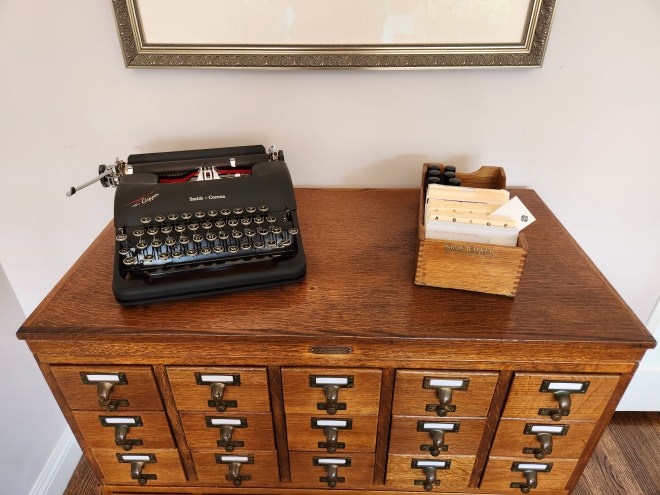
On the top of the catalog, in addition to space for writing notes, I’ll keep one of my two desktop card indexes and a 1948 Smith-Corona Clipper.
What would you do with a library card catalog?
Kardex: for when your analog #Zettelkasten grows too big for just a few filing cabinets and you’re ready to automate just a little bit of your slip finding work!
I’m in a book club (comprised of academics, historians, inveterate note takers, commonplacers, zettelkasten users, and lifelong learners) that is just starting the 1972 (or later) revised edition of Mortimer J. Adler and Charles van Doren’s How to Read a Book. Our first Zoom session covering chapters 1-5 is Saturday, September 9th at 8:00 am (Pacific). Email Dan with the details at the original listing to get the details for joining or DM me directly.
We’re pretty laid back, especially for Saturday mornings, so grab your favorite beverage and join us to talk about reading and intellectual history. If you’re joining late, feel free to stop by and join in knowing that you can catch up as we continue along for the coming month or so.
I’m just wrapping up a year of maintaining my bullet journal practice using index cards instead of the more popular notebook form factor. It’s heavily inspired by the century+ old Memindex method.
The sixth grade language arts class at the school in Altadena, CA, which my daughter attends, has a weekly set of vocabulary exercises which they keep in a simple composition notebook. Each week the teacher picks two vocabulary words (eg: passage, intelligent) and throughout the week the students fill in bits of knowledge about the word itself. On Monday they write down the word, a preliminary definition of it in their own words, a quick sketch or drawing of their perception of the word, and any prior knowledge they have of it. On Tuesday they revisit the words and look up dictionary definitions and write them down in their notebooks. On Wednesday they compose an original sentence using the words. Thursday finds them filling in spaces under each word with their morphologies, and variations with prefixes and suffixes. Finally on Friday they complete the weekly exercise by writing down synonyms and antonyms for the week’s words.
When I saw their notebooks at a recent open house night, it immediately reminded me of a now partially forgotten lexicographer’s and grammarian’s practices of excerpting (ars excerpendi) and collecting examples of sentences and words on slips of paper. Examples of this can be seen in the editing and creation of the Oxford English Dictionary, the Thesaurus Linguae Latinae (Latin for Thesaurus of the Latin Language), and the Wörterbuch der ägyptischen Sprache (German for Dictionary of the Egyptian Language).
I first became aware of the practice when reading Simon Winchester’s entertaining book The Professor and the Madman: A Tale of Murder, Insanity, and the Making of the Oxford English Dictionary. In the book , Winchester describes the pigeonhole and slip system that Oxford professor James Murray and collaborators used to create the Oxford English Dictionary (OED). The editors of the dictionary put out a call to readers to note down interesting everyday words they found in their reading along with example sentences and source references. They then collected these words alphabetically into pigeonholes and from here were able to collectively compile their magisterial dictionary which uses the collected example sentences. While tangentially about the creation of the OED, the heart of the fascinating story in the book focuses on Dr. William C. Minor, a Civil War veteran and a convicted murderer living in Britain in the Broadmoor Criminal Lunatic Asylum, who began a long written correspondence with James Murray by sending in over ten thousand slips with words from his personal reading. Many years went by between the two men before the dictionary editor realized that his collaborator was in an insane asylum. The 1998 book was ultimately turned into the 2019 movie starring Mel Gibson and Sean Penn.
Thesaurus Linguae Latinae
Somewhat similar to the compilation of the Oxford English Dictionary which predated it is the ongoing compilation of the Thesaurus Linguae Latinae (TLL). An academic research project begun in 1894 and projected to be finished by a team of international scholars sometime around 2050, the TLL is a massive dictionary written entirely in Latin which contains every instance of every known Latin word in every known medium (manuscripts, scrolls, artworks, coins, buildings, monuments, graffiti, etc.) from the beginning of the language down to the 2nd century CE and from then on, every lexicographically significant instance from that time until the 6th century CE.
The Thesaurus Linguae Latinae used the Meusel system for creating zettel (a German word meaning slip) by utilizing double folio sheets onto which they copied text in hectographic ink which can be reproduced by lithography before cutting them up into individual slips. It took approximately five years of collecting and excerpting material before the researchers of the TLL began writing “articles”, by which they mean individual entries in their dictionary of Latin words. Because of the time-consuming work to research and write individual articles, researchers are individually credited within the Thesaurus for their work on individual words.
Between the 2nd and 6th centuries CE, the Thesaurus Linguae Latinae doesn’t excerpt every single word in written Latin, just what the researchers thought was lexicographically significant. As an example, they didn’t excerpt all of Saint Augustine’s works because if they had, the collection would have been approximately 50% larger because Augustine was such a prolific writer.
The magisterial zettelkasten (German for slip box) which powers the Thesaurus Linguae Latinae is befittingly housed on the top floors of the Residenz, the former palace of the Bavarian royal family, now a part of the Bavarian Academy (Bayerische Akademie der Wissenschaften) in Munich, Germany.
An example slip in the TLL for the word “sentio”.
The slips in the TLL’s collection are organized alphabetically by headword (or catchword) in a box in the top right hand side of the card and then secondarily by their appearance or publication in chronological time, which is indicated in a box on the top left of each slip. The number of copies of each slip is written in the bottom left hand corner and circled. Within the text excerpts on the cards themselves, occurrences of the word are underlined in red.
Basic statistics regarding the Thesaurus:
comprised of approximately 55,000 ancient Latin vocabulary words
10,000,000+ slips
stored in about 6,500 boxes
with approximately 1,500 slips per box
excerpted from a library of 32,000 volumes
contributors: 375 scholars from 20 different countries, with:
12 Indo-European language specialists
8 romance language specialists
100 proof-readers
approximately 44,000 words published in their dictionary already
published content: 70% of the entire vocabulary
print run: 1,350 copies
Publisher: consortium of 35 academies from 27 countries on 5 continents
Longest remaining words which remain to be compiled into the dictionary
non / 37 boxes of ca. 55,500 slips
qui, quae, quod / 65 boxes of ca. 96,000 slips
sum, esse, fui / 54.5 boxes of ca. 81,750 slips
ut / 35 boxes of ca. 52,500 slips
As a point of comparison, the upper end of prolific academic researchers and note takers who use index card collections for their lifelong research (25-40 year careers) have compiled collections of 90,000 (Niklas Luhmann), 70,000+ (Gotthard Deutsch), 30,000 (Hans Blumenberg), 27,000+ (S.D. Goitein) and 12,500 slips (Roland Barthes). This means that there are individual Latin words in the TLL have more slips than these researchers produced in their research lifetimes.
A sample of the note cards being used to compile the TLL. Courtesy of Samuel Beckelhymer.
Living languages
While many think of Latin as a “dead language”, something one notices quickly about the articles in the TLL is that words changed meanings over the span of time which they were in use. Linguists call this change in word meaning over time semantic shift. Many articles focus on these subtle changes and different meanings over time. Often words with only a few hundred attestations in the corpus of the language will be quoted and cited in articles about them with every example of use along with their contexts to help highlight these subtleties. Just like people had the choice of which words to use in the ancient world, we have those same choices today and this is where the use of modern dictionaries and thesauruses can make our words and word choices more exciting.
Normally, a dictionary just tells you what words mean—and of course we do that—but the scale of the project gives us the space and opportunity to say what we’re not sure of too. This is important because it leaves the door open for further scholarship and it gives the reader choices rather than dictating to them what to think. The dictionary can be a catalyst for more research and this is what makes the dictionary a living thing.—Adam Gitner, a TLL scholar
For those interested in more details on the TLL, Kathleen Coleman’s presentation on YouTube is a fantastic resource and primer on what is in it, how they built it and current work:
TLL Podcast and the Wordhord
Based on the history and usage of the Latin word horreum, which is featured in the first episode of the Thesaurus Linguae Latinae podcast, I can’t help but think that not only is the word ever so apropos for an introduction to some of the TLL, but it does quite make an excellent word for translating the idea of card index in English or Zettelkasten from German into Latin: “My horreum is a storehouse or treasury for my thoughts and ideas which nourishes my desire to discover and build upon my knowledge.” One might also notice that the Latin word horreum is also cognate with the fun Old English word “wordhord” that one encounters in classics like Beowulf and which roughly translates as one’s brain or their memory, especially for words.
Wörterbuch der ägyptischen Sprache (A Dictionary of the Egyptian Language)
Like the Thesaurus Linguae Latinae the Wörterbuch der ägyptischen Sprache was an international collaborative zettelkasten project. Started in 1897, it was finally published as five volumes in 1926.
The structure of the filing system for the Wörterbuch der ägyptischen Sprache (Wb) was designed based on the work done for the Thesaurus Linguae Latinae started three years earlier. Texts in the collection were roughly divided into passages of about 30 words and written in hieroglyphic form on postcard-sized slips of paper. The heading contained the designation of the text and the body included the texts’ context (inscriptions, etc.) as well as a preliminary translation of the passage.
These passages were then cross-referenced with other occurrences of the hieroglyphics to provide better progressive translations which ultimately appeared in the final manuscript. As a result some of the translations on the cards were incomplete as work proceeded and cross-comparisons of individual words were puzzled out.
A slip showing a passage of text from the victory stele of Sesostris III at the Nubian fortress of Semna. The handwriting is that of project leader Adolf Erman, who had “already struggled with the text as a high school student”.
With support from the German Research Foundation, the 1.5 million sheets of the Wörterbuch der ägyptischen Sprache began to be digitized and put online in 1997. The Digitized Card Archive (DZA) of the Dictionary of the Egyptian Language (Wörterbuch der ägyptischen Sprache) has been available on the Internet since 1999. The archive can be searched at: https://aaew.bbaw.de/tla/servlet/DzaIdx. Since 2004, the materials and query functions have been integrated into the larger Thesaurus Linguae Aegyptiae project at https://aaew.bbaw.de/thesaurus-linguae-aegyptiae.
Wörterbuch der ägyptischen Sprache by Adolph Erman and Hermann Grapow can be viewed online using the Wb. browser at https://aaew.bbaw.de/tla/servlet/WbImgBrowser. Links from reference points within the dictionary go directly to corresponding slips of paper in the digitized slip archive.
Although he’s a fictional character, given one could suppose that given his areas of specialization in archaeology, Indiana Jones would certainly have been aware of the Wörterbuch, would likely have used it, and may even have worked on it as a young college student.
The method used for indexing the Wörterbuch der ägyptischen Sprache and the Thesaurus Linguae Latinae is now generally known as a key word in context (KWIC) index. The design of these sorts of indices is now a subject within the realm of computer science and database design. Given that the work on the TLL has taken over 100 years, could it be possible that digital versions might speed up the process of excerpting, collating, and writing articles in the future? Perhaps these examples might be used for compiling other languages in the future.
Modern day practice: Wordnik and Hypothes.is
Having looked at some historical word and idea collecting practices, how might one do this sort of work in a modern, digital world? A similar word collecting scheme is currently happening on the internet now, though perhaps with a bit more focus on interesting neologisms (and hopefully without many insane asylum patients.) The lovely folks at the online dictionary Wordnik have been using the digital annotation tool Hypothes.is to collect examples of words as they happen in the wild. One can create a free account on the Hypothes.is service and quickly and easily begin collecting words for their dictionary efforts by highlighting example sentences and tagging them with “wordnik” and “hw-[InsertFoundWordHere]”.
To create accurate animations, we generate the speech, run it through our in-house speech recognition and pronunciation models, and get the timing for each word and phoneme (speech sound). Each sound is mapped onto a visual representation, or viseme, in a set we designed based on linguistic features.
So I clicked on my handy browser extension for Hypothes.is, highlighted the sentence with a bit of context, and tagged it with “wordnik” and “hw-viseme”. The “hw-” prefix ostensibly means “head word” which is how lexicographers refer to the words you see defined in dictionaries.
Then the fine folks at Wordnik are able to access the public annotations matching the tag Wordnik, and use Hypothes.is’ API to pull in the collections of new words for inclusion into their ever-growing corpus of examples. Lexicographers can then use examples of words appearing in context to define, study, and research their meanings and their shifts in meaning over time.
Since I’ve collected interesting new words and neologisms for ages anyway, this has been a quick and easy method of helping out other like-minded wordhoarders along the way. (Note how this last sentence has brought wordhord back into more active usage with a tinge of shift?!) In addition to the ability to help out others, a side benefit of the process is that the collected words are all publicly available for reading and using in daily life! You can not only find the public page for Wordnik words on Hypothes.is, but you can subscribe to it via RSS to see all the clever and interesting neologisms appearing in the English language as collected in real time! So if you’re the sort who enjoys touting new words at cocktail parties, a rabid cruciverbalist who refuses to be stumped by this week’s puzzle, or a budding lexicographer yourself, you’ve now got a fantastic new resource! I’ve found it to be far more entertaining and intriguing than any ten other word-of-the-day efforts I’ve seen in published calendar or internet form.
The basic pedagogic exercise I’ve described above is an incredibly solid base for nearly any school-aged child. But with some of the historical context we’ve explored, the weekly word notebook exercise could be expanded. Some could be done during the week while others could be done at a later date/time, which could serve as potential (spaced repetition) reminders to students as they see words throughout the year potentially for bonus points.
What is the earliest attestation (evidence or proof of existence) of a word?
Can students find attestations of their words during their weekly reading or reading later in the year?
What is the word’s etymology? What other words sound like it or are related to it? What words are cognate to it in other languages they might be studying/learning? These could be collected too.
What new and interesting words are students coming across that they haven’t seen before in their own reading? Bonus points for doing additional words they find themselves, or add them to the queue of the words the teacher assigns on future weeks.
Double bonus points for finding new words in their reading that are neologisms which aren’t in the dictionary yet. Can they find and add words to the Wordnik dictionary using Hypothes.is?
Instead of using a notebook for their supplemental wordhord, students might try the older practice of keeping their words on index cards and storing them in a zettelkasten just like the OED, the TLL, or the Wb. A shoebox works nicely and can be fun to decorate, but there are fancier boxes out there. Here they might also be used as flashcards for occasional review. Students can index them alphabetically and perhaps their example sentences may come in handy later in life while they’re doing their own writing (see Draft No. 4 and boxing words.) Perhaps their collections will come in handy at the end of high school when they take the SAT or the ACT tests? Might their collections rival those of famed academics like Niklas Luhmann, Gotthard Deutsch, Hans Blumenberg, S.D. Goitein or Roland Barthes? Maybe they’ll become professional lexicographers and help to finish up work on the TLL later in life?
For a fun math exercise, can students calculate how long it would take them (individually or as a class) to copy out 10,000,000 slips for their words at the pace of two or three words a week? How many notebooks would this require? Would they fit into their classroom? their house, their library, or their school?
What other ideas might one add to such a classroom exercise?
Winchester, Simon. The Professor and the Madman: A Tale of Murder, Insanity, and the Making of the Oxford English Dictionary. 1st ed. New York: Harper, 1998.
Hugh McLeod’s original cartoon of Information vs Knowledge which was later extended by David Somerville is actually a very solid representation of much of what many sensemaking workflows look like including the process of making and maintaining a Zettelkasten for writing. It could also be an active representation of Bloom’s Taxonomy.
I’ve been watching a growing number of teachers, professors, and researchers who have been transferring their personal note taking, zettelkasten, or personal knowledge management practices into the classroom for students from 6th or 7th grade up into college/university level. As it’s been a while since this practice was more commonplace (excuse the pun), perhaps it could be useful (and fun) to do a meetup or mini-unconference on the topic to discuss some ideas, practices, and pedagogy?
Format
Depending on everyone’s general availability, we could do something on a quiet day over the summer break? I’m thinking something in the 2-4 hour range depending on the level of interest and what folks think would be most productive. At the lower end we could do a few hours as a simple meetup/discussion if there are 10 or fewer, though if there is more interest, then I’m thinking that a BarCamp style (unconference) may be easier with 3-4 sessions of about 45 minutes each and to which people submit various ideas at the start of “camp” and folks can decide what ideas they’re interested in supporting or exploring. (If you’ve never attended an unconference or BarCamp style event, this IndieWeb page and related pages will give you a bit of an idea of what to expect, though we’ll do a much more scaled down version. I’m also a fan of their Code of Conduct, and propose to adopt it for participants.)
Given the potential time zone differentials across Europe and the Americas across which most practitioners I know live, I’ve found that Saturday morning starts at 8:30 AM Pacific have been historically most convenient, but I’m not opposed to an weekday timeslot if that’s more preferrable with a majority of schedules.
If there’s enough interest I’m happy to help facilitate something 2-3 times a year in smaller doses. We can start small and informal and expand as necessary.
Interest?
If this is something in which you’d be interested in doing, please drop a comment on my website or send me an email (you’ll find it on my homepage). Let me know the following:
Range of referred dates/times along with any major vacation plans we might work around
Interest in leading a BarCamp session? Topics? Do you have a presentation/experience you’d like to present (even if it’s totally informal)?
Your area/level of teaching (elementary, middle school, high school, undergraduate, graduate, other) and institution — schedule-wise, I’d like to give the most preference to active educators, though I’m sure we’ll attract participants interested in the broader idea of ZK/PKM.
Would you like to help volunteer time/resources to mounting this as an online only event?
Other ideas? Needs?
My goal for a first session is to be highly creative and get ideas/discussions of experiences/improvements flowing with the minimal amount of organization and work on the part of all participants. I would hope this would be more fun for the prospective group than work.
Background
I’ve been collecting examples of teachers/professors who used their zettelkasten for teaching, some of which include Mario Bunge, Frederic L. Paxson, Gotthard Deutsch, Roland Barthes, and Joachim Jungius. In more recent contexts, I’ve seen Dan Allosso (aka u/danallosso), Mark Robertson (aka @calhistorian u/calhistorian), Nick Santalucia, and Sean Graham using zettelkasten or linked notes using Obsidian, Roam, etc. for either directly teaching, teaching students how to start such a practice, or using it for OER related practices. I’ve also heard from a few who are planning on offering coursework with zettelkasten underpinned pedagogy in the near future.
Do you know of others who are practicing and implementing these methods? Those who plan to in the coming year? Please forward this along and we’ll see what we can arrange based on the level of interest.
 Letterform Archive (@letterformarchive@typo.social) (typo.social)