West coast - class of ‘96 represents at WordCamp Santa Clarita! #wcscv with @ecotechie pic.twitter.com/GebIJWXQgn
— Joseph Dickson (@joe4ska) April 7, 2019
Month: April 2019

Reflections on WordCamp Santa Clarita Valley 2019
I really had a grand time at WordCamp Santa Clarita Valley yesterday. I’d like to thank the visionary Joe Simpson, Jr. and his entire group of fantastic organizers and kind volunteers for putting the entire thing together. I couldn’t imagine a better launch for a brand new camp.


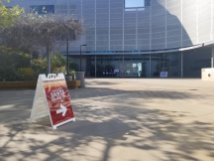



College of the Canyons was a fantastic location for the camp and even had some excellent outdoor patio and dining space for lunch.
I do wish I’d been able to make my schedule work out to have been able to attend on Friday. I’m particularly bummed that I didn’t get to see Glenn Zucman’s presentation as he’s always doing some of the most interesting and creative things with WordPress. I’ll wait patiently for WordPress.tv to deliver it for me.
Some of my favorite highlights:
- David Nuon wearing a blonde Richard Dean Anderson wig during his talk MacGyver plays with blocks: Using the Gutenberg editor in new and surprising ways
- Chatting with Kat Christofer of Woo Commerce about how she and the Woo team create better documentation for their product. I think there’s some things we can learn for documenting pieces of the IndieWeb experience with WordPress. She also mentioned the beginning of a new short Mustang road trip.
- Joseph Dickson going old school on Upgrading Kubrick for Gutenberg. His highlighting the fact that the editor is able to better mirror the ultimate output as a time saver is an intriguing idea.
- Not that they aren’t always in general, and I didn’t think about it until reflecting on it today, but I also want to mention the spectacular diversity of speakers and attendees at the camp. It really made for a better and more well-rounded experience. I’ll give all the credit to Joe and his team who I suspect are directly responsible for designing it to be that way from the very beginning.
On a more personal level, my two favorite parts included: Seeing the viceral reactions of a handful of people as the proverbial light switch was turned on when they realized the power and flexibility of the posting interfaces provided by micropub clients during my talk. There was also a palpable rush at the end while using a few minutes of extra time demoing some examples of my website and and the power of Micropub, Webmention, and backfeed along with some other IndieWeb goodness. I’ve already had a number of people following up with additional questions, conversations, and emails.
For those who may have missed them, here is a link to my slides from the Micropub and WordPress talk and a link to some of the bigger pieces I’ve wrtitten about with respect to WordPress and IndieWeb technologies in the past. Naturally, these are only a supplement to the hundreds of others who are working in and documenting the space.
I’ll also give a special thanks to Joseph Dickson for the photo/tweet of me just before the talk:
Micropub Rocks! With @ChrisAldrich @wordcampscv #WCSCV learning about “Micropub and WordPress: Custom Posting Applications” pic.twitter.com/MQnOTFFkWY
— Joseph Dickson (@joe4ska) April 6, 2019
Dr. Dianne G. Van Hook University Center on the campus of College of the Canyons
Inside the Hook University Center where WordCamp Santa Clarita Valley 2019 was held
Clear signage directs pedestrians to WordCamp Santa Clarita at Hook University Center
The afterparty for WordCamp Santa Clarita was held at Draconum in Newhall
WordCampers from Santa Clarita gathering on the outdoor patio at Draconum

Joseph Dixon, Erik Blair
 Sergio Scabuzzo
I’m not far away over in Pasadena, so I’m sure we’ll bump into each other at upcoming local Camps. Happy to have coffee and chat outside of that. Let me know if you have any Micropub or #IndieWeb related questions.
❤️ scott_gruber tweeted Excellent deck intro to #indieweb, Micropub & WordPress
 Scott Gruber (Twitter)
Excellent deck intro to #indieweb, Micropub & WordPress - Google Slides via @ChrisAldrich https://t.co/0yFaqH6tcG
— Scott Gruber (@scott_gruber) April 7, 2019
Following Association for Learning Technology
The Association for Learning Technology (ALT) represents individual and organisational Members from all sectors and parts of the UK. Our Membership includes practitioners, researchers and policy makers with an interest in Learning Technology. Our community grows more diverse as Learning Technology has become recognised as a fundamental part of learning, teaching and assessment.
Our charitable objective is "to advance education through increasing, exploring and disseminating knowledge in the field of Learning Technology for the benefit of the general public". We have led professionalisation in Learning Technology since 1993.
How we define Learning Technology
We define Learning Technology as the broad range of communication, information and related technologies that can be used to support learning, teaching and assessment. Our community is made up of people who are actively involved in understanding, managing, researching, supporting or enabling learning with the use of Learning Technology. We believe that you don't need to be called 'Learning Technologist' to be one.
What we value and what we do
Our current strategy sets out our aims for 2017-2020:
Increasing the impact of Learning Technology for the wider community, strengthening recognition and representation for the Membership at a national level and leading professionalisation for individual Learning Technology professionals in a broad range of roles.
You can explore the strategy slides, download the full text in PDF or Google docs. Visual content is available on Flickr.

Following Virtually Connecting
Enhancing the virtual event experience
The purpose of Virtually Connecting is to enliven virtual participation in academic conferences, widening access to a fuller conference experience for those who cannot be physically present at conferences. We are a community of volunteers and it is always free to participate.
Using emerging technologies, we connect onsite conference presenters and attendees with virtual participants in small groups. This allows virtual conference participants to meet and talk with conference presenters and attendees in what often feels like those great spontaneous hallway conversations, something not usually possible for a virtual experience. There is only room for 10 in each session but we record and, whenever possible, live stream, to allow additional virtual attendees to participate in the discussion by listening and asking questions via Twitter.

👓 In San Francisco, Making a Living From Your Billionaire Neighbor’s Trash | New York Times
In a city swollen by the wealth of the tech industry, the rich and poor live very separate lives. But sometimes they connect through the garbage.
👓 Right Here, in Santa Clarita | WordCamp Santa Clarita
Thank You. You’ll never realize how much April 5 and April 6 meant to our fledgling WordPress Community here in Santa Clarita. Imagine, having your best friends AND the WordPress world descending on our north Los Angeles County valley, sharing twenty-four informative and entertaining sessions, gre...
Thank you Joe!
👓 Logos in Slide Decks and WordCamp Videos | Make WordPress Communities
A while ago, there was a discussion about the use of logos in slide decks and WordCamp videos. A consensus was reached as to what the permitted guidelines should be, but this was never documented i…
I did notice few presentations at Camp this weekend that were overly busy and had too much corporate logo splayed all over them. I can definitely be a bit too much.
👓 Push notifications with Indigenous | realize.be
 swentel (realize.be)
Indigenous for Android has a new home. To celebrate, a new release is out which allows you to receive and send Push notifications! #indieweb https://realize.be/blog/push-notifications-indigenous
This is awesome!
 Den McHenry (denmchenry.com)
Not exactly, but who can resist writing a "considered harmful" article when you can get away with it?
The real harm is that you can very easily conceal the semantics conveyed by
font-weightdepending on the font that's rendered, which is not always in your control. This all depends on how you define the base weight to which your relative values refer, and (1) whether that base weight is actually available in the rendered font and (2) which value is substituted if it isn't.
You get a webmention, and you get a webmention, and…

 The second URL resolves to the page on which the annotation was made and both will automatically open up Hypothesis’ side drawer UI to the annotation in question and will–on most browsers–auto-scroll down the page to show the point at which the annotation was made. Essentially this second URL shows the annotation in-situ in conjunction with the Hypothes.is user interface. I’ll note that they can also have some human readable trailing data in the URL that indicates the site on which the annotation was made like so:
 👓 Trump is removing US Secret Service director | CNN
United States Secret Service director Randolph "Tex" Alles is being removed from his position, multiple administration officials tell CNN.
👓 4+1 Interview: Kate Owens | Robert Talbert
Kate Owens of the College of Charleston talks about mastery grading, innovative teaching in a historic institution, and more.
👓 The Death of an Adjunct | The Atlantic
Thea Hunter was a promising, brilliant scholar. And then she got trapped in academia’s permanent underclass.