Merchants and traders have a waste book (Sudelbuch, Klitterbuch in German I believe) in which they enter daily everything they purchase and sell, messily, without order. From this, it is transferred to their journal, where everything appears more systematic, and finally to a ledger, in double entry after the Italian manner of bookkeeping, where one settles accounts with each man, once as debtor and then as creditor. This deserves to be imitated by scholars. First it should be entered in a book in which I record everything as I see it or as it is given to me in my thoughts; then it may be entered in another book in which the material is more separated and ordered, and the ledger might then contain, in an ordered expression, the connection sand explanations of the material that flow from it. [46]
—Georg Christoph Lichtenberg, Notebook E, #46, 1775–1776, as translated in Georg Christoph Lichtenberg: Philosophical Writings
In this single paragraph quote from his own notebook, Lichtenberg, using the model of Italian bookkeepers of the 18th century, broadly outlines almost all of the note taking technique suggested by Sönke Ahrens in How to Take Smart Notes.
While he doesn’t use the same terms, he encourages writing down and keeping fleeting notes as well as literature notes. (Keeping academic references would have been commonplace by this time.) He follows up with rewriting and expanding on the original note to create additional “explanations” and even “connections” (links) to create what Ahrens describes as permanent notes or which some would call evergreen notes.
Lichtenberg’s version calls for the permanent notes to be “separated and ordered” and while he may have kept them in book format himself, it’s easy to see from Konrad Gessner’s suggestion at the use of slips centuries before, that one could easily put their permanent notes on index cards (“separated”) and then number and index or categorize them (“ordered”).
The only serious missing piece of Luhmann’s version of a zettelkasten then are:
the ideas of filing related ideas nearby to each other, though the idea of creating connections between notes is immediately adjacent to this, and
his numbering system, which was broadly based on the popularity of Melvil Dewey’s decimal system and early 20th Century German filing practices (Aktenzeichen).
It may bear noticing that John Locke’s indexing system for commonplace books was suggested originally in French in 1685, and later in English in 1706. Given it’s popularity, it is not unlikely that Lichtenberg would have been aware of it.
Further, given that Lichtenberg’s very popular published waste books were known to have influenced Leo Tolstoy, Albert Einstein, Andre Breton, Friedrich Nietzsche, and Ludwig Wittgenstein, it would not be hard to imagine that Niklas Luhmann would have also been aware of them.
This short paragraph certainly says something interesting about the note taking methods of Lichtenberg’s time.
References
Lichtenberg, Georg Christoph. Georg Christoph Lichtenberg: Philosophical Writings. Edited and translated by Steven Tester. SUNY Series in Contemporary Continental Philosophy, 1.0. State University of New York Press, 2012
Lichtenberg, Georg Christoph (2000). The Waste Books. New York: New York Review Books Classics. ISBN 978-0940322509.)
Open questions
Did Lichtenberg number the entries in his own (original) waste books? This would be early evidence toward the practice of numbering notes for future reference. Based on this text, it’s obvious that the editor numbered the translated notes for this edition, were they also Lichtenberg’s numbering, or added later by other scholars/editors?
Is there evidence that Lichtenberg knew of Locke’s indexing system? Did his waste books have an index?
In a quest to expand on my analog office practices, last Saturday, I drove out to Rancho Cucamonga to purchase a spectacular midcentury Gaylord Bros., Inc. modular library card catalog. I spent parts of the week making some minor tweaks (gluing some broken wood rails) and cleaning it up in the garage. Last night, as a present and to celebrate the start of Autumn, I brought it into the house to reassemble it. It now lives in the dining room adjacent to the the office and near both the bar as well as the library that others in the household prefer to call our formal living room. I honestly didn’t pre-plan it this way, but given our floorplan, it is sitting in the “heart” of our home.
Three of the four sections are all similarly made out of oak and appear to be co-contemporaneous in terms of style and materials (solid wood and metal). The final section, a five drawer insert is obviously of later manufacture and while stained brown with what appears to potentially be a mahogany frontispiece, has plastic trays with metal fittings and what appear to be galvanized steel card stops. The other sections comprise a low level table-like support with four legs; a 5×3 drawer section; and a 2 inch thick top which covers the holes in the top of the modular drawer sections and provides a flat surface. The top section also features the traditional Gaylord Bros., Inc. name plate.
Given the subtle intricacies of the construction, I’ll provide some photos of how the pieces dovetail together as well as the smaller mechanics and features in a future post.
Fully assembled the piece is 33″ wide x 17 3/8″ deep and stands 36 1/2″ tall. With internal drawer space of 13 3/4″ for the 15 drawers and 14 1/2″ for the other 5, there should be space for approximately 38,715 index cards.
I’m thrilled that all the fittings seem to be original, and all the drawers have their original card catalog rods. The drawers on the 5×3 drawer section have a spring loaded mechanism under the front of the drawer which when pushed to the left side unlocks the card catalog rods which have beefy brass knobs. The 5×1 drawer section rods are unlocked by pulling up on them slightly from the bottom and then pulling them straight out.
I’ll have to do some more in-depth research of old Gaylord Bros. catalogs, but based on materials, manufacture, and style, I’m going to guess that the older portion of the card catalog dates from the mid-30s to the 1940s, while the newer section is likely late 60s. The overall size and standardized, modular structure allows the pieces to sit together in quite a clever way and were made over a long enough period of time that different pieces from disparate decades still work well together. While the wood grain, stain, and even fittings are all slightly different, the to different styles work fairly well together.
For those who appreciated my recent article Market analysis of library card catalogs in 2023, I’m thrilled to report that I purchased this stunning beauty—one of the prettiest, oldest, and best conditioned catalogs I’ve seen listed—for a very reasonable $250. I suspect the seller, who is a vintage collector, seasoned eBay seller, and is well aware of the market, may have gone even lower, but I was happy to overpay a little. Given the online market, something like this would usually list for between $1,200 and $1,600, but would likely sit unsold and unloved for years.
I love the style and the condition, and it does make for a fantastic little piece of fine furniture with a lovely patina. Unexpectedly, someone else in the house may be even more enamored of it than I, which bodes well for its actual long term care and use. Currently it will serve as an archive storage for some of my 3 x 5″ index card note collection in addition to storage of a partial library card cataloging for some of our physical books. I also have cards from an older rolodex and a small recipe collection that will take up residence. Other empty drawers will house a small wine selection along with several bottles of scotch until they’re pushed out by the growing collection of cards.
Surely this is what Hemingway would have done?!
Other than general maintenance I don’t think I’ll be doing any other restoration work on it beyond the small fixes I’ve already made.
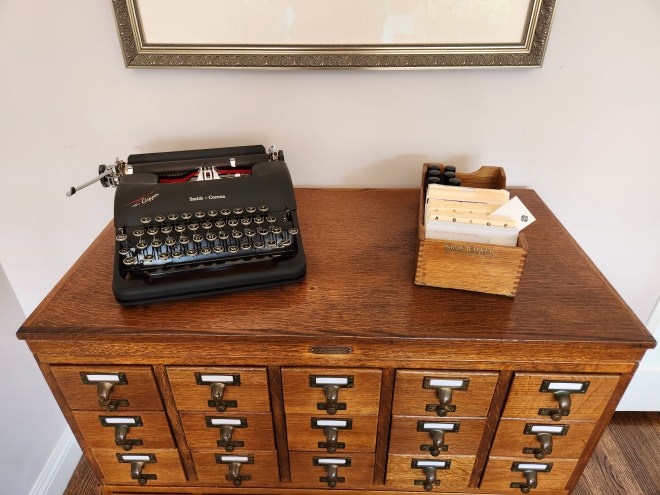
On the top of the catalog, in addition to space for writing notes, I’ll keep one of my two desktop card indexes and a 1948 Smith-Corona Clipper.
As card catalogs lost their functionality in libraries and were de-acquisitioned there was a wave of nostalgia which caused people to purchase them, often in auctions, at higher than expected prices. Once they had them, most of these purchasers realized that they didn’t have functional uses in their homes for them (beyond wine or liquor bottle storage, small crafts, or use as a zettelkasten, which seem to be the only reasonable upcycling use cases I’ve seen and the last seems to be very rare and niche). They sit and take up space for very little value in return beyond some esthetic beauty and nostalgia. As a result many soured on their ownership. Most owners naturally want to recoup their original purchase price thinking that relative rarity will save them.
Combined with this there was a resurgence in mid-century design esthetic which had some furniture restorers and designers buying and doing full (and very pretty) expensive restorations of older 20s-40s versions which sold at auctions for $4,500 and up. Given the rarity of some of these older, fine furniture versions along with the work in restoration and the limited market only those who had a tinge of nostalgia and money to burn made purchases which resulted in a limited number of actual sales.
These two factors mean that almost all of the listings for library card catalogs are heavily overvalued on eBay, Facebook Marketplace, Craig’s List, Etsy, etc. The fine furniture restorations have set an artificially high price point which some feel theirs must match as well. The difference in quality however is stark. Because of their size and lack of functionality, there is a relative glut of them on the market which all bear inflated prices. Those who originally spent inordinate amounts for them, feel they will still have that same value to others, so they list them online for inflated prices.
I’ve been closely watching the online “market” for them for over a year and see the same several dozen or more listed across the country usually in the range of about $30-$60 per drawer. Many are listed as local pick up only, which further hampers the overall market. This also brings up the issue of shipping a 60 drawer card catalog which can easily run in the $800-$1,500+ range which usually requires additional shipping logistics involved with freight. Most catalogs are already overpriced, but adding an additional $1000 tax on top is a bridge too far for all but the highest end of the market. Some platforms like Etsy and eBay which take cuts of the final sale also add to the cost of the sale (at least to the owner).
In the year and a half or more that I’ve been watching, I’ve only seen a handful of actual sales, all of which were local, and many of which were in the Los Angeles area. All of these sales have been for listings which eventually were reduced down to the $15 per drawer range. One local sale was in Wisconsin was for $10 per drawer (a 30 drawer file) and another in Los Angeles was for $12.50 per drawer (on a 20 drawer file).
A note on condition
Outside of a small handful of fine furniture listings in the $4,000+ range, most ex-Library card catalogs are generally very well worn and not in great condition which makes them less valuable as decoration pieces. In fact, many are often missing their original card catalog rods, have dents, dings, or other cosmetic issues. Some are missing drawers or have replacement drawers which don’t match. Some may be slightly mismatched having been purchased in different eras as modular pieces and put together. Frequently they have been modified from their original states to include inserts or other material to fill in the holes which where almost standard in the bottoms of the drawers.
Advice
If you’re in the market, know that it is tremendously inflated, a fact which most sellers are aware of as they’ve got them listed, some for many years, not resulting in actual sales. If you really want one and find it in a reasonable condition, I highly recommend making an offer for it at about $10 per drawer and potentially go up to $15. Anything higher than that is overpaying based on actual recent market conditions. If you have the money to burn, feel free, but keep in mind that like many others in the past, once the initial nostalgia has passed, you’ve probably got a large piece of relatively non-functional furniture in your home.
It’s not common, but some government auction sites will list card catalogs for auction from time to time. Because they actively want to sell them these can be purchased in the $2-10 per drawer range or less. Often they tend toward the larger 60+ drawer range, aren’t in good condition, or need to be picked up and shipped to your final destination, usually within a few days of purchase as the original owners don’t or explicitly won’t handle shipping. These are likely to need some restoration work to be decorative pieces in many homes.
If you want something brand new, you can check out Brodart, which is the only remaining card catalog manufacturer/sales firm I’m aware of in the United States. Their systems are modular, so you can pick and choose what you’d like to have. The only caveat is that they start at $1,700 for their smallest 9 drawer model and can go up to $11,648 (plus shipping) for a full 60 drawer model. The other potential drawback, for some, is that they are made of a mixture of wood, metal and plastic versus the all wood and metal fittings of older vintage models.
If you’re in the market primarily for nostalgic reasons, then you might also consider looking at some of the older desktop wooden card catalogs which are often much less expensive, take up far less space, and can be wonderfully decorative. Some of the smaller two to six drawer desktop models have the benefit of potentially serving as recipe boxes or paper rolodexes, zettelkasten, or simply small office storage. Here again, the online markets are likely to be heavily overpriced with 2 drawer models being continually listed at $150 and 4 drawer models in the $250-400 range. These sellers know that these prices don’t result in actual sales as they’ve been sitting on them for long periods of time (presumably hoping to get lucky). Here I’d recommend you make offers in the $20-30 per drawer range to see what you can find. Another benefit is that these smaller models are far cheaper to ship across the country. For additional advice on these, see: The Ultimate Guide to Zettelkasten Index Card Storage.
While doing this, I’ve had a hard target search for available card index files for the better part of two years. I’ve purchased a large metal one and a small handful of open wooden desktop models.[1][2] I’ve shied away from some of the wooden 2-6 drawer models because they’re listed for exorbitant prices on eBay, Facebook Marketplace, Craigslist, and other online retailers where sellers think they’re worth far more than they really are. Hint: you’ll find lots of listings, but you won’t see very many actual sales—a good indication that the market is dramatically overpriced.
However, this past week I saw a reasonable listing for a two drawer quarter sawn Shaw-Walker card index made for 4×6″ index cards for $32.95. Since cardboard boxes sell for almost $20 each, I couldn’t pass up the opportunity, so I made the minimum bid and naturally won the auction uncontested.
The box showed up yesterday afternoon and had roughly the wear I expected it would. It took some serious elbow grease, but I managed to clean about a half century of dirt and grime off of it, and it looks significantly better already. I don’t think I’ll do a full refurbishment of it, preferring to appreciate some of the natural patina. I will probably give it another solid cleaning later this week and then a coating of wax or furniture polish to shine it up. I’m wavering on polishing what I suspect are probably bronze drawer pulls and leaving their dark oxidized beauty.
For a small, solid wooden box, it does bring an inordinate amount of joy.
While showing some wear, particularly to the top, it still has most of its original Shaw-Walker gilded logo. The box is 15 5/8 x 14 11/16 x 6 3/8 inches, 14.6 pounds, and each drawer has 11 3/4 inches of space for cards, so it should comfortably fit about 3,300 index cards. I intend to use it as my day-to-day desktop card index and split the two drawers between my card-based productivity system (based on the Memindex) and my zettelkasten practice. The balance of my notes will go into either my Arca Studiorum or possibly another metal card index I’ve had my eye on for a while, but which needs some significant restoration.
In addition to the thrill of having a new analog piece of office equipment, another unexpected benefit it will impart by being on my desk is that it seems to be just the perfect sort of height for placing my laptop onto so that my camera is just that little bit higher for better video conference call framing. Now I won’t need to drag down the dictionaries or Wolfram’s New Kind of Science off the shelf anymore.
Coda: I just made a purchase of two wooden library card charging trays which will hopefully arrive later this week. More on that after they arrive…
I’m just wrapping up a year of maintaining my bullet journal practice using index cards instead of the more popular notebook form factor. It’s heavily inspired by the century+ old Memindex method.
The sixth grade language arts class at the school in Altadena, CA, which my daughter attends, has a weekly set of vocabulary exercises which they keep in a simple composition notebook. Each week the teacher picks two vocabulary words (eg: passage, intelligent) and throughout the week the students fill in bits of knowledge about the word itself. On Monday they write down the word, a preliminary definition of it in their own words, a quick sketch or drawing of their perception of the word, and any prior knowledge they have of it. On Tuesday they revisit the words and look up dictionary definitions and write them down in their notebooks. On Wednesday they compose an original sentence using the words. Thursday finds them filling in spaces under each word with their morphologies, and variations with prefixes and suffixes. Finally on Friday they complete the weekly exercise by writing down synonyms and antonyms for the week’s words.
When I saw their notebooks at a recent open house night, it immediately reminded me of a now partially forgotten lexicographer’s and grammarian’s practices of excerpting (ars excerpendi) and collecting examples of sentences and words on slips of paper. Examples of this can be seen in the editing and creation of the Oxford English Dictionary, the Thesaurus Linguae Latinae (Latin for Thesaurus of the Latin Language), and the Wörterbuch der ägyptischen Sprache (German for Dictionary of the Egyptian Language).
I first became aware of the practice when reading Simon Winchester’s entertaining book The Professor and the Madman: A Tale of Murder, Insanity, and the Making of the Oxford English Dictionary. In the book , Winchester describes the pigeonhole and slip system that Oxford professor James Murray and collaborators used to create the Oxford English Dictionary (OED). The editors of the dictionary put out a call to readers to note down interesting everyday words they found in their reading along with example sentences and source references. They then collected these words alphabetically into pigeonholes and from here were able to collectively compile their magisterial dictionary which uses the collected example sentences. While tangentially about the creation of the OED, the heart of the fascinating story in the book focuses on Dr. William C. Minor, a Civil War veteran and a convicted murderer living in Britain in the Broadmoor Criminal Lunatic Asylum, who began a long written correspondence with James Murray by sending in over ten thousand slips with words from his personal reading. Many years went by between the two men before the dictionary editor realized that his collaborator was in an insane asylum. The 1998 book was ultimately turned into the 2019 movie starring Mel Gibson and Sean Penn.
Thesaurus Linguae Latinae
Somewhat similar to the compilation of the Oxford English Dictionary which predated it is the ongoing compilation of the Thesaurus Linguae Latinae (TLL). An academic research project begun in 1894 and projected to be finished by a team of international scholars sometime around 2050, the TLL is a massive dictionary written entirely in Latin which contains every instance of every known Latin word in every known medium (manuscripts, scrolls, artworks, coins, buildings, monuments, graffiti, etc.) from the beginning of the language down to the 2nd century CE and from then on, every lexicographically significant instance from that time until the 6th century CE.
The Thesaurus Linguae Latinae used the Meusel system for creating zettel (a German word meaning slip) by utilizing double folio sheets onto which they copied text in hectographic ink which can be reproduced by lithography before cutting them up into individual slips. It took approximately five years of collecting and excerpting material before the researchers of the TLL began writing “articles”, by which they mean individual entries in their dictionary of Latin words. Because of the time-consuming work to research and write individual articles, researchers are individually credited within the Thesaurus for their work on individual words.
Between the 2nd and 6th centuries CE, the Thesaurus Linguae Latinae doesn’t excerpt every single word in written Latin, just what the researchers thought was lexicographically significant. As an example, they didn’t excerpt all of Saint Augustine’s works because if they had, the collection would have been approximately 50% larger because Augustine was such a prolific writer.
The magisterial zettelkasten (German for slip box) which powers the Thesaurus Linguae Latinae is befittingly housed on the top floors of the Residenz, the former palace of the Bavarian royal family, now a part of the Bavarian Academy (Bayerische Akademie der Wissenschaften) in Munich, Germany.
An example slip in the TLL for the word “sentio”.
The slips in the TLL’s collection are organized alphabetically by headword (or catchword) in a box in the top right hand side of the card and then secondarily by their appearance or publication in chronological time, which is indicated in a box on the top left of each slip. The number of copies of each slip is written in the bottom left hand corner and circled. Within the text excerpts on the cards themselves, occurrences of the word are underlined in red.
Basic statistics regarding the Thesaurus:
comprised of approximately 55,000 ancient Latin vocabulary words
10,000,000+ slips
stored in about 6,500 boxes
with approximately 1,500 slips per box
excerpted from a library of 32,000 volumes
contributors: 375 scholars from 20 different countries, with:
12 Indo-European language specialists
8 romance language specialists
100 proof-readers
approximately 44,000 words published in their dictionary already
published content: 70% of the entire vocabulary
print run: 1,350 copies
Publisher: consortium of 35 academies from 27 countries on 5 continents
Longest remaining words which remain to be compiled into the dictionary
non / 37 boxes of ca. 55,500 slips
qui, quae, quod / 65 boxes of ca. 96,000 slips
sum, esse, fui / 54.5 boxes of ca. 81,750 slips
ut / 35 boxes of ca. 52,500 slips
As a point of comparison, the upper end of prolific academic researchers and note takers who use index card collections for their lifelong research (25-40 year careers) have compiled collections of 90,000 (Niklas Luhmann), 70,000+ (Gotthard Deutsch), 30,000 (Hans Blumenberg), 27,000+ (S.D. Goitein) and 12,500 slips (Roland Barthes). This means that there are individual Latin words in the TLL have more slips than these researchers produced in their research lifetimes.
A sample of the note cards being used to compile the TLL. Courtesy of Samuel Beckelhymer.
Living languages
While many think of Latin as a “dead language”, something one notices quickly about the articles in the TLL is that words changed meanings over the span of time which they were in use. Linguists call this change in word meaning over time semantic shift. Many articles focus on these subtle changes and different meanings over time. Often words with only a few hundred attestations in the corpus of the language will be quoted and cited in articles about them with every example of use along with their contexts to help highlight these subtleties. Just like people had the choice of which words to use in the ancient world, we have those same choices today and this is where the use of modern dictionaries and thesauruses can make our words and word choices more exciting.
Normally, a dictionary just tells you what words mean—and of course we do that—but the scale of the project gives us the space and opportunity to say what we’re not sure of too. This is important because it leaves the door open for further scholarship and it gives the reader choices rather than dictating to them what to think. The dictionary can be a catalyst for more research and this is what makes the dictionary a living thing.—Adam Gitner, a TLL scholar
For those interested in more details on the TLL, Kathleen Coleman’s presentation on YouTube is a fantastic resource and primer on what is in it, how they built it and current work:
TLL Podcast and the Wordhord
Based on the history and usage of the Latin word horreum, which is featured in the first episode of the Thesaurus Linguae Latinae podcast, I can’t help but think that not only is the word ever so apropos for an introduction to some of the TLL, but it does quite make an excellent word for translating the idea of card index in English or Zettelkasten from German into Latin: “My horreum is a storehouse or treasury for my thoughts and ideas which nourishes my desire to discover and build upon my knowledge.” One might also notice that the Latin word horreum is also cognate with the fun Old English word “wordhord” that one encounters in classics like Beowulf and which roughly translates as one’s brain or their memory, especially for words.
Wörterbuch der ägyptischen Sprache (A Dictionary of the Egyptian Language)
Like the Thesaurus Linguae Latinae the Wörterbuch der ägyptischen Sprache was an international collaborative zettelkasten project. Started in 1897, it was finally published as five volumes in 1926.
The structure of the filing system for the Wörterbuch der ägyptischen Sprache (Wb) was designed based on the work done for the Thesaurus Linguae Latinae started three years earlier. Texts in the collection were roughly divided into passages of about 30 words and written in hieroglyphic form on postcard-sized slips of paper. The heading contained the designation of the text and the body included the texts’ context (inscriptions, etc.) as well as a preliminary translation of the passage.
These passages were then cross-referenced with other occurrences of the hieroglyphics to provide better progressive translations which ultimately appeared in the final manuscript. As a result some of the translations on the cards were incomplete as work proceeded and cross-comparisons of individual words were puzzled out.
A slip showing a passage of text from the victory stele of Sesostris III at the Nubian fortress of Semna. The handwriting is that of project leader Adolf Erman, who had “already struggled with the text as a high school student”.
With support from the German Research Foundation, the 1.5 million sheets of the Wörterbuch der ägyptischen Sprache began to be digitized and put online in 1997. The Digitized Card Archive (DZA) of the Dictionary of the Egyptian Language (Wörterbuch der ägyptischen Sprache) has been available on the Internet since 1999. The archive can be searched at: https://aaew.bbaw.de/tla/servlet/DzaIdx. Since 2004, the materials and query functions have been integrated into the larger Thesaurus Linguae Aegyptiae project at https://aaew.bbaw.de/thesaurus-linguae-aegyptiae.
Wörterbuch der ägyptischen Sprache by Adolph Erman and Hermann Grapow can be viewed online using the Wb. browser at https://aaew.bbaw.de/tla/servlet/WbImgBrowser. Links from reference points within the dictionary go directly to corresponding slips of paper in the digitized slip archive.
Although he’s a fictional character, given one could suppose that given his areas of specialization in archaeology, Indiana Jones would certainly have been aware of the Wörterbuch, would likely have used it, and may even have worked on it as a young college student.
The method used for indexing the Wörterbuch der ägyptischen Sprache and the Thesaurus Linguae Latinae is now generally known as a key word in context (KWIC) index. The design of these sorts of indices is now a subject within the realm of computer science and database design. Given that the work on the TLL has taken over 100 years, could it be possible that digital versions might speed up the process of excerpting, collating, and writing articles in the future? Perhaps these examples might be used for compiling other languages in the future.
Modern day practice: Wordnik and Hypothes.is
Having looked at some historical word and idea collecting practices, how might one do this sort of work in a modern, digital world? A similar word collecting scheme is currently happening on the internet now, though perhaps with a bit more focus on interesting neologisms (and hopefully without many insane asylum patients.) The lovely folks at the online dictionary Wordnik have been using the digital annotation tool Hypothes.is to collect examples of words as they happen in the wild. One can create a free account on the Hypothes.is service and quickly and easily begin collecting words for their dictionary efforts by highlighting example sentences and tagging them with “wordnik” and “hw-[InsertFoundWordHere]”.
To create accurate animations, we generate the speech, run it through our in-house speech recognition and pronunciation models, and get the timing for each word and phoneme (speech sound). Each sound is mapped onto a visual representation, or viseme, in a set we designed based on linguistic features.
So I clicked on my handy browser extension for Hypothes.is, highlighted the sentence with a bit of context, and tagged it with “wordnik” and “hw-viseme”. The “hw-” prefix ostensibly means “head word” which is how lexicographers refer to the words you see defined in dictionaries.
Then the fine folks at Wordnik are able to access the public annotations matching the tag Wordnik, and use Hypothes.is’ API to pull in the collections of new words for inclusion into their ever-growing corpus of examples. Lexicographers can then use examples of words appearing in context to define, study, and research their meanings and their shifts in meaning over time.
Since I’ve collected interesting new words and neologisms for ages anyway, this has been a quick and easy method of helping out other like-minded wordhoarders along the way. (Note how this last sentence has brought wordhord back into more active usage with a tinge of shift?!) In addition to the ability to help out others, a side benefit of the process is that the collected words are all publicly available for reading and using in daily life! You can not only find the public page for Wordnik words on Hypothes.is, but you can subscribe to it via RSS to see all the clever and interesting neologisms appearing in the English language as collected in real time! So if you’re the sort who enjoys touting new words at cocktail parties, a rabid cruciverbalist who refuses to be stumped by this week’s puzzle, or a budding lexicographer yourself, you’ve now got a fantastic new resource! I’ve found it to be far more entertaining and intriguing than any ten other word-of-the-day efforts I’ve seen in published calendar or internet form.
The basic pedagogic exercise I’ve described above is an incredibly solid base for nearly any school-aged child. But with some of the historical context we’ve explored, the weekly word notebook exercise could be expanded. Some could be done during the week while others could be done at a later date/time, which could serve as potential (spaced repetition) reminders to students as they see words throughout the year potentially for bonus points.
What is the earliest attestation (evidence or proof of existence) of a word?
Can students find attestations of their words during their weekly reading or reading later in the year?
What is the word’s etymology? What other words sound like it or are related to it? What words are cognate to it in other languages they might be studying/learning? These could be collected too.
What new and interesting words are students coming across that they haven’t seen before in their own reading? Bonus points for doing additional words they find themselves, or add them to the queue of the words the teacher assigns on future weeks.
Double bonus points for finding new words in their reading that are neologisms which aren’t in the dictionary yet. Can they find and add words to the Wordnik dictionary using Hypothes.is?
Instead of using a notebook for their supplemental wordhord, students might try the older practice of keeping their words on index cards and storing them in a zettelkasten just like the OED, the TLL, or the Wb. A shoebox works nicely and can be fun to decorate, but there are fancier boxes out there. Here they might also be used as flashcards for occasional review. Students can index them alphabetically and perhaps their example sentences may come in handy later in life while they’re doing their own writing (see Draft No. 4 and boxing words.) Perhaps their collections will come in handy at the end of high school when they take the SAT or the ACT tests? Might their collections rival those of famed academics like Niklas Luhmann, Gotthard Deutsch, Hans Blumenberg, S.D. Goitein or Roland Barthes? Maybe they’ll become professional lexicographers and help to finish up work on the TLL later in life?
For a fun math exercise, can students calculate how long it would take them (individually or as a class) to copy out 10,000,000 slips for their words at the pace of two or three words a week? How many notebooks would this require? Would they fit into their classroom? their house, their library, or their school?
What other ideas might one add to such a classroom exercise?
Winchester, Simon. The Professor and the Madman: A Tale of Murder, Insanity, and the Making of the Oxford English Dictionary. 1st ed. New York: Harper, 1998.
I’ve heard many people mention their issues with writing in new notebooks or coming up with ideas for what to put in their ever-growing collections of multiple brand new notebooks. Some feel like they’re just notebook collectors who appreciate the look and feel of a new notebook, pregnant with so much possibility. Others are frozen by the need for perfection and can’t bring themselves to write on a page. One writer told me that he purposely mars the first page in every new notebook, just to force himself to get over the fear of the newness and perfection—something he picked up from his dad who dinged with a hammer on day one every new car he bought to get over the preciousness of the new.
This is why I like having stacks of index cards at hand. They’re beautiful and lovely, but if you screw up or make a mistake, it’s just one card. Copy it and throw the imperfect one out if you need to. (Though I find in practice I don’t ever do this.) Because they’re not bound together, you’re also not bound by what you write on one card needing to fit in with what you write on any of the others. There’s no worrying about what subject you’re going to write on this one card tying you to something the way writing in a single subject notebook might. Did this sort of fear exist in the users of 17th century commonplace notebooks, or was it something that evolved in the 20th century with the idea of single subject school notebooks?
My nicest index cards don’t carry the same baggage as my nicest notebooks.
I’ve been watching a growing number of teachers, professors, and researchers who have been transferring their personal note taking, zettelkasten, or personal knowledge management practices into the classroom for students from 6th or 7th grade up into college/university level. As it’s been a while since this practice was more commonplace (excuse the pun), perhaps it could be useful (and fun) to do a meetup or mini-unconference on the topic to discuss some ideas, practices, and pedagogy?
Format
Depending on everyone’s general availability, we could do something on a quiet day over the summer break? I’m thinking something in the 2-4 hour range depending on the level of interest and what folks think would be most productive. At the lower end we could do a few hours as a simple meetup/discussion if there are 10 or fewer, though if there is more interest, then I’m thinking that a BarCamp style (unconference) may be easier with 3-4 sessions of about 45 minutes each and to which people submit various ideas at the start of “camp” and folks can decide what ideas they’re interested in supporting or exploring. (If you’ve never attended an unconference or BarCamp style event, this IndieWeb page and related pages will give you a bit of an idea of what to expect, though we’ll do a much more scaled down version. I’m also a fan of their Code of Conduct, and propose to adopt it for participants.)
Given the potential time zone differentials across Europe and the Americas across which most practitioners I know live, I’ve found that Saturday morning starts at 8:30 AM Pacific have been historically most convenient, but I’m not opposed to an weekday timeslot if that’s more preferrable with a majority of schedules.
If there’s enough interest I’m happy to help facilitate something 2-3 times a year in smaller doses. We can start small and informal and expand as necessary.
Interest?
If this is something in which you’d be interested in doing, please drop a comment on my website or send me an email (you’ll find it on my homepage). Let me know the following:
Range of referred dates/times along with any major vacation plans we might work around
Interest in leading a BarCamp session? Topics? Do you have a presentation/experience you’d like to present (even if it’s totally informal)?
Your area/level of teaching (elementary, middle school, high school, undergraduate, graduate, other) and institution — schedule-wise, I’d like to give the most preference to active educators, though I’m sure we’ll attract participants interested in the broader idea of ZK/PKM.
Would you like to help volunteer time/resources to mounting this as an online only event?
Other ideas? Needs?
My goal for a first session is to be highly creative and get ideas/discussions of experiences/improvements flowing with the minimal amount of organization and work on the part of all participants. I would hope this would be more fun for the prospective group than work.
Background
I’ve been collecting examples of teachers/professors who used their zettelkasten for teaching, some of which include Mario Bunge, Frederic L. Paxson, Gotthard Deutsch, Roland Barthes, and Joachim Jungius. In more recent contexts, I’ve seen Dan Allosso (aka u/danallosso), Mark Robertson (aka @calhistorian u/calhistorian), Nick Santalucia, and Sean Graham using zettelkasten or linked notes using Obsidian, Roam, etc. for either directly teaching, teaching students how to start such a practice, or using it for OER related practices. I’ve also heard from a few who are planning on offering coursework with zettelkasten underpinned pedagogy in the near future.
Do you know of others who are practicing and implementing these methods? Those who plan to in the coming year? Please forward this along and we’ll see what we can arrange based on the level of interest.
Over the weekend I had the good fortune to hear about a little stationery shop 10 minutes from my house. Baum-kuchen is a spectacular little space hiding over on Lincoln in Altadena with a warm, wabi-sabi (わびさび) charm. The business began in 2010, but opened up their physical location in 2019. Obviously not the most fortuitous time to have opened a brick and mortar location, they’re primarily still online, but have regular open hours usually from 12-5pm on Sundays.
The space, while modest, is rich and well-appointed, as one would expect a fine stationery store to be. I spent almost as much time appreciating the small touches of hardware for merchandising purposes as I did lusting after the stationery, pens, pencils, cases, bags, washi tape, stamps, paper twine, and miscellanea. I think the first three things I asked for prices on were store fixtures. (But with a lush, rare Wabash Cabinet on display, who wouldn’t?)
If you’re looking for the corporate, completist, and cramped feel of something like Kinokuniya, this is assuredly not that. This is a place to luxuriate in stationery and spark some creativity away from the madding crowd.
Of particular note, they’ve got one of the most beautiful, well-appointed, and fully stocked pigeonhole displays I’ve ever seen for Traveler’s Notebooks. They also offer a nice selection of The Superior Labor products to which they also offer customization touches you can easily add on to make your notebook “Truly Yours”.
They seem to have a full selection of MIDORI paper products, lots of Stalogy, and PERPANEP. Also on offer were analog planners like Jibun Techos, Roterfaden, and Nolty along with brands like Classiky, Kokuyo, Kuretake, Mizushima, Postalco, and ateliers PENELOPE among others.
I’ll take a moment to note that this was the first time I’ve ever seen Roterfaden for sale in a physical shop. They truly are lovely analog items with a high level of tactile joy. I find myself needing more thick felt in my life beyond the large grey mat I use for shodo.
This also reminds me that the shop does a fantastic job of providing physical samples of nearly almost every product that you can open, play with, and try out (including samples of most of the notebook paper!) It’s small touches like this that will keep the stationery afficionados coming back every time.
Community
In addition to all the spectacular things I saw, I would be remiss not to mention one of the kindest touches in the whole shop. Front and center in the main room is a fantastic wooden and metal table with several fine chairs. They invite the community to come in with their journals to sit and write with each other.
I arrived on the early side of their store hours, but just after, two people showed up who browsed for a bit, but then sat down to write and try out some of the available stamps on the table in their own journals. Wakako even invited me to feel free to bring my typewriter to sit and write for a bit in the future. Anyone up to join me? With such a nice space, why not use it on a Sunday afternoon to plan out your week or reflect on the week past?
Beyond the warm and inviting space, they keep things in stock in the store which seem to be marked as sold out in their online storefront. On first blush this could be written down as a potential accounting error or maybe delays in updating the website, but I suspect that they’re carefully holding onto stock for their local community to be able to see items and purchase things in person.
As rare as it is to see a shop revel in the idea of analog, it’s even more refreshing and heartening to see one doing its best to strive towards kindness within its own community the way that Baum-kuchen does.
Next time, with money in my pocket
I usually make a habit of leaving my wallet at home on first visits to nearby stationery stores. (Those inflicted with the gentle madness like me will know why.) But I’ve started a list on my pocket notebook with a few things I must have on my next visit…
There are too many things to like about Baum-kuchen, and I haven’t even mentioned the pastry origins of the German-named shop. Some will scream that I’ve buried the lede in this whole story when I mention the following exciting revelation: This fall, Baum-kuchen will be carrying a wide variety of Hobonichi products!!! I’m only aware of a tiny handful of US-based stores which carry or ship Hobonichi (JetPens anyone?), but Baum-kuchen will be one of them. I’ve generally ordered these directly from Japan in the past, but it will be ever so nice to be able to place an order to a physical shop that’s just a few minutes away. I’m hoping they’ll open up the store on announcement day and have a little party to celebrate. If they do, I’m definitely baking them a homemade tree cake!
I am wholly unsurprised that Harold Innis (1894-1952) maintained a card index (zettelkasten) through his research life, but I am pleased to have found that his literary estate has done some work on it and published it as The Idea File of Harold Adams Innis (University of Toronto Press, 1980). The introduction seems to have some fascinating material on the form and structure as well as decisions on how they decided to present and publish it.
For those unaware of his work, primarily as a political economist, he wrote extensively on media and communication theory including the influential works Empire and Communications (1950) and The Bias of Communication (1951).
While I appreciate the published book nature of the work, it would be quite something to have it excerpted back down to index card form as a piece of material culture to purchase and play around with. Perhaps something in honor of the coming 75th anniversary of his passing?
I saw a sign on April 2nd next to a cash register at local mom and pop restaurant El Matador in Pasadena, CA that read, “$0.75 per (credit) card transaction”.
It reminded me of the growing number of stores, vendors, and service providers that are passing credit and debit card transaction fees back to the consumer. In my past experience credit card companies like Visa, American Express, and AmEx all vehemently insisted that their credit card fees, usually amounting to 2.0-3.9+% of a transaction would be borne by the company accepting their cards. The fine print in their agreements all indicated that their agreements would end and companies would be cut off if they didn’t swallow the fees themselves as a basic cost of doing business.
But it would seem that sometime during the pandemic and the financial turmoil that has ensued that a growing number of businesses, presumably feeling the squeeze of the economy, have begun passing these fees directly back to the consumer.
I first began noticing it when paying for our daughter’s ballet school tuition which charged us an extra 3% credit card fee for using our credit card instead of paying by cash or check. Then her private school tuition processor began charging a 3% credit card fee. Now it seems like every small company is taking the cue and passing along credit card fees to the consumer, including the local Mexican food restaurant.
What effects does this seemingly small, yet somehow massive shift in the economy have on consumers, businesses, and the country? How does it effect inflation and its impact on consumers? How does it effect the overall banking sector? Much the same way austerity measures within the economy ordinarily have an outsized, but “unseen” impact on women, does this additional tax on consumers hit everyone equally? What effects does this have on an increasingly cashless society that has normalized credit cards? What will potential long term changes in credit card processing will this foment? Will the tide change as interest rates decrease?
A common outlier to this pattern before the pandemic was gasoline chain ARCO which only accepted debit cards or cash and charged an automatic $0.35 fee for any debit card transactions to cover the single use banking fee that the bank charged them (though generally the debit card fee most banks charge companies has been in the $0.22 – $0.30 range; research should confirm the specific number). Sometime during the pandemic, the shift in competition/pricing apparently led ARCO to begin accepting major credit cards. However, in their case, they post different gas pricing for cash/debit transactions versus credit card transactions, typically an extra $0.10/gallon, which at about 2.0% of $4.80/gallon of regular gas at my local station in Pasadena represents a rough breakeven point for charging back the overall credit card fee, presuming they’re operating at high enough volume to get a 2% fee. What happens when gas prices go up though? Will their per gallon fee also go up to cover the credit card differential?
I’d love to see some on-the-ground economics reportage on this growing trend. Perhaps it’s something that Marketplace might take up?
I recently watched the documentary Aby Warburg: Metamorphosis and Memory (Wechsler, 2016) via Kanopy (for free using my local library’s gateway) and thought that others here interested in the ideas of memory in culture, history, and art history may appreciate it. While a broad biography of a seminal figure in the development of art history in the early 20th century, there are some interesting bits relating to art and memory as well as a mention of Frances A. Yates whose research on memory was influenced by Warburg’s library.
Of specific “note” is the fact that Aby Warburg (1866-1929) had a significant zettelkasten-based note taking practice and portions of his collection (both written as well as images) are featured within the hour long documentary. You’ll see it in the opening scenes in the background during many of the interviews, but there’s also a portion featured at the 30 minute mark which looks at a few of his zettels. Like several other zettelkasten practitioners he had a significant zettelkasten practice but did not publish much, but did lecture quite a lot and had outsized influence both during his life as well as posthumously and his zettelkasten and research remain as an archive for scholars who still study and extend his work.
Sadly, I’m unable to catch any screenshots from the film due to technical glitches, but if folks can figure out how to pull some out, I’d appreciate them.
Aby Warburg’s extant zettelkasten at the Warburg Institute’s Archive consists of ninety-six surviving boxes (of 104 or possibly more) which contain between 200-800 individually numbered index cards. Dividers and envelopes are used within the boxes to separate the cards into thematic sections.
In case some haven’t been watching, I’ll mention that Simon Winchester’s new book Knowing What We Know on knowledge to transmission was published by Harper on April 25th in North America. For zettelkasten fans, you’ll note that it has some familiar references and suggested readings including by our friends Markus Krajewski, Ann Blair, Iaian McGilchrist, Alex Wright, Anthony Grafton, Dennis Duncan, and Mortimer J. Adler to name but a few.
Many are certain to know his award winning 1998 book The Professor and the Madman which was also transformed into the eponymous 2019 film starring Sean Penn. Though he didn’t use the German word zettelkasten in the book, he tells the story of philologist James Murray’s late 1800s collaborative 6 million+ slip box collection of words and sentences which when edited into a text is better known today as the Oxford English Dictionary.
If you need some additional motivation to check out his book, I’ll use the fact that Winchester, as a writer, is one of the most talented non-linear storytellers I’ve ever come across, something which many who focus on zettelkasten output may have a keen interest in studying.
Book club anyone? (I’m sort of hoping that Dan Allosso’s group will pick it up as one of their next books after Donut Economics, but I’m game to read it with others before then.)
Book released on 4/25/2023; Book acquired on 4/26/2023
I’ve bought (yet another) card index on April 22nd. This must mean that I’m officially a collector, but if I keep this up I may have to start a museum soon.
This model is a Remington Rand Library Bureau Division 10 5/8″ x 5 5/8″ x 2″ dovetailed wooden box with steel follower and toothed sliding track. The sides of the box are 1/4″ thick and was designed for 3 x 5 inch index cards. The box has a softer brown color and wider grain typical of the mid-century Remington Rand Library Bureau Division products. Because it is short enough, it can fit inside my larger card catalog filing cabinet if necessary.
Given that Remington Rand used the Library Bureau Division brand name from its acquisition in 1927 into the 1950s and the materials and design used, I’m guessing that this model is likely from the late 40s to early 50s. This was likely used as a desktop card index or possibly as a charging tray in a library. Sadly it didn’t come with any information about provenance. With the follower all the way back it’s got 8 1/2 inches for cards which means space for about 1,200 standard index cards.
There are no nail holes on the bottom indicating that it had feet, but it does have the faint appearance that it may have either had felt feet or a felt sheet glued to the bottom to prevent it scratching one’s desktop. As I expect to use it on a glass top, I probably won’t modify it. Beyond this and a few small scuffs showing very moderate use, it’s in exceptionally fine shape.
I’d picked up an 11 inch Shaw-Walker card index recently, but I couldn’t help making a knee-jerk purchase of another vintage desktop card index. I got it used on eBay for the pittance of $16, which compared to some of the modern cardboard, plastic and metal options is honestly a steal, especially since it’s got a much nicer look and permanent feel compared to some of the more “modern” zettelkasten containers. Who wants a $20 cardboard box from Amazon when you can have a solid piece of history made of hard wood and steel on your desk?
Since my father worked in manufacturing for both Ingersoll Rand (no relation) and Remington at different points in his life, its quite a nice reminder of him sitting on my desk on a daily basis. Because it bears the name Library Bureau, it also harkens back to the early days of mass manufactured library card catalog equipment beginning with Melvil Dewey in 1876.
Of course, I ought to quit picking up these 3 x 5 inch card boxes and get some more 4 x 6 inch boxes since I primarily use those on a daily basis.
Any ideas what I ought to use this box for? Perhaps it ought to be an address card index/rolodex? I’ve already made the decision to do my “memindex” in 4 x 6″ cards and the Shaw-Walker is accumulating cards with jokes and humorous observations (jokerzettel anyone?).
Of course I now have a small voice inside saying that I need a Remington typewriter on my desk to match it.