The Ultimate Guide to Zettelkasten Index Card Storage

Invariably, when one is starting out on their analog zettelkasten or index-card based commonplace book journey, one of the first questions besides what size and type of cards should I use, is naturally what sort of box should I put them in? This is one of the more frequently asked questions I’ve seen of those who have detailed their systems or especially in online fora.

Generally until you’ve made the commitment to keep up at it beyond a few hundred cards, a simple cardboard box, shoebox, or something sitting around the house will generally do. If a simple box worked so well for Vladimir Nabokov‘s work, surely you might do as well? Eventually you might want to move to something larger or more permanent, or at least something that looks nice on your desk or tucked into a corner. Those who, like Niklas Luhmann, Gotthard Deutsch, Gershom Scholem, Roland Barthe, S.D. Goitein or many others, are in it for the long haul and may need storage for more than 10,000 – 100,000+ cards might prefer something larger and more permanent, or at least something modular that might grow with their collection over time.

Whatever your choices, budget, and ultimate path, it might help to have a list of some of the more common options available to take a look at to see what might work for you now or in the future so you can begin thinking (or if you’re smitten: dreaming) about what your ultimate path might might be. Hopefully this guide will be helpful in that endeavor.

While storage for 3 x 5 inch and 4 x 6 inch index cards are the most ubiquitous and easy to find (with there being a fairly larger market for 3 x 5 inch card storage), one can find larger cards (5 x 8, 6 x 9, etc.) and storage boxes for them, they just may take more searching or cost a bit more. One should keep in mind that the larger the card and box, the harder and more expensive sourcing them will usually become. Your home country may also play a factor in your card size and box choices. I generally wouldn’t recommend that those in the United States opt for the European standards like A4, A5, or A6 cards as they’re slightly harder to source here and there aren’t nearly as many options for the range of storage options unless you’re willing to buy and ship cabinetry from overseas which can become expensive for the more budget conscious. A similar caveat should be noted for those in other countries looking at the standards in the United States. One of the greatest benefits of the A size standard is that larger slips can be folded in half to create the next smaller size down, so for example you could use A4 slips, but fold them in half and have them fit very neatly into your A5 standard box.

Your personal working needs may also play a factor in your choice. Nabokov, mentioned above, may have opted for simple shoebox like boxes because he preferred to be able to work easily on the move. However as seen in the example in Robert Pirsig’s book Lila: An Enquiry into Morals, you might also want to guard against your box tipping over and spilling all over your room. This incidentally is the purpose of the holes in library card catalog cards which are held into their drawers by long metal rods. One should keep in mind that death by zettelkasten as seen in Anatole France’s book L’Île Des Pingouins (1908) is rare, but given the vending machine size and weight of some of the larger index card filing cabinets below, one might consider some care. 

My personal preference has been for the 4 x 6 inch form factor, so most of the suggestions below are geared toward that size, though in many cases options for 3 x 5 inch cards are all readily, if not more readily, available. Card storage for larger form factors may not be as readily available for more modern options, but with a little bit of looking, perhaps you’ll find something functional and within your budgetary range. I have definitely seen some lovely storage options for larger cards.

Of course if you go all-in on a gorgeous restored wooden card filing cabinet for something in the $5,000+ range that you intend to use for the next 50 years, the $100/year storage cost over time may seem like a drop in the bucket for something that will help to develop and expand your knowledge and creativity. When you compare this to computers in the $500 – $2,000 range, it’s really not so bad, particularly when you realize that these won’t need replacements or upgrades over time the way your computer might. They also don’t come with the recurring costs for data storage, back up, or software subscriptions that digital zettelkasten methods entail.

One of the few caveats in purchasing a box for your cards is to make sure that they’ll actually fit. While many boxes may advertise that they’re for a specific size and usually those will fit, you may actually want them to be slightly larger. For example, a box may fit your 4 x 6 inch slips, but will it also accommodate the tabbed index cards you use to help organize them? As a result you may actually want something that will accommodate 4.5 – 4.75 inches in height instead of just 4 inches. If you’re shopping for boxes in person, it may behoove you to carry around an index card or two or even a tabbed card to make sure your potential new box will work for you.

DIY and Makeshift Boxes

As I recommended above, your best bet on a first box is something that you have on hand, can upcycle, or that you can make for yourself in DIY fashion. Cardboard boxes, shoeboxes, or even custom cut and glued/taped cardboard can serve as a useful and functional zettelkasten box. One practitioner I’ve encountered swears by her upcycled Sam Edelman shoeboxes which are incredibly sturdy and colorfully handsome boxes which others might spend upwards of $40 on otherwise. Some recycled cardboard and duct tape can give you a custom-sized box for pennies on the dollar and fit anywhere from 500 – 2,000 cards pretty easily.

If you want to go crazy you can decorate your box with stickers, construction paper, or even wrap it with fabric or contact or shelf paper with a variety of patterns and designs. Because they’re cheap, you may as well spend a few dollars and minutes decorating and making your box something you enjoy working with for the coming weeks and months.

Modern Boxes

Before exploring boxes made specifically for index cards, keep in mind that there are some vendors who make boxes for other purposes, but which will easily accommodate your index cards as well.

Recipe boxes

While these tend to be relatively small and only hold somewhere from 200 – 1000 cards, they can be excellent starter boxes that allow some portability and more style options than many of the other options on the market. You can easily find these sorts of recipe boxes in online stores like Amazon and Etsy in a variety of styles, colors, and materials (wood, plastic, metal, etc.) A wide variety of these should be easy to find in the $10 – $100 range from such a wide variety of vendors and suppliers that I won’t bother to mention them.

My first box was a small tin, green box that I’m reasonably sure was from the Martha Stewart collection from Macy’s that I repurposed until it outgrew its 300 card capacity.

photo of desk featuring a green index card with a fountain pen on top of it. Surrounding it are a book on a book stand, a green card index and a pair of glasses

Microfiche boxes

Library supplies company Brodart has a selection of potential boxes including Microfiche boxes. These should easily fit 4 x 6″ index cards as well as card dividers with taller tabs which commercially don’t often get taller than 4 1/2″. See also their microfiche divider guides which might be used for sectioning one’s work.

Postcard boxes

Brodart and some other art and photo supply manufacturers make boxes for postcards or photos. (N.B. presuming the 4 1/8″ H dimension of Brodart’s postcard box is even the outer dimension, this means that one can’t easily keep tab cut dividers which often go from 4 3/8″ to 4 1/2″ tall in these boxes with the lids on properly.)

Another subtle difference between Brodart’s postcard and microfiche boxes is that the smaller postcard box is 60-pt paper versus 40-pt for the larger microfiche box, which means that while sturdy, isn’t quite as sturdy. A side benefit in addition to their stackability is that they’re designed for archival storage purposes which may help in long term storage of your collection.

Other options:

Photo boxes

While they’re no longer available, Ryan Holiday has previously indicated in many places that he prefers and uses Cropper Hopper plastic photo boxes to keep his index card-based commonplace book. Though those aren’t around anymore, there are certainly others that will fit the bill well since 4 x 6 inch standard photo size are the same size as many index cards. And of course, if you’ve got a favorite index card or two, why not buy a photo frame to feature it on your desk?

Decorative boxes

Kuggis is a generic, but fashionable IKEA box with a lid that can be used for card storage. At 7 x 10.25 x 6 inches its a nice size and just about the perfect size for 4 x 6″ index cards. The lid has a slight indent to make it easily stackable. At $5.99 its a nice budget-conscious option.

Surely there are a wide variety of other decorative boxes one might find with a bit of looking. The downside may be that while these might look nice on a desk, they’re less likely to be high capacity, modular, or able to grow beyond a certain point.

a white wooden crate with rope handles at each end and a red placard on the side that reads "Joy" with the "o" replaced with a snowflake.
I recently saw a simple decorative holiday box from Kohl’s that could be repurposed into a holiday themed zettelkasten. Does your zettelkasten bring you this kind of “joy”?

Universal Storage Boxes

There are a number of available mass manufactured boxes made for a variety of general use purposes which can be used for zettelkasten containers. Some of these include:

Room Essentials™ 6qt Clear Storage Box White, a clear plastic box with a white lid whose interior measurements are 11 1/2″ x 6 3/8″ x 4 3/8″ and retails for $1.50. These are billed as nested/stackable as well. (Example in use

Sterilite 1751 – 6 Qt. ClearView Latch™ Box, a clear plastic box with handles whose interior measurements are 11 5/8″ x 6 1/8″ x 4 5/8″ and retails for $3.89 at vendors like Target, Home Depot, TruValue, and Big Lots. (Example in use)

Boxes made specifically for index cards

For the more serious zettler, one may prefer to have boxes which are custom made for storing index cards. These usually have some nice refinements for daily use, are more rugged, and come in a variety of colors and styles and are generally meant for easy use in a desk drawer, on one’s desktop, or for easy storage on office shelves. As a result, they’re also generally a bit more expensive than their non-custom brethren.

Acrimet makes a number of box sizes (3 x 5, 4 x 6, 5 x 8, and 6 x 9) and a variety of colors in metal with plastic lids. They all hold approximately 600 index cards and range from $28.00 – 45.00 depending on the card size they’re meant for. While these are quite beautiful on a desk, their hinged lids don’t lend them to easy stackable accessibility if you have a larger collection. This is what I personally used after making the step up from a recipe box, though I opted for purchasing a few additional plastic dividers for $4.20 each 

A small metal zettelkasten with a clear plastic lid sitting on a wooden table with a fountain pen and index card in front of it

コレクト (Collect, or sometimes translated as Correct) MDF boxes from Japan, $40 and up holds approximately 1,000 cards. The dimensions for these are usually given in centimeters, and so are more likely to be found for DIN sized cards (A6 or A7). These were the boxes used by Hawk Sugano who used a Correct Indexcard Dock (C-153DF) box for some of his 3×5″ index card “Pile of Index Cards” practice.

Globe-Weis/Pendaflex Fiberboard Index Card Storage Box, $20 – $25, holds up to 1,000 cards. These are the boxes used by writer Robert Green to write his books. When they were originally manufactured by Weis, these were also the boxes used by the Rev. Dr. Martin Luther King, Jr. while he was studying for his doctorate at Boston University. They’re made of some sturdy archival quality cardboard and their simple structure makes them fairly large and easy to stack. 

Snap-N-Store Index Card holder is a collapsible box fits that will fit 1,100 4 x 6 cards for $10 – $15.

Max Gear business card/index card boxes are made of bamboo and will hold up to 600 cards for about $40.00. 

JUNDUN index card holder can contain 1,200 cards, comes in 3 x 5 and 4 x 6 options with several available colors from $18 – $30. While being portable, these are also lockable and fireproof. 

Steelmaster card files manufactured by MMF Industries are one of the more industrial/serious options in this category. Their 263644BLA Index Card File Holds 400 4 x 6 cards with dimensions of 6 3/4 x 4 1/5 x 5 inches. $80- $100.

Library Charging Trays

These boxes were originally intended for use in libraries to help librarians keep physical track of the books which were out on loan. Because the 3 x 5″ index cards used in the pockets of library books were primarily used in portrait orientation instead of landscape, these boxes are meant to accommodate that specific size and orientation. These might be an interesting choice if you use a non-standard card orientation or perhaps if you’re recreating the old Memindex card productivity system. A few manufacturers like Brodart still make them or they might be found on the used market as libraries continue computerizing. You’re exceptionally unlikely to find them for larger card sizes. I’ve seen them in 1 to 5 tray styles in a variety of lengths and colors and some even with lids. Used versions of Remington-Rand and Gaylord Brothers versions can be found used online (eBay often has them), but they’re usually misidentified as drawers and very rarely identified as library card charging trays.

Update [2023-11-30]: I’ve written a bit more about these boxes and provided photos of a couple I’ve collected for those interested in more information about them.

Side view of a three row charging tray with index cards sitting in it.


Brodart Full-Length Single Charging Tray Intended for desktop use, it holds 1,000 5″H x 3″W cards, has an adjustable steel follower block with automatic lock, and felt pads on tray bottom to protect your desktop.

Brodart Mini Single Charging Tray holds 600 5″H x 3″W cards, adjustable steel follower block with automatic lock, felt pads on tray bottom 

Modular and Industrial options

For the more serious long term zettelers who have rapidly growing collections, there are some options for modular systems that will allow you to easily add additional boxes over time.

Vaultz 2 drawer card file both with/without locks, $69. These are the type used by many in the zettelkasten space including Scott Scheper.

Steelmaster by MMF Industries, mentioned above in a smaller form factor, also manufactures a two drawer modular card cabinet that holds up to 3,000 cards. Their model MMF263F4616DBLA runs in the $75-100 range. If you’re interested in these, they seem to be becoming harder to find, so you may wish to purchase a few up front in case they are discontinued in the coming years, which seems to be the general case for these sturdier metal filing boxes over the past several decades.

Office furniture manufacturer Bisley has a relatively wide variety of small modular boxes in a variety of form factors and vibrant colors. Some of these aren’t as readily sourced in the United States, but can be ordered from their New York offices. They are not only meant to be stackable, but have options for locking them as well. 

Tennsco is one of the few remaining index card filing cabinet manufacturers left in the United States. They make significantly larger cabinets with a variety of sizes, numbers of drawers and colors. Amazon carries a variety of them as does the aptly named Metal Cabinet Store. For purchasing new card filing cabinets that can hold tens of thousands of cards, this seems to be the only stop. Depending on type, number of drawers, and your particular card size these can range from $1,800 – $2,300 and will store up to 43,400 index cards. On the positive side with such high capacities, two of them will likely to take you a lifetime to fill. I’ve not seen exact specifications for these, but I suspect they’re made of slightly lighter 18 gauge alloy steel which makes them fairly sturdy while still being only about 220 pounds. They’re not quite as industrial as the 20 gauge steel filing cabinets made in the mid-1900s which can much stronger as well as much heavier.

FireKing Card, Check & Note File Cabinet, 6 Drawers (6-2552-C) FireKing International manufactures a 1-hour fire protection filing cabinet with index card inserts, that has options for various locks, is rated for 30 foot drops, and is sealed against potential water damage. They offer both four and six drawer options with the larger clocking in at a massive 863 pounds. With each of the 18 sections on the 6 drawer model capable of 25 15/16″ of storage, this beast should hold about 64,800 index cards. The rough news is that this king of cabinets, while providing great protection and security for your zettelkasten, runs a fairly steep $6,218.00 and up which makes it one of the more expensive options out there. Despite the initial sticker shock though, keep in mind that it should provide a lifetime of secure and worry-free storage for just under 10 cents per card.  

Brodart libary card catalogs. Brodart is one of the few companies still manufacturing library card catalogs, and they’re doing so in a modular way so that you have a bit more selection about how big your filing cabinet is and how it’s configured. Generally you can choose a table base or not, how many sections of drawers you purchase, whether or not it includes writing board sections (for having writing surfaces for quick note taking in front of it), as well as the ability to remove the top and add new sections. The down side here is that they only make them in the 3 x 5 inch form factor. I’ve previously written about them and some of their available supplies in detail in the past here: Brodart Library Supplies for the Analog Zettelkasten Enthusiast.

Vintage Boxes

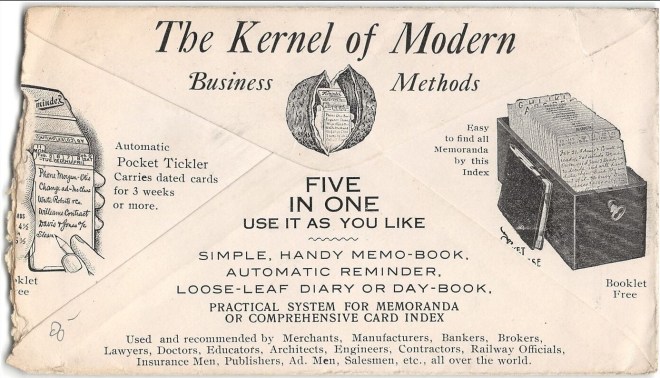
Commercial demand for card index files has waned dramatically since the advent of commercial computing. Fortunately they were so tremendously ubiquitous from the late 1800s through the mid-to-late 1900s, they can readily be found in acceptable to excellent used condition, and sometimes even in restored condition for a reasonable sum in comparison to purchasing new filing cabinets. Because the market for people looking for these used boxes and filing cabinets is so thin they’re not terribly expensive. The one caveat to this seems to be for larger restored/refinished wooden library card catalogs from the early 1900s in part because they are stunning pieces of nostalgic furniture and can still function as curiosity cabinets or high end wine storage cabinets.

These cabinets can be searched for at specialty office liquidation companies, surplus government/school/library companies, auctions, and vintage and antique stores. However, some of the quickest places to find these on the less expensive side can be your local Craigslist furniture listings, E-bay, Etsy, Facebook Marketplace, Offerup.com, and even Nextdoor.com. I recommend looking around at all of these venues for the variety of what’s available versus your particular style, taste, and budget level. Looking and waiting can be particularly useful if you’re budget conscious, but I’d also advise that once you know what you want and have fallen in love with something, buy it immediately as you may not come across a particular piece again.

A wooden 12 drawer index card filing cabinet (or zettelkasten) sitting in an antique store.
I ran across this 12 drawer 4 x 6 inch index card filing cabinet at an antique store in Southern California in December 2022.

Because some of these cabinets are so large and the demand is so low, many sellers may be motivated to offload them for much less than they list them for. I purchased my own Singer Industrial cabinet for $200.00 and another a refurbished Steelcase 8 drawer cabinet for $125 while I’ve seen similar ones listed online (and unsold for long periods of time) for over $1,000.

Sellers of refinished pieces are much less likely to drop their prices for obvious reasons.

Another factor to consider in purchasing larger cabinets is that in the 200+ pound range, these can be harder to package and ship and may require freight or furniture shipping methods. As a result, shipping can easily cost as much as the piece itself, so when shopping, keep this in mind. If you’re more budget conscious, narrow your search to local sellers which may make pick-up or shipping significantly cheaper. An additional weight factor to keep in mind is placement of the cabinet(s) and structural support. With my own Steelcase 8 drawer cabinet weighing in at about 240 pounds and a capacity of 61,000 index cards which would have an approximate weight of 255 pounds, the total comes to almost 500 pounds. If you ultimately have a few of these, the load can be significant on home grade construction. I keep mine in a corner of the house which has a slab concrete support because I’ve previously had the experience of a large tanker desk creating a 3/4 inch sinking of the floor underneath it (measured at the baseboard moulding) over the span of about 5 years.

Once you’ve gotten something, keep in mind that the original wear and tear and potential patina of a piece can be part of the allure and nostalgia. Sadly, second and third hand owners may not realize the functionality of some pieces of these files and as a result they may be missing some hardware like card rods, following blocks, locks, or other pieces which may be hard if not impossible to find or replace. 

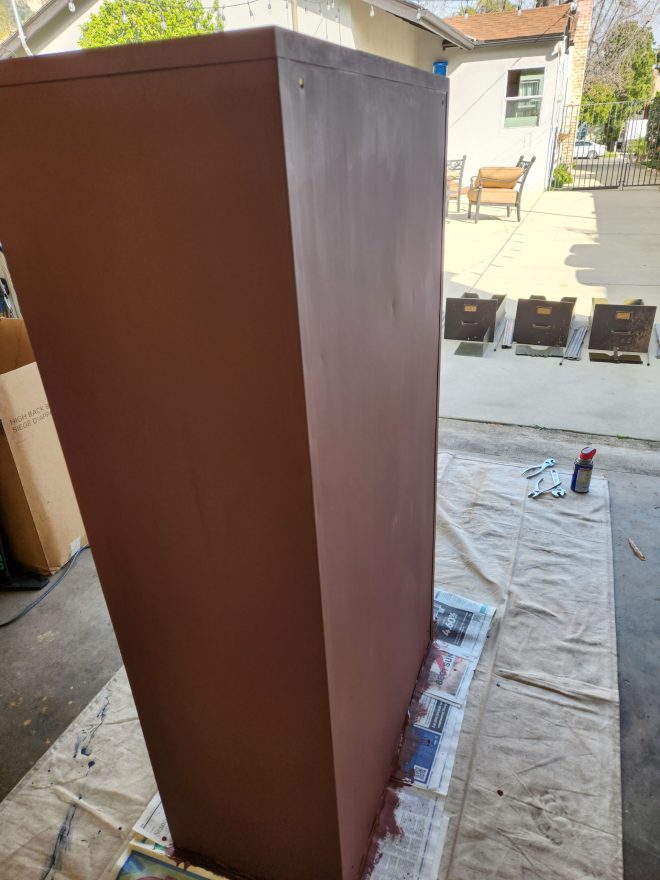
If you’re inclined, you can either send them out for refinishing or refinish them yourself. Some of the larger metal pieces can run from $500 – $1,500 to bead blast and re-paint or re-enamel, but have the benefit that you can choose which color(s) you’d like them to be to fit into your decor. You may have to search around to find refinishing shops for these, but you might also find that your local auto-repair firm is well set up for stripping, priming, and repainting these as well (some of them are almost as large as a car, but without wheels and engines.) 

Wood

Cabinets in the late 1800s and early 1900s were primarily manufactured out of wood. Some midcentury and later cabinets mixed wood with steel drawers or in the late century wood cabinets with plastic drawers inside mounted to wooden fronts. Many were made with quarter sawn oak or with “tiger oak”, which can often be a useful key search term for finding them. Sometimes it can also be useful to search for the key phrase “apothecary cabinet” as many who have these either don’t understand the difference or add it to increase their search exposure for potential buyers who seemingly no longer desire to store large quantities of index cards. Another useful search phrase is midcentury modern (or the abbreviation MCM) especially if you like that particular esthetic. 

While a number of manufacturers focused on the library card catalog space with catalogs containing 10-30 or more drawers almost exclusively for the 3 x 5 inch index card, many also made file card furniture for business use and these can usually be found with 1-10 drawers in size. Possibly most common are the two drawer files which can often be stacked in a modular way to allow for growth of one’s desktop system. In these areas it is more common to find 3 x 5 inch and 4 x 6 inch form factors, but often larger card sized furniture was built and distributed, though these are rarer on the second hand market.

Oblique angle on a Shaw-Walker 11 inch 3 x 5 inch card index
An 11 inch Shaw-Walker wooden card index that I picked up for $10.

With some searching, one can also find combination cabinets that have drawers not only for index cards, but also contain standard hanging file drawers for 8.5 x 11 inch files and paper filing purposes. These sorts are particularly more common in the very early 1900’s as modular systems which were focused on the business market.

A two drawer wooden card index sitting on a wooden table

Some of the more common manufacturers for wood card catalog files include: 

  • Library Bureau (Ilion, NY) (1876), Sometimes listed as “Library Bureau Sole Makers”
  • Yawman & Erbe 
  • Globe-Wernicke
  • Gaylord Bros. Inc. (Syracuse, NY and Stockton, CA) (1896)
  • Remington Rand
  • Weis (Monroe, Michigan)
  • Wagemaker
  • Tucker File & Cabinet Co. (Ilion, NY)
  • The Fred Macey Company, Ltd. (Grand Rapids, Michigan), later renamed Macey-Wernicke Co. Ltd., and again as The Macey Co. 

A light brown Macey Co. oak card index with 16 drawers sits between a black and gray Steelcase card index and an oak barrister bookcase.

Update: In September 2023, I’ve written more detail about the state of the used Library Card Catalog market, for those who might be interested in going that route for 3 x 5″ index cards: Market analysis of library card catalogs in 2023.

A waist high Gaylord Bros. library card catalog with a smaller desktop card index and black Smith-Corona Clipper typewriter on top.

Another option on the secondary market are used library charging trays, but it’s rare that sellers know what these were called or how they were used, so searching for and finding them can be difficult at best. Most often sellers confuse these with card catalog drawers or tray inserts. Additionally searching for charging trays directly results in modern accessories for charging cell phones and other personal electronic devices. Because they’re difficult to search, there’s a greater than necessary implied rarity to them, and as a result, they can be listed for several hundreds of dollars though most often they sell in the range of $5-15 per row of cards in the tray and are frequently found in configurations of one, two, three, and sometimes up to five rows of cards in a single unit.

Library charging tray with two rows for storing 3 x 5" index cards in portrait orientation. It's sitting on a small library card catalog.
A two row charging tray sitting on top of a library card catalog.

In addition to the more standard run-of-the-mill card files in single or multi-box form, you might also find some rarer combination furniture like the Satelite Combination Card Index Cabinet and Telephone Stand (circa 1906), though something like this could also be used as a semi-portable or movable piece of furniture that one could place as a small writing surface next to their favorite reading chair to write and file notes away on a leisurely evening.

1906 Advertisement for a combination card index table and telephone stand featuring a desk with the satellite combination table next to it.
1906 magazine ad from the Adjustable Table Company

Steel

As the 20th century progressed, many manufacturers switched from wood to steel as their material of choice. Most library card catalogs continued to be made of wood though a few can be found in steel. The larger proportion of steel filing cabinets cabinets were manufactured by companies that also manufactured desks and other industrial use filing cabinets. 

Again, here desktop two drawer modular/stackable cabinets abound though 8 – 10 drawer and even larger free-standing filing cabinets can be found. Many of these include tab and slot features to lock them together for safer stacking. A good example of a modularly built collection can be seen in this photo from a 2017 New York Times article of Joan Rivers’ collection of index cards with 36 drawers of 4-by-6-inch index cards containing jokes she’d accumulated over her lifetime of work. 

Credit: Hiroko Masuike/The New York Times

Somewhat rarer, but findable, one may encounter filing cabinets meant for Hollerinth or punch cards which eventually standardized at 3.25 x 7.375 inches, which was also the standard size for paper currency of 1862–1923. Often these will have drawers high enough to accommodate 4 x 6 inch cards, but one should double check this prior to purchase.

Some of the more common steel cabinet makers include:

  • Yawman & Erbe 
  • All-Steel Equipment, Inc. (ASE) (Aurora, Illinois) 
  • Steelmaster (Art Steel Co., Inc.) (New York)
  • Browne-Morse (Muskegon, Michigan)
  • Cole-Steel Equipment Company (New York) 
  • Singer Business Furniture
  • Globe-Wernicke
  • Buddy (later Sandusky/Buddy)
    • They seem to have ceased manufacturing them some time around 2016
  • MMF Industries
  • GWS

The smaller 1 to 3 drawer vintage metal card files are readily available on a variety of online shopping sites usually between $15 and $40. This isn’t bad given how expensive new files can run. Many were made with small fittings that allow them to be stackable. Usually these are sturdy, but light enough for relatively inexpensive shipping. If they’re in bad shape, they can usually be easily cleaned up and primed and repainted in more modern colors to suit your taste and style. 

The larger multi-drawer full cabinets can often run from $200 to over $1,000, but their bigger issue is that they’re so large and heavy that they can be in the range of $800 or more to ship anywhere. If you want something like this, your best bet is to try to find something local that you can drive to and pick up locally.

If you’re into 4 x 6 inch cards, double check with the seller to make sure that they’ll fit as most sellers won’t list the card sizes for drawers since they don’t expect them to actually still be used as card indexes and they’ll neglect to not additional clearances for tabbed cards. Keep in mind that often even the somewhat larger cabinets are a 1/4″ too short for 4 x 6 inch cards, much less the slightly taller tabbed cards (A-Z) you might use for separating sections. 

A while back I personally picked up a large Singer Business Furniture card index and a refurbished Steelcase 8 drawer cabinet which I’ve written a fair bit about. Some of the information there may help to provide some more context about these larger cabinets.

Fully assembled Steelcase card index filing cabinet next to a bookcase

Custom made

Of course given all this selection, you still may not have found the right box for your taste or your working style. In this case you may want to have something custom made. Given this, however, it may still behoove you and your designer to be aware of what has existed in the past when designing something specific for your needs. 

Some common features you might find useful in either designing or choosing your own cabinets include:

  • follow blocks to bunch cards to the front of the drawer and hold them upright or at a slight angle without falling over;
  • bail stops, a mechanism to keep the drawer from being accidentally pulled completely out of the case and dropping your cards everywhere;
  • card rods as often seen in library card catalogs which insert from the front to the back of the bottom of drawers to prevent accidental card spillage.

I don’t have many examples of custom made set ups, but I’ll add links to what I find below and some individuals may add others in the comments section below as well.

Examples

Been working on this Zettlekasten for my thesis for nearly a year… Made some personal modifications to the system, so it includes a chronological stack of cards and lots of images.
by inantinet

In late 2022/early 2023, Scott Scheper commissioned a two drawer solid wood (cedar) desktop zettelkasten box similar to those from the early 20th century. He had it listed on his website initially for $995 and then later for a reduced price of $495. He created a waitlist sign up for copies like it, ostensibly to test the interest in  manufacturing/selling them as a product. To my knowledge he never made any beyond the initial prototype, but it does show that one could custom make their own if they prefer.

Foreign Made Zettelkasten

Particularly missing from this collection is a wide array of European standard furniture and boxes for A4, A5, A6 etc. cards. There are some great German, Russian, and other cultural design specific pieces I’ve not included, in part because they’re not as readily available in my market and I haven’t yet had the time to delve into their histories. If you’ve got experience here, I’d love to hear what’s available.

Anecdotally, I’ve heard that the IKEA Moppe will work for A7 cards. Additionally, I’ve heard that some Chinese practitioners have used Taobao cabinets.

Others?

In addition to the A-standard types mentioned above, surely I’ve missed some boxes and cabinets along the way, though this may be one of the more complete collections of boxes I’ve seen compiled. If I’ve missed any that should be included, or you have an example (your own perhaps?) that I can feature or link to, please let me know in the comments or via a reply in social media. Particularly appreciated are examples of non-standard boxes in use as zettelkasten or custom made examples, particularly if they include photos and/or DIY instructions for construction.

Remember that you shouldn’t have to settle for your zettel… Happy zettel-casting!


Some links on this page are affiliate links which may provide this site with a small commission on store sales by site visitors directed from such links. These links will not affect the prices you pay as a consumer. We use the miniscule amount of income these provide to defray the costs of hosting and improving this site.

Index Card Accessories for Note Taking on the Go

Index Card “Notebooks”?

Before I go the DIY route, has anyone seen gummed 4 x 6″ index cards available for sale? I’d love to have a bunch of index cards temporarily glued together almost in notebook form for easy use and portability.

I’m looking for something along the lines of traditional note pads or memo pads like this: https://finecardstock.com/product/memo-pads-paper-white-4×6/, but which used a thicker index card stock.

I know there are a handful of manufacturers who make spiral bound versions with perforations for tearing cards out, but I’m looking for something a tad less bulky for putting in a back pocket or jacket pocket. I’ve also considered using binder clips and even book rings, but again, I’m trying to slim the system down.

If there’s nothing great, I may just go with my favorite cards and DIY with some PVA Glue which is often used in book binding and is suggested frequently in crafting videos like: https://www.youtube.com/watch?v=b-Wp0sLpnMY. In the end, this may be the best route to allow me to choose my favorite cards in addition to how thick I can make the “notebooks”.

Note card cases, folios, and holders

Similar/related/useful things I’ve come across in this related space:

Kaitiaki 3×5 Inches Index Card Organizer, though they don’t seem to have anything for 4 x 6 inch index cards.

Rite in the Rain (zettelkasting in the elements while hiking anyone?), though they all appear to be designed around 3 x 5″ cards.

Oxford At-Hand Note Card Case, this could work, but as ever, it only seems to be available for 3 x 5″ index cards

YOAVIP 4×6 Index Cards Clear Plastic Holder looked interesting, but was a larger, notebook sized version, though still had some useful portability features, yet might be a bit persnickety for regular in-and-out usage.

Other ideas?

Has anyone else done this or anything similar? How about wallets, folios, or thin covers? What’s your experience?

Update

This is ultimately what I ended up doing

A notepad for my Zettelkasten! 🗃️
30 index cards, some bookbinder’s (PVA) glue, a brush, some clips, and ten minutes of craft time. We’re ready for the road…

Wooden table featuring a deck index cards bound by glue at the top stand up near some PVA adhesive surrounded by some binder clips, a paint brush, a Lochby case of fountain pens and a stationery bag.

Victor Margolin’s zettelkasten process for note taking and writing

It’s not as refined or as compartmentalized as Niklas Luhmann’s process, but art historian Victor Margolin broadly outlines his note taking and writing process in reasonable detail in this excellent three minute video. (This may be one of the shortest and best produced encapsulations of these reading/note taking/writing methods I’ve ever seen.)

Though he indicates it was a “process [he] developed”, it is broadly similar to that of the influential “historical method” laid out by Ernst Bernheim and later Seignobos/Langlois in the late 1800s.


Victor Margolin’s note taking and writing process

  • Collecting materials and bibliographies in files based on categories (for chapters)
  • Reads material, excerpts/note making on 5 x 7″ note cards
    • Generally with a title (based on visual in video)
    • excerpts have page number references (much like literature notes, the refinement linking and outlining happens separately later in his mapping and writing processes)
    • filed in a box with tabbed index cards by chapter number with name
    • video indicates that he does write on both sides of cards breaking the usual rule to write only on one side
  • Uses large pad of newsprint (roughly 18″ x 24″ based on visualization) to map out each chapter in visual form using his cards in a non-linear way. Out of the diagrams and clusters he creates a linear narrative form.
  •  Tapes diagrams to wall
  •  Writes in text editor on computer as he references the index cards and the visual map.

I’ve developed a way of working to make this huge project of a world history of design manageable.
—Victor Margolin

Notice here that Victor Margolin doesn’t indicate that it was a process that he was taught, but rather “I’ve developed”. Of course he was likely taught or influenced on the method, particularly as a historian, and that what he really means to communicate is that this is how he’s evolved that process.

I begin with a large amount of information.
—Victor Margolin


As I begin to write a story begins to emerge because, in fact, I’ve already rehearsed this story in several different ways by getting the information for the cards, mapping it out and of course the writing is then the third way of telling the story the one that will ultimately result in the finished chapters.
—Victor Margolin

Your Twitter “Go Bag”

In all the great spy and heist movies and a number of gangster films, characters in the stories that may need to drop everything at a moments notice and disappear “in 30 seconds flat if you feel the heat around the corner” often have a “go bag” typically filled with jewelry, bundles of cash, and a variety of passports and associated identification.

The Heat’s Around the Corner

Given the seismic shifts in the social media space these past weeks since Elon Musk took over at Twitter, it looks like some people will wish they had their proverbial Twitter go bags ready. 

After reports of an ultimatum and mass exodus tonight at Twitter Headquarters and Musk posting some not so funny remarks, some people are preparing for Twitter’s addition to the IndieWeb wiki’s Site Deaths page.

But after sharecropping content for them for up to 16 years and creating networks of friends on the platform, how can your retain as much value from the dying site as possible? What would you put in your go bag and how can you do it quickly? 

Obviously, doing a full data export would be a wise move, but recent reports are that it is taking three or more days for those to process and get sent out. (What if it doesn’t last that long?) Worse, it’s not always the sort of usable data you’d want to have when moving somewhere else. What can you do to save as much usable data as quickly as possible?

Below are some quick and dirty tools for stocking your go bag:

https://listfollowers.com/ will access the Twitter API to pull out your followers, followees, and mutuals (people you’re following who follow you back). You can save these as a .csv or .json files for use or import to other tools.

 https://opml.glitch.me/ will query Twitter and provide you with the web pages and feeds of your friends so that you can follow them in a feed reader. It also provides you with an .opml file which many feed readers can import so that you can automatically follow all your friends by other methods.

https://fedifinder.glitch.me/ is a tool for tracking where your friends have decamped within the Fediverse. It will allow you to extract the Fediverse handles (where available) of your Twitter followings or list members and import them into Mastodon to follow them all at once. If this is your exit strategy, be sure to add your own Mastodon address to your Twitter profile or bio to help others find you as you all orderly file to the exit while the building burns down behind you.

https://pruvisto.org/debirdify/ is another tool for moving some of your Twitter data over to Mastodon or other parts of the Fediverse.

https://bridge.birb.space/ is an instance for helping to bridge the move from Twitter to an ActivityPub-based site (like Mastodon).

https://twitodon.com/ is yet another tool to help you find your Twitter friends on Mastodon.

One Last Heist

Of course if things continue to devolve, but you have some extra time for one last go, consider carefully your exit strategy and why and what you hope to get out of the experience. 

Many have left to go to Mastodon. I’ve been collecting some rough notes under the tag “Twitter Migration” which may be helpful here. While Mastodon represents a step up in terms of choice, freedom and flexibility over Twitter, I know we can still do better for both user interface as well as a more humane social media experience.

My personal suggestion for a quick and dirty escape is to go IndieWeb and have and use your own domain name and website to become your personal home on the web. If you’ve got the technical chops, our friends at IndieWebCamp have some help and pointers waiting for you. If you’re stuck and have some means, Micro.blog is a great way to go IndieWeb and own all your content while still being able to interact with a large number of other IndieWeb sites as well as Twitter and Mastodon if you choose. Plans there are $5 a month and are an exceptional deal. 

Other options are to move to other blogging platforms like Tumblr, which has shown interest in adding IndieWeb building blocks, WordPress.com, and Blogger.  

Other options?

What export options have I missed? (Keep in mind that we all know there are lots of command line options that dovetail with APIs and require advanced knowledge of programming. We’re specifically looking for quick and dirty options that are immediately usable by the masses, preferably with directions or suggests as to what can be done with the outputs.) 

What other options are there for easy migration that still allow people to stay connected with their friends and family? Hopefully it’s obvious that suggestions for moving to other corporate social silos that practice surveillance capitalism where this viscous cycle will happen again within a decade are now moot. 

#FeedReaderFriday: A Suggestion for Changing our Social Media Patterns

In the recent Twitter Migration, in addition to trying out Mastodon, I’ve been seeing some people go back to blogs or platforms like Micro.blog, WordPress, Tumblr, WriteFreely (like Mastodon it’s a part of the Fediverse, but built for blogging instead of short posts) and variety of others. They’re looking for a place where they can truly own and share their content, often in healthier and more humane ways. Many are extolling the virtues of posting on their own website so that they own their content to protect against the sort of platform problems many are now seeing and experiencing on the rapidly dying birdsite. I’ve seen a growing number of people in/on several platforms reviving the early Twitter practice of to help people discover new and interesting people to follow.

As a result, while everyone is exploring new platforms and new online spaces for maintaining their identities and communicating, I’m going to suggest something else interesting to shift our online social patterns: Instead of spending time on Twitter, Mastodon, Instagram, or other major social platforms, start practicing by carving out some time to find and follow people’s websites directly with a feed reader or social reader. Then engage with them directly on their own websites. 

I already spend a reasonable amount of time in a variety of readers looking at both longform articles as well as social media posts (status updates, notes, bookmarks, and photos), but starting this Friday, I’m going to practice . Instead of opening up Twitter or Mastodon, I’ll actively and exclusively reach for one of my feed readers to read people’s content and respond to them directly.

As part of the effort, I’ll share people’s sites I follow and enjoy. I’ll also suggest some feed readers to try out along with other related resources. I’ll use the tag/hashtag to encourage the website to website conversation. If you’re interested in the experiment, do come and join me and help to spread the word. 

Currently I’m relying on readers like Inoreader, Micro.blog, and Monocle, but there are a huge variety of feed readers and a nice selection of even more fully featured social readers available.

Just as many people are doing the sometimes difficult but always rewarding emotional labor of helping people migrate from the toxicity of Twitter and its algorithmic feeds, perhaps those of us who have websites and use social readers could help our friends and family either set up their own spaces or onboard them to social readers in this effort? Mastodon’s decentralized nature is an improvement and provides a reasonable replacement for Twitter, but eventually people will realize some of the subtle issues of relying on someone else’s platform just as they’ve seen issues with Twitter, Facebook, Instagram, or the now defunct Google+. 

Feel like you’ll miss people’s content on traditional social media? There are definitely a variety of ways to follow them in a variety of feed and social readers. Not sure what RSS is? Feel free to ask. Know of some interesting tricks and tools you use to make discovering and subscribing to others’ blogs easier? Share them! Have fantastic resources for discovering or keeping up with others’ websites? Share those too. Not quite sure where to begin? Ask for some help to better own your online identity and presence. 

It may be a slow start, but I think with some care, help, and patience, we can help to shift both our own as well as others’ online social reading and correspondence habits to be kinder, smarter, and more intentional. 

What will you read on ? Who will you recommend following?


Featured photo by Dulcey Lima on Unsplash

New Mastodon Instances and a Local Timeline Experiment

I’ve been tempted to join a smaller Mastodon instance to be able to appreciate the value of having a useful local timeline. Mastodon.social is so large as to have a generally un-useful local timeline because I lack the context of all the users and its generally very hit-and-miss for my discovery and serendipity needs. It’s not like I really spent a lot of time sipping from Twitter’s firehose timeline, which is a rough equivalent.

I almost jumped yesterday when Jim Groom and the Reclaim Hosting spun up a Mastodon instance focused on DS 106 at https://social.ds106.us/about. I’ve followed a large part of that community for over a decade, but didn’t have the bandwidth.

This morning I noticed that Boris Mann and gang have spun up a Mastodon instance around the idea of tools for thought which dovetails with their efforts at Tools for Thought Rocks! So I’m going to bite there to see what happens and have the experience of a smaller specific and focused timeline to watch.

I still have to figure out how to best dovetail the experience into my own IndieWeb site given potential limitations with backfeed of POSSE posts from Brid.gy. Perhaps I’ll just use it as read only to start and simply federate my content there? We’ll see. It’s solely an experiment, but some of those few already there are people I see regularly. No guarantees on how much I’ll post there, but if it’s your favorite reader/platform you can find me at @chrisaldrich@toolsforthought.rocks. Most likely anything I post to it will be more relevant to thinking.

As ever, following me directly via my own site is the best way to ensure you’re getting the best of everything.

Hypothes.is as a Digital Zettelkasten for Neologism and Word Collection for Wordnik

A little while ago, one of the followers of my Hypothes.is account where I actively mark up my reading with highlights, annotations, and notes asked me why I was tagging seemingly random sentences with “wordnik” and other odd tags that started with “hw-“. Today I thought I’d write out the explanation of the habits around one of my side hobbies of word collecting.

Some background

In the book The Professor and the Madman: A Tale of Murder, Insanity, and the Making of the Oxford English Dictionary, Simon Winchester describes the pigeonhole and slip system that professor James Murray used to create the Oxford English Dictionary. The editors essentially put out a call to readers to note down interesting every day words they found in their reading along with examples sentences and references. They then collected these words alphabetically into pigeonholes and from here were able to collectively compile their magisterial dictionary.  Those who are fans of the various methods of knowledge collection and management represented by the index card-based commonplace book or the zettelkasten, will appreciate this scheme as a method of collectively finding and collating knowledge. It’s akin to Paul Otlet and Henri La Fontaine’s work on creating the Mundaneum, but focused  on the niche area of lexicography and historical linguistics.

Book cover of The Professor and the Madman featuring a sepia toned image of a seated professor in a full beard and a mustache holding a book.The Professor and the Madman is broadly the fascinating story of Dr. W. C. Minor, an insane asylum patient, who saw the call to collect words and sentences began a written correspondence with James Murray by sending in over ten thousand slips with words from his personal reading. 

Wordnik and Hypothes.is

A similar word collecting scheme is currently happening on the internet now, though perhaps with a bit more focus on interesting neologisms (and hopefully without me being cast as an insane asylum patient.) The lovely folks at the online dictionary Wordnik have been using the digital annotation tool Hypothes.is to collect examples of words as they happen in the wild. One can create a free account on the Hypothes.is service and quickly and easily begin collecting words for the effort by highlighting example sentences and tagging with “wordnik” and “hw-[InsertFoundWordHere]”.

So for example, this morning I was reading about the clever new animations in the language app Duolingo and came across a curious new word (at least to me): viseme.

To create accurate animations, we generate the speech, run it through our in-house speech recognition and pronunciation models, and get the timing for each word and phoneme (speech sound). Each sound is mapped onto a visual representation, or viseme, in a set we designed based on linguistic features.

So I clicked on my handy browser extension for Hypothes.is, highlighted the sentence with a bit of context, and tagged it with “wordnik” and “hw-viseme”. The “hw-” prefix ostensibly means “head word” which is how lexicographers refer to the words you see defined in dictionaries.

Then the fine folks at Wordnik are able to access the public annotations matching the tag Wordnik, and use Hypothes.is’ API to pull in the collections of new words for inclusion into their ever-growing corpus.

Since I’ve collected interesting new words and neologisms for ages anyway, this has been a quick and easy method of helping out other like minded word collectors along the way. In addition to the ability to help out others, a side benefit of the process is that the collected words are all publicly available for reading and using in daily life! You can not only find the public page for Wordnik words on Hypothes.is, but you can subscribe to it via RSS to see all the clever and interesting neologisms appearing in the English language as collected in real time! So if you’re the sort who enjoys touting new words at cocktail parties, a rabid cruciverbalist who refuses to be stumped by this week’s puzzle, or a budding lexicographer yourself, you’ve now got a fantastic new resource! I’ve found it to be far more entertaining and intriguing than any ten other word-of-the-day efforts I’ve seen in published or internet form.

If you like, there’s also a special Hypothes.is group you can apply to join to more easily aid in the effort. Want to know more about Wordnik and their mission, check out their informative Kickstarter page.


Thoughts on Zettelkasten numbering systems

I’ve seen variations of the beginner Zettelkasten question:

“What happens when you want to add a new note between notes 1/1 and 1/1a?”

asked at least a dozen times in the Reddit fora related to zettelkasten and note taking, on zettelkasten.de, or in other places across the web.

Dense Sets

From a mathematical perspective, these numbering or alpha-numeric systems are, by both intent and design, underpinned by the mathematical idea of dense sets. In the areas of topology and real analysis, one considers a set dense when one can choose a point as close as one likes to any other point. For both library cataloging systems and numbering schemes for ideas in Zettelkasten this means that you can always juxtapose one topic or idea in between any other two.

Part of the beauty of Melvil Dewey’s original Dewey Decimal System is that regardless of how many new topics and subtopics one wants to add to their system, one can always fit another new topic between existing ones ad infinitum.

Going back to the motivating question above, the equivalent question mathematically is “what number is between 0.11 and 0.111?” (Here we’ve converted the artificial “number” “a” to a 1 and removed the punctuation, which doesn’t create any issues and may help clarify the orderings a bit.) The answer is that there is an infinite number of numbers between these!

This is much more explicit by writing these numbers as:
0.110
0.111

Naturally 0.1101 is between them (along with an infinity of others), so one could start here as a means of inserting ideas this way if they liked. One either needs to count up sequentially (0, 1, 2, 3, …) or add additional place values.

Decimal numbering systems in practice

The problem most people face is that they’re not thinking of these numbers as decimals, but as natural numbers or integers (or broadly numbers without any decimal portions). Though of course in the realm of real numbers, numbers above 0 are dense as well, but require the use of their decimal portions to remain so.

The tough question is: what sorts of semantic meanings one might attach to their adding of additional place values or their alphabetical characters? This meaning can vary from person to person and system to system, so I won’t delve into it here.

One may find it useful to logically chunk these numbers into groups of three as is often done using commas, periods, slashes, dashes, spaces, or other punctuation. This doesn’t need to mean anything in particular, but may help to make one’s numbers more easily readable as well as usable for filing new ideas. Sometimes these indicators can be confusing in discussion, so if ever in doubt, simply remove them and the general principles mentioned here should still hold.

Depending on one’s note taking system, however, when putting cards into some semblance of a logical, sort-able order (perhaps within a folder for example), the system may choke on additional characters beyond the standard period to designate a decimal number. For example: within Obsidian, if you have a “zettelkasten” folder with lots of numbered and named files within it, you’ll want to give each number the maximum number of decimal places so that when doing an alphabetic sort within the folder, all of the numbered ideas are properly sorted. As an example if you give one file the name “0.510 Mathematics”, another “0.514 Topology” and a third “0.5141 Dense Sets” they may not sort properly unless you give the first two decimal expansions to the ten-thousands place at a minimum. If you changed them to “0.5100 Mathematics” and “0.5140 Topology, then you’re in good shape and the folder will alphabetically sort as you’d expect. Similarly some systems may or may not do well with including alphabetic characters mixed in with numbers.

If using chunked groups of three numbers, one might consider using the number 0.110.001 as the next level of idea between them and then continuing from there. This may help to spread some of the ideas out as surely one may have yet another idea to wedge in between 0.110.000 and 0.110.001?

One can naturally choose almost any any (decimal) number, so long as it is somewhat “near” the original behind which one places it. By going out further in the decimal expansion, one can always place any idea between two others and know that there will be a number that it can be given that will “work”.

Generally within numbers as we use them for mathematics, 0.100000001 is technically “closer” by distance measurement to 0.1 than 0.11, (and by quite a bit!), but somehow when using numbers for zettelkasten purposes, we tend to want to not consider them as decimals, as the Dewey Decimal System does. We also have the tendency to want to keep our numbers as short as possible when writing, so it seems more “natural” to follow 0.11 with 0.111, as it seems like we’re “counting up” rather than “counting down”.

Another subtlety that one sees in numbering systems is the proper or improper use of the whole numbers in front of the decimal portions. For example, in Niklas Luhmann’s system, he has a section of cards that start with 3.XXXX which are close to a section numbered 35.YYYY. This may seem a bit confusing, but he’s doing a bit of mental gymnastics to artificially keep his numbers smaller. What he really means is 3000.XXXX and 3500.YYYY respectively, he’s just truncating the extra zeros. Alternately in a fully “decimal system” one would write these as 0.3000.XXXX and 0.3500.YYYY, where we’ve added additional periods to the numbers to make them easier to read. Using our original example in an analog system, the user may have been using foreshortened indicators for their system and by writing 1/1a, they may have really meant something of the form 001.001/00a, but were making the number shorter in a logical manner (at least to them).

The close observer may have seen Scott Scheper adopt the slightly longer numbers in the thousands (like 3500.YYYY) as a means of remedying some of the numbering confusion many have when looking at Luhmann’s system.

Those who build their systems on top of existing ones like the Dewey Decimal Classification, or the Universal Decimal Classification may wish to keep those broad categories with three to four decimal places at the start and then add their own idea number underneath those levels.

As an example, we can use the numbering for Finsler geometry from the Dewey Decimal Classification wikipedia page shown as:

500 Natural sciences and mathematics
   510 Mathematics
      516 Geometry
         516.3 Analytic geometries
            516.37 Metric differential geometries
               516.375 Finsler geometry

So in our zettelkasten, we might add our first card on the topic of Finsler geometry as “516.375.001 Definition of Finsler geometry” and continue from there with some interesting theorems and proofs on those topics.

Don’t Waste Time on Complex Classification Systems

Of course, while this is something one can do doesn’t mean that one should do it. Going too far down the rabbit holes of “official” forms of classification this way can be a massive time wasting exercise as in most private systems, you’re never going to be comparing your individual ideas with the private zettelkasten of others and in practice the sort of standardizing work for classification this way is utterly useless. Beyond this, most personal zettelkasten are unique and idiosyncratic to the user, so for example, my math section labeled 510 may have a lot more overlap with history, anthropology, and sociology hiding within it compared with others who may have all of their mathematics hiding amidst their social sciences section starting with the number 300. One of the benefits of Luhmann’s ad hoc numbering scheme, at least for him, is that it allowed his system to be much more interdisciplinary than using a more complicated Dewey Decimal oriented system which may have dictated moving some of his systems theory work out of his politics area where it may have made more sense to him in addition to being more productive on a personal level.

Of course if you’re using the older sort of commonplacing zettelkasten system that was widely in use before Luhmann’s variation, then perhaps using a Dewey-based system may be helpful to you?

A Touch of History

As both a mathematician working in the early days of real analysis and a librarian, I wouldn’t be surprised if some of these loose ideas may have occurred tangentially to Gottfried Wilhelm Leibniz (1646 – 1716), though I’m currently unaware of any specific instances within his work. One must note, however, that some of the earliest work within library card catalogs as we know and use them today stemmed from 1770s Austria where governmental conscription needs overlapped with card cataloging systems (Krajewski, 2011). It’s here that the beginnings of these sorts of numbering systems begin to come into use well before Melvil Dewey’s later work which became much more broadly adopted.

The German “file number” (aktenzeichen) is a unique identification of a file, commonly used in their court system and predecessors as well as file numbers in public administration since at least 1934. We know Niklas Luhmann studied law at the University of Freiburg from 1946 to 1949, when he obtained a law degree, before beginning a career in Lüneburg’s public administration where he stayed in civil service until 1962. Given this fact, it’s very likely that Luhmann had in-depth experience with these sorts of file numbers as location identifiers for files and documents. As a result it’s reasonably likely that a simplified version of these were at least part of the inspiration for his own numbering system. [] []

Your own practice

At the end of the day, the numbering system you choose needs to work for you within the system you’re using (analog, digital, other). I would generally recommend against using someone else’s numbering system unless it completely makes sense to you and you’re able to quickly and simply add cards to your system with out the extra work and cognitive dissonance about what number you should give it. The more you simplify these small things, the easier and happier you’ll be with your set up in the end.

References

Krajewski, Markus. Paper Machines: About Cards & Catalogs, 1548-1929. Translated by Peter Krapp. History and Foundations of Information Science. MIT Press, 2011. https://mitpress.mit.edu/books/paper-machines.

Munkres, James R. Topology. 2nd ed. 1975. Reprint, Prentice-Hall, Inc., 1999.


Featured photo by Manson Yim on Unsplash

NaNoWriMo with Zettelkasten Approach for an AcWriMo Non-Fiction Writing

Using Niklas Luhmann’s rough average of six zettels per day working full time for 8 hours a day versus writing approximately 1,667 words in an hour’s work (~28 words written per minute, which seems a reasonable average), I’ve created a zettelkasten word count equivalent for reading, research, and note making.

  • 28 words for every minute spent reading and making fleeting notes.
  • 415 words for every well-formed, fully written out permanent note
  • 500 words for every well-formed, fully written out and installed permanent note (includes work to install it in the box)
  • 84 words for every cross link created from one note to another
  • 140 words for every bibliographic card created
  • 56 words for every index entry created

If you’re diligently working at any or all of the above, instead of measuring all the small pieces, you could just use a 28 word/minute measure for your zettelkasten-based work.

If you’re not a full time research-only academic (without a teaching load or other administrative obligations) and for fun want to measure your NaNoWriMo for non-fiction work on a card per day basis using Niklas Luhmann as a guide/measure, then you should do the reading, research and note taking work to produce 0.75 cards per day (that is, well written permanent notes installed, indexed, and well-linked; we’re not keeping track of the indexing cards, bibliographic cards, or other fleeting notes here, which you’ll also be doing along the way) to keep pace for an equivalent 50,000 words during the month. This is about 5.25 cards per week or about 23 cards for the entire month.

The goal here is, instead of churning out raw words, to churn out reading, research, and note making towards material you can reasonably use to write journal articles, book chapters, or a full non-fiction book.

If you’re using an index card-based system for fiction writing the way Vladimir Nabokov did, then you really should do a traditional word count as that’s more closely in line with the workflow of the standard NaNoWriMo work.

N.B. This probably overshoots the mark, as the 6 cards/day number for Luhmann probably includes all cards and not just permanent notes in his entire collection over his entire lifetime’s work. It also doesn’t take into account the possibility that he carried a teaching load, administrative work, fundraising work, or other nonsense required of professors.) Of course this is is all just for fun anyway, so… quit worrying and start researching and writing a little bit every day.

Death by Zettelkasten!!

Just in time for Halloween, a haunting story about information overload featuring the most deadly zettelkasten in literary history.

Coming soon to a theater near you…

In the preface to the novel Penguin Island (L’Île des Pingouins. Calmann-Lévy, 1908) by Nobel prize laureate Anatole France, a scholar is drowned by an avalanche of index cards which formed a gigantic whirlpool streaming out of his card index (Zettelkasten)!

Translation via:
France, Anatole. Penguin Island. Translated by Arthur William Evans. 8th ed. 1908. Reprint, New York, NY, USA: Dodd, Mead & Co., 1922. 

Small changes in the translation by me, comprising only adding the word “index” in front of the occurrences of card to better represent the historical idea of fiches used by scholars in the late 1800s and early 1900s, are indicated in brackets.

The walls of the study, the floor, and even the ceiling were loaded with overflowing bundles, paste board boxes swollen beyond measure, boxes in which were compressed an innumerable multitude of small [index] cards covered with writing. I beheld in admiration mingled with terror the cataracts of erudition that threatened to burst forth.
“Master,” said I in feeling tones, “I throw myself upon your kindness and your knowledge, both of which are inexhaustible. Would you consent to guide me in my arduous researches into the origins of Penguin art?”
“Sir,” answered the Master, /“I possess all art, you understand me, all art, on [index] cards classed alphabetically and in order of subjects. I consider it my duty to place at your disposal all that relates to the Penguins. Get on that ladder and take out that box you see above. You will find in it everything you require.”
I tremblingly obeyed. But scarcely had I opened the fatal box than some blue [index] cards escaped from it, and slipping through my fingers, began to rain down.
Almost immediately, acting in sympathy, the neighbouring boxes opened, and there flowed streams of pink, green, and white [index] cards, and by degrees, from all the boxes, differently coloured [index] cards were poured out murmuring like a waterfall on a mountain-side in April. In a minute they covered the floor with a thick layer of paper. Issuing from their in exhaustible reservoirs with a roar that continually grew in force, each second increased the vehemence of their torrential fall. Swamped up to the knees in cards, Fulgence Tapir observed the cataclysm with attentive nose. He recognised its cause and grew pale with fright.
“ What a mass of art! ” he exclaimed.
I called to him and leaned forward to help him mount the ladder which bent under the shower.
It was too late. Overwhelmed, desperate, pitiable, his velvet smoking-cap and his gold-mounted spectacles having fallen from him, he vainly opposed his short arms to the flood which had now mounted to his arm-pits . Suddenly a terrible spurt of [index] cards arose and enveloped him in a gigantic whirlpool. During the space of a second I could see in the gulf the shining skull and little fat hands of the scholar; then it closed up and the deluge kept on pouring over what was silence and immobility. In dread lest I in my turn should be swallowed up ladder and all I made my escape through the topmost pane of the window.

The original French

Les murs du cabinet de travail, le plancher, le plafond même portaient des liasses débordantes, des cartons démesurément gonflés, des boîtes où se pressait une multitude innombrable de fiches, et je contemplai avec une admiration mêlée de terreur les cataractes de l’érudition prêtes à se rompre.
—Maître, fis-je d’une voix émue, j’ai recours à votre bonté et à votre savoir, tous deux inépuisables. Ne consentiriez-vous pas à me guider dans mes recherches ardues sur les origines de l’art pingouin?
—Monsieur, me répondit le maître, je possède tout l’art, vous m’entendez, tout l’art sur fiches classées alphabétiquement et par ordre de matières. Je me fais un devoir de mettre à votre disposition ce qui s’y rapporte aux Pingouins. Montez à cette échelle et tirez cette boîte que vous voyez là-haut. Vous y trouverez tout ce dont vous avez besoin.
J’obéis en tremblant. Mais à peine avais-je ouvert la fatale boîte que des fiches bleues s’en échappèrent et, glissant entre mes doigts, commencèrent à pleuvoir. Presque aussitôt, par sympathie, les boîtes voisines s’ouvrirent et il en coula des ruisseaux de fiches roses, vertes et blanches, et de proche en proche, de toutes les boîtes les fiches diversement colorées se répandirent en murmurant comme, en avril, les cascades sur le flanc des montagnes. En une minute elles couvrirent le plancher d’une couche épaisse de papier. Jaillissant de leurs inépuisables réservoirs avec un mugissement sans cesse grossi, elles précipitaient de seconde en seconde leur chute torrentielle. Baigné jusqu’aux genoux, Fulgence Tapir, d’un nez attentif, observait le cataclysme; il en reconnut la cause et pâlit d’épouvante.
—Que d’art! s’écria-t-il.
Je l’appelai, je me penchai pour l’aider à gravir l’échelle qui pliait sous l’averse. Il était trop tard. Maintenant, accablé, désespéré, lamentable, ayant perdu sa calotte de velours et ses lunettes d’or, il opposait en vain ses bras courts au flot qui lui montait jusqu’aux aisselles. Soudain une trombe effroyable de fiches s’éleva, l’enveloppant d’un tourbillon gigantesque. Je vis durant l’espace d’une seconde dans le gouffre le crâne poli du savant et ses petites mains grasses, puis l’abîme se referma, et le déluge se répandit sur le silence et l’immobilité. Menacé moi-même d’être englouti avec mon échelle, je m’enfuis à travers le plus haut carreau de la croisée.

The Two Definitions of Zettelkasten

What do we mean when we say Zettelkasten? There’s a specific set of objects (cards and boxes or their digital equivalents), but there’s also a spectrum of methods or practices which can be split into two broad categories.

TL;DR

Historically, Zettelkasten as used to describe both Luhmann’s notes and his method is patently in the minority compared to the vast prior Zettelkasten tradition, dating back at least to Konrad Gessner in 1548, which could be broadly framed as a commonplace book kept on index cards, usually organized by topic or subject headings and kept in a card index.

If you’ve been watching the tools for thought space, the note taking space, or the productivity spaces over the past several years, you’ve run across the seemingly foreign idea of Zettelkasten if not possibly tried it out for yourself. Surely by now there are several hundred short one page blog posts that make cursory, but excited attempts to describe what a zettelkasten is, how it works, and why you might want one. Aside from the excitement they all share, nearly all of them will mention the now famous example of Nicholas Luhmann’s collection of over 90,000 notes, and his prolific writing output of hundreds of papers and scores of books. Almost all of them will also inevitably make the error, courtesy of the availability heuristic compounded by the lack of appropriate history and context, of stating that Niklas Luhmann invented the idea of Zettelkasten.

However, in the growing amounts of literature about zettelkasten online there is a massive swath of history and knowledge often missing from what could and should be a broader discussion. The so-called “Zettelkasten Method” you hear about in 99% of the cases is specifically the variation of that method practiced by Niklas Luhmann. Historically, however, the idea of a zettelkasten (or slip box) as practiced by the vast majority of people—and there have assuredly been many—from the mid 1500s to now—is really that of the idea of a commonplace book kept using index cards. Some will be organized by subject headings while others won’t. Some of these will have indexes and some won’t. Some, surprisingly, aren’t even kept in boxes.

The “old” definition of Zettelkasten

So what was a Zettelkasten before we were overwhelmed with all the conversation about Niklas Luhmann’s instantiation?

Since antiquity, writers and thinkers have used what has come to be called the commonplace book tradition. They typically collected quotes (sententiae), thoughts, and ideas in books and notebooks for later review and potential reuse in their own writing. From the 8th to the 12th centuries there was a closely related practice of keeping florilegium that was used in Christian settings and particularly popular within the mendicant orders of the Catholic church. These were focused more on religious topics and ideas and were often used for creating sermons as their ultimate output.

In the 16th century, Swiss physician Konrad Gessner (1516 – 1565), building on the commonplace tradition, realized that one’s notes or excerpts might be easier to use if they were cut out of their places on the page and re-arrangeable. Gessner’s method in brief:

  1. When reading, everything of importance and whatever appears useful should be copied onto a good sheet of paper.
  2. A new line should be used for every idea.
  3. “Finally, cut out everything you have copied with a pair of scissors; arrange the slips as you desire, first into larger clusters which can then be subdivided again as often as necessary.”
  4. As soon as the desired order is produced, arranged, and sorted on tables or in small boxes, it should be fixed or copied directly.

—Gessner, Konrad. Pandectarum sive Partitionum Universalium. 1548. Zurich: Christoph Froschauer. Fol. 19-20 (Tr. Markus Krajewski via Paper Machines) 1

Subsequent note takers and composers eventually realized that, while useful, Gessner’s method could be improved by using “slips of equal size” (thus making it easier to flip through and prevent smaller slips from getting lost) and by indexing them or cross referencing them internally. Because note taking was frequently done on scraps of paper which were often kept in piles by topic, if one didn’t file or properly manage them, they came to be known as “scrap heaps”, a phrase which has linguistically gained the meaning of “trash”, as lack of indexing or coherence made them useless to anyone but their originator.

Indexing of commonplace books became much more common with the publication of John Locke’s Méthode nouvelle de dresser des recueils in Le Clerc’s Bibliothèque universelle vol. 2 (1685) (cf. Catalogue générale des livres imprimés (Paris, Bibliothéque nationale. Département des imprimés) v. 99, col. 192-195) which was translated with Le Clerc’s Observations (Lond., 1697, Lowdnes. v.4, p. 1379-1380) and was posthumously published as the stand alone text A new method of making common-place-books (1706).2

Using cards of equal size became more common following the “invention” of the index card by Carl Linnaeus (1707-1778) who hand cut his own cards used and reused his research materials throughout his career.3 Of course, taking notes on index cards was far easier in the early 20th century with the rise of library card catalogs, the Dewey Decimal System, and Melvil Dewey’s Boston-based company Library Bureau. Mass manufacturing of these cards improved both quality and pricing making it much easier to source one’s own cards. Dewey’s push for profits included expanding his library wares into the business sector, a practice which became more common after his own company adopted a card file-based system for its own office work.

Manuals on note taking and early Zettelkasten

In addition to early popular handbooks on commonplace book methods by Desiderius Erasmus, Rudolph Agricola, and Phillip Melanchthon, which were written for both teachers and students, one can find a growing number of texts which are either dedicated to note taking practices which heavily feature slips of paper or index cards or give them significant discussion. Some of these include:

  • Bernheim, Ernst. Lehrbuch der historischen Methode und der Geschichtsphilosophie : mit Nachweis der wichtigsten Quellen und Hilfsmittelzum Studium der Geschichte … völlig neu bearbeitete und vermehrte Auflage. 1889. Reprint, Leipzig : Duncker, 1903. http://archive.org/details/lehrbuchderhisto00bernuoft.
    • This book, in German, is an influential handbook on historical method which influenced the early science of history and historical method and helped to reinvigorate card-based note taking methods in a short section discussing such methods. I’m unaware of any translations in English.
  • Langlois, Charles Victor, and Charles Seignobos. Introduction to the Study of History. Translated by George Godfrey Berry. First. New York: Henry Holt and company, 1898. http://archive.org/details/cu31924027810286.
    • Influenced by Bernheim, but going further, this text, originally in French, has a section outlining a commonplace-esque zettlekasten method.
  • Seward, Samuel Swayze. Note-Taking. Boston, Allyn and Bacon, 1910. http://archive.org/details/cu31924012997627.
    • Popular text in the early 1900’s written by the brother of William Henry Seward.
  • Sertillanges, Antonin Gilbert, and Mary Ryan. The Intellectual Life: Its Spirit, Conditions, Methods. First English Edition, Fifth printing. 1921. Reprint, Westminster, MD: The Newman Press, 1960. http://archive.org/details/a.d.sertillangestheintellectuallife.
    • Has a fascinating chapter on note taking with some rich philosophy not often seen in such treatises including encouraging making active links between ideas and numbering one’s notes using a decimal system.
  • Dow, Earle Wilbur. Principles of a Note-System for Historical Studies. New York: Century Company, 1924.
  • Webb, Beatrice Potter. My Apprenticeship. First Edition. New York: Longmans, Green & Co., 1926.
    • While the book is a fascinating autobiography of one of the founders of the London School of Economics, The Fabians, and The New Statesman with broad experience in sociology and economics, of most interest here is Appendix C which she writes on note taking. She describes a zettelkasten based system which she describes as “scientific note taking” and which many are sure to recognize as a an early structured database or spreadsheet functionality which would find its way into edge notched cards, early computer programming, and computer science.
  • Heyde, Johannes Erich. Technik des wissenschaftlichen Arbeitens: zeitgemässe Mittel und Verfahrungsweisen. Junker und Dünnhaupt, 1931.
    • In German, though there is an English translation of a portion making it’s way around. This is the handbook which Niklas Luhmann apparently read and heavily influenced his own method. If true, I’m a developing theory on how he may have devised his method, presuming that he didn’t learn it or parts of it from colleagues or friends while in school.
  • Mills, C. Wright. “On Intellectual Craftsmanship (1952).” Society 17, no. 2 (January 1, 1980): 63–70. https://doi.org/10.1007/BF02700062.
    • A spectacular essay which later made it into Wright’s influential book The Sociological Imagination (1959), it goes far beyond basic note taking to some more serious substance and is closer in line to Luhmann’s Communicating with Slip Boxes (1981).
  • Eco, Umberto. How to Write a Thesis. Translated by Caterina Mongiat Farina and Geoff Farina. 1977. Reprint, Cambridge, MA, USA: MIT Press, 2015. https://mitpress.mit.edu/books/how-write-thesis.
    • While written for an academic audience of students focusing on writing for a particular purpose (the thesis), he does suggest that one could use the method as a lifelong practice.
  • Goutor, Jacques. The Card-File System of Note-Taking. Approaching Ontario’s Past 3. Toronto: Ontario Historical Society, 1980. http://archive.org/details/cardfilesystemof0000gout.
    • Just as commonplace books and zettelkasten are taking their last gasps in the 21st century, Goutor revives some of the ideas for helping out a local historical society by framing things as if the traditions had never existed in force within intellectual history.
  • Weinberg, Gerald M. Weinberg on Writing: The Fieldstone Method. New York, N.Y: Dorset House, 2005.
    • Written for the writers who want to be productive, Weinberg analogizes research and note taking to collecting the most useful and fascinating fieldstones that one might find to use to build a wall, a building, or other useful structure.

This brief, but limited collection, shows that there was certainly a long and illustrious note taking tradition using slips or index cards. It doesn’t highlight the fact that often these methods were also handed down from teacher to student, which was also a major mode of transmission and somewhat similar to current messy person-to-person transmission on the internet using examples and conversation on various fora and social platforms.

Resurgence of the old Zettelkasten in the new Millennium

Of course, the most recent resurgence of these commonplace and older zettelkasten ideas comes to us courtesy of a handful of interesting practitioners who have kept the memory alive as well as helped to push some of them into digital form. A limited selection of some of these include:

  • technologist Ward Cunningham, inventor of the wiki, which he based in part on Hypercard functionality. He also created the Smallest Federated Wiki (aka FedWiki) at an early IndieWebCamp in 2011 which features a card-like user interface which encourages small, atomic-sized notes.
  • writer, scientist, and engineer Mark Bernstein who created Tinderbox in 2002 as a note taking tool, outliner, and publishing software that along with DevonThink is an early precursor of tools like Evernote, Obsidian, and Roam Research. He’s also the author of the influential hypertext essay Hypertext Gardens: Delightful Vistas (1998).
  • TiddlyWiki, first released on September 20, 2004, is a card-based user interface software built by Jeremy Ruston who was inspired by Ward Cunningham’s wiki and focused on small chunks of interlinked information. 4
  • author Steven B. Johnson who wrote frequently about his experiences with note taking, commonplaces, and DevonThink in the early 2000s in The New York Times as well as his blog. 5
  • authors Robert Green and his former assistant Ryan Holiday who have talked at reasonable length about their commonplace methods using index cards in videos and blog posts over the last decade.

Practitioners of the older Zettelkasten method

While there are thousands upon thousands of practitioners of the commonplace book tradition using the notebook format, there is a smaller less well known set who have used these methods with index cards or other slip-like formats. I’ll present just a handful of some that I’m aware of, but I’m sure that there are thousands upon thousands more.

  • Vladimir Nabokov (author) famously wrote many of his books on including Lolita on index cards which he filed in boxes 6
  • Phyllis Diller (comedienne) with 52,000 3×5-inch index cards
  • Joan Rivers (comedienne) over a million 3×5-inch index cards
  • Bob Hope (comedian) 85,000 pages in files
  • George Carlin (comedian) paper notes in folders
  • Ronald Reagan (actor, President), unlike the majority, Reagan kept his note cards in a photo album-like binder which allowed him to flip through it like a book while still retaining the ability to move cards or add pages as necessary.
  • Robert Greene (author)
  • Ryan Holiday (author)
  • Eminem Yes! Even Slim Shady himself has the most basic version of the OG practice I’ve ever seen: he literally had “just” slips and a box in a practice he aptly called “Stacking Ammo”, but which Anderson Cooper analogized as the scrawlings of a crazy person. The scare quotes on the word just here underline the fact that his practice contained no organization at all other than his potential internal mental recognition of his handwriting and variations in the papers sizes, types, and letterheads when available. It worked, because it worked for him and his needs.
  • Roland Barthes (French philosopher and writer) called his collection of about 12,250 cards by the traditional French name fichier boîte; he also kept a form of diary using a card index which his biographer called a fichierjournal
  • Hans Blumenberg (German philosopher and intellectual historian)
  • Mortimer J. Adler’s team which created The Syntopicon as part of the Great Books of the Western World (1952), used a shared card index to create it. 7
  • Michael Ende (German writer, possibly best known for his book The Never Ending Story which became a movie with the same title) kept a Zettelkasten, and in 1994, a year prior to his death, he published Michael Endes Zettelkasten: Skizzen und Notizen (translation: Michael Ende’s File-card Box: Drafts and Notes), an anthology of some of his writing as well as observations and aphorisms
  • Frederic L. Paxson (historian)
  • Walter Benjamin (German philosopher and cultural critic)
  • Gotthard Deutsch (history professor) had a card index of 70,000 cards, mostly focused on Jewish history. 8

The “new” definition of Zettelkasten

Niklas Luhmann has, for the last several years, almost entirely defined much of popular culture’s conceptualization of the idea of what a zettelkasten is, when, in fact, he represents only the tiniest tip of the iceberg of a much broader tradition.

Why the new definition

Rather than spend our time on rehashing what is already a massive and still growing volume of words, work, and available research on Luhmann’s particular practice, perhaps a more productive question is how his version manages to capture so much mind share? In large part, I attribute it to the fact that the prior tradition has significantly waned from cultural consciousness, making it seem like the idea is new while pitches for Luhmann’s system simultaneously tout it as being almost wholly responsible for Niklas Luhmann’s outsized productivity.

To some extent, our “new” definition (at least in the English language) of a Zettelkasten is driven by a several factors:

Lack of a broader history of the older methods

Given some of the basic discussion above outlining some of this history will point out a fraction of some of we’ve all been missing. I’ll leave the aphorism “Those who cannot remember the past are condemned to repeat it” here to gild this lily. Hopefully those in the space will look more closely at the well-worn cow paths of analog history in deciding how to pave our (digital) futures. Students looking to improve upon their own practices will hopefully have more examples to examine and use as models.

It bears mention that Vannevar’s influential essay “As We May Think” in the July 1945 issue of The Atlantic is entirely underpinned by the commonplace book and zettelkasten traditions pervading Western thought and culture. Rather than acknowledge this tradition explicitly, he creates the neologism “Memex” which stands in for a networked and connected zettelkasten. Given that his essay appears at the cusp of the waning of these older traditions and that following technologists would not have been as knowledgeable of them, Bush did a massive disservice to the computing field by specifically leaving the earlier words out of his essay. Had he mentioned them, designers and programmers would have had them as more explicit examples to emulate in their work.

Lack of an “official” name or branded method

Many of our note taking traditions were explicitly taught and learned from either handbooks, transmitted from teacher to student, or from practitioner to practitioner. (We definitely see a lot of this mode online now via blogposts, Twitter, YouTube, and fora (including https://zettelkasten.de, r/zettelkasten, and r/antinet, amongst a slew of productivity writers and influencers who make a living promoting variations of these ideas.) But historically, outside of older phrases like florilegia and commonplace books, there weren’t concrete names or brands for these practices.

Compare the traditional zettelkasten to the ideas of a “card catalog” or a “rolodex”. The card catalog has an immediate definition as a physical object consisting of wooden filing cabinets specifically for index cards containing information about the subjects, titles, and authors of books. The rolodex is now a generic term (like Kleenex is for tissues or Xerox for photocopies) stemming from the company product Rolodex for a previously ubiquitous piece of office furniture. Having both explicit terms for their physical instantiations and their specific uses helped to drive the ubiquity of both compared to the humble, generic card index, which while ubiquitous in physical form in early 20th century offices was never defined explicitly with respect to a specific form of note taking practice. Just as academics in English speaking countries referred to their generic card indexes, those in Germany and France talked about their Zettelkasten and fichier boîte, respectively. The linguistic shift occurs broadly with the transmission of zettelkasten from German into English spheres around the time of the German exhibition “Zettelkästen. Machines of Fantasy” at the Museum of Modern Literature, Marbach am Neckar in 2013 where we begin to equate the physical objects with a particular method. It bears noting that the Marbach exhibition featured a number of very similar Zettelkasten (the physical item consisting of boxes and slips), but with a variety of zettelkasten methods, the majority of which were more similar to each other than the “different” one represented by Luhmann’s.

One can’t help but notice the proliferation of specific method names for slightly different practices within the now growing space. These specific names for practices literally give both a name and power to the space and help to make it grow. Some of these names include: Zettelkasten itself as a name for Luhmann’s method; Smart Notes (Sönke Ahrens’ delineation of Luhmann’s method, Linking Your Thinking (aka LYT, Nick Milo’s method); Building a Second Brain (BaSB, Tiago Forte’s method); ANTInet (Scott P. Scheper’s analog branded version of Luhmann’s method); and even Pile of Index Cards (PoIC, Hawk Sugano’s productivity-based method from 2006). The naming tends to expand here as many of these examples have a commercial need to differentiate these practices to make them sellable to a larger audience. Should one really consider it a coincidence that Obsidian is so heavily used by those in Tiago Forte’s Building a Second Brain camp when Obsidian’s tag line on their home page boldly declares “A second brain, for you, forever.”?

This naming craze even extends to a proliferation of names for note types within each system including fleeting notes, permanent notes, literature notes, atomic notes, evergreen notes, source notes, point notes, concept notes, claim notes, etc. Of course the power of naming begins to wane here as the over-proliferation of names causes semantic collisions and worries when these systems and their adherents talk about related ideas online in broader overlapping publics. One would presume that over time this list of names will settle down and roughly standardize around a much smaller (dare I say atomic?), possibly mutually exclusive set.

The lack of a specific name to distinguish the methods and uses of card indexes from each other in the early 20th century further muddles the picture of their use. How does one specifically differentiate the use of a card index for business versus note taking versus a library card catalogue? The library card catalogue has a both a named object and a method (verb) and is much more easily distinguished than the card index being used for either business or note taking use, and in fact there may have been reasonable overlap of business and note taking use making their distinct uses less clear. As an example, in The Crown season 1 episode 4 “Act of God” (Netflix, 2016) there is a scene portraying former British Prime Minister Clement Atlee in his office in which he is prominently bookended in the background by two four drawer card indexes: one 3 x 5″ and the other 4 x 6″. Are these for general business filing use and document tracking or were they full of ideas from his reading and thinking?

Screen grab from The Crown showing an actor playing a bald and bespectacled Atlee at his desk in his office. Behind him on a credenza are a variety of files including two card index boxes each with four drawers.

Tangential names exist for practices in the German part of the tradition. For example there is the phrase Wissenschaftliches Arbeiten which translates as “scientific work”. This phrase arises out of Ernst Bernheim’s framing of the zettelkasten practice within his formulation of historical method, or how a professional historian might scientifically approach their work. The phrase not only pops up in the title of the book which likely inspired Niklas Luhmann’s practice, but curiously and even surprisingly, searching on the term within the Internet Archive reveals 106 works, predominantly textbooks in the English language, about research methods, note taking, and writing geared toward masters and Ph.D. students.

The lack of a named method, generally makes finding written examples of these practices in the historical record more difficult as one must search for generic words (index cards, slips, notes) used within the practice rather than specific method words with dramatically higher signal-to-noise ratios.

Relegation of the practice to academia

Knowledge about these note taking practices has almost always been geared toward academic settings and even there it has been primarily geared toward masters and Ph.D. level students who would more profitably use them over extended time horizons for not only their thesis work, but their extended careers. While early manuals on commonplace methods were written for broader student audiences, it’s exceedingly rare to find works written for non-specialist or popular audiences. It’s only within the last decade or so that one finds general note taking advice or practices for knowledge workers or those interested in greater productivity in their work. Advice of the sort and form given by Twyla Tharp or Anne Lamott is the exception rather than the rule.

Hidden transmission and unclear value proposition

Beyond the modes of written transmission of these practices and methods which have been geared toward academics, the primary mode of transmission is from either teacher to student or from practitioner to practitioner. This transmission mode is often much “quieter” and ostensibly hidden from historical view without significant work. There are media studies and history scholars who look at the notebooks and records of students and teachers to follow some of these methods, so some of these specific practices may surface over time.

These “manual” transmission modes are “high touch” (requiring a lot of work) and as a result are very slow to diffuse. Quite often they fail to adequately inspire or communicate their immense long term value. In a zettel in his second zettelkasten entitled “Does Spirit hide in the filing cabinet” (literally, though one could translate it as “Is there a Ghost in the machine?”), Niklas Luhmann wrote a note about people disappointed in seeing his system in person: “People come, they see everything [his boxes, slips, and notes] and nothing more than that, just like in porn movies; consequently, they leave disappointed.” 9

In Appendix C of her autobiography, Beatrice Webb found difficulty in explaining the massive value she found in her note taking practice and resorted to telling the reader to trust her experience:

“What is the use of this pedantic method of note-taking, involving masses of paper and a lot of hard thinking, not to mention the shuffling and reshuffling, which is apparently the final cause of this intolerable elaboration?” will be asked by the post-graduate student eager to publish an epoch-making treatise on the History of Government, or, perchance, on the History of Freedom, within the two years he has allotted to the taking of his doctorate. The only answer I can give is to cite our own experience.

My own anecdotal experience of research and note taking with index cards dates to 1985 when, in sixth grade, I was admonished to take my notes on index cards so that I could later string them together in outline form to create a narrative. While this was done with good intentions, there was no indication of doing this as a life-long practice nor was there any discussion of potential long term uses or potential beneficial affordances or effects. To make matters worse, my natural memory for storing ideas for a 3 page essay with only a handful of sources was strong enough that note taking seemed a waste of time. Never anticipating the need to be able to think and write over a lifetime, I filed the idea into the proverbial circular bin. I suspect this is the case for the vast majority students in the latter half of the twentieth century.

These historically hidden transmission modes can be contrasted directly with a more public facing and readily visible transmission mode of these practices which now occurs online. Social media, blogs, online fora and video platforms makes it dramatically easier for individual users to write about and pass along their particular experiences and affordances they find in specific methods, tools, and modes of use.

The hidden value proposition of the older methods can be contrasted with the incessant drumbeat of the value and productivity inherently “promised” by those describing Niklas Luhmann’s system. Look at all the books and papers he wrote in his lifetime! The system explains it all! It’s so simple. You can do this too! Reframed, one could almost visualize Ron Popeil pitching the idea of Luhmann’s zettelkasten and having his audience chant “Set it and forget it!”

The rise of the new Zettelkasten

The rise of the Zettelkasten as a name for both a specific object and a specific practice (Luhmann’s) in English started roughly in 2007. The first instances come from the work of Manfred Kuehn on note taking with his blog Taking Note starting in 2007 and ending in 2018, though large portions are still fortunately archived on the Internet Archive. He was definitely aware of Niklas Luhmann’s note taking practices and even translated Luhmann’s 1981 article “Kommunikation mit Zettelkästen” into English. This is supplemented on March 4, 2013 with the opening of the Marbach exhibition followed closely by the launch on June 20, 2013 and subsequent growth of the website https://zettelkasten.de begun by Christian Tietze and featuring both a blog as well as a forum for questions and further discussion of the practice. While these started a low brew of Luhmann’s method within the productivity and writing communities in the mid 2010s, things continued to heat up with the release of Sönke Ahrens’ English language book How to Take Smart Notes in 2017. Full boil was reached after 2018 and during the COVID-19 pandemic as a massive swath of note taking applications like Roam Research, Obsidian, and Notion came to the forefront of internet culture which was ostensibly idle enough to need ideas and tools like these to fill their new found free time and distract them from their pandemic worries.

In addition to all these applications, which could be used to implement digital versions of Luhmann’s method, a lot of the hype behind the idea of this particular Zettelkasten Method (again, the one specifically practiced by Luhmann) is driven by the often quoted prolific writing output of Luhmann. It’s as if no one prior to him had been creative or productive within the history of ideas. Surely his output is notable for its size, but he also had more freedom and flexibility by being employed full time as a research professor at a German University where it was both his life-long vocation and avocation to produce this output. Certainly his modification of earlier commonplacing techniques helped him along, but if one looks at the historical record, nearly every famous writer or researcher in the Western tradition had some sort of note taking or commonplace book practice upon which to build. In a handful of cases, we see well known intellectuals of their day writing down some of these ideas and influential methods in handbooks, addenda to other works, or in autobiographies including Erasmus, Agricola, Melanchthon, John Locke, Beatrice Webb, Jacques Barzun, and Umberto Eco.

Other definitions of zettelkasten

Of course, there are surely other uses of the term zettelkasten in various places and languages—this is a well known feature of ever-evolving words in active use. One which comes quickly from my old word horde is the current use of zettelkasten within German speaking countries of an office product consisting of a stack of slips of note paper held in a box. There are a variety of these available for sale within the German version of Amazon.

It also bears pointing out that card indexes were used in the early 1900s for a variety of business use functionalities including for accounting, general back office management and file maintenance, as indexes for larger filing systems, as early proto-rolodexes, and what would now be known as customer relationship management purposes.

Differences in the traditions

I’ve made some presumptions about the level of familiarity readers may have with the commonplace book tradition and that of Niklas Luhmann’s practice. It may be helpful for those missing parts of one or both to have some quick resources to fall back on as well as to describe the broad differences.

Commonplace Books and Early Zettelkasten

For the commonplace tradition, I can heartily recommend Earle Havens’ Commonplace Books: A History of Manuscripts and Printed Books from Antiquity to the Twentieth Century (Yale, 2001) short but reasonably wide ranging text as a crash course on the topic. Additionally Colleen Kennedy has an excellent 12 page primer she developed for classroom use on how to actively implement and create one’s own commonplace book which takes into account some of the historical practices seen in the literature.

Broadly, the commonplace book tradition involves excerpting ideas (ars excerpendi), quotes, or writing one’s own ideas into a notebook either pre-broken into topical categories (love, war, civility, productivity, etc.), or indexed after the fact with cross-references to particular pages. In index card or early zettelkasten form, this process is easier as each idea is placed on its own card and placed behind a tabbed card with a single topic heading written on it. As a result, one might have dozens of cards (generally unordered) on the topic of “Hope”, for example, and when writing about that topic, one would ostensibly go to that section of their index, pull out those related cards, sort through them, identify one appropriate for the piece, and insert the relevant idea(s) into their writing. One might thus look at the essays of Montaigne and discern that he’d taken years of reading and excerpting and formed essays around topics in his collection based on his experience and thinking.

Niklas Luhmann’s Zettelkasten

While broadly similar, Luhmann’s practice puts far less emphasis on the index portion of the work, but relies on juxtaposing ideas that are close in thought next to each other. This means that he needs a method for both ordering and finding specific cards. He chose a decimal numbering system, which (mathematically) allows for infinite internal branching and growth and was likely based on Melvil Dewey’s system from half a century prior. One could frame his system as building a book in reverse, so he would take an idea, create a single index entry for it, and then number it and place it in his system. Rather than indexing each further related idea, he would visit the index, find that idea and then find the section of related prior cards. He could then install his new idea behind the most closely related idea already in the system. Repeating this thousands and thousands of times creates a complex branching tree structure of inter-related ideas. Once a particular interesting branch becomes large enough, one can reverse the process and turn it into a paper or book. Traversing one’s tree and its branches of knowledge regularly generates not only reminds one of prior knowledge, but also tends to generate new ideas.

While the method is very simple in form, it can generate a great deal of complexity. One will notice that instead of having a single card index tab labeled “Sociology” with thousands of (unordered) cards behind it, as would be likely in the earlier tradition, Luhmann’s index only contains a few links into the idea of sociology from whence things branch out into multiple directions. Thus his index can focus on the more specific to find what he needs rather than the broad. This also allows for greater levels of inter-disciplinarity across ideas which may have otherwise been split into different topic headings.

In the near future, I expect to write out a theory of how Niklas Luhmann may have evolved his practice from the older zettelkasten practice which will surely point out a number of differences in the practices as well as affordances each provides. While we have some indications of where Luhmann’s practice originated historically, it is presently unknown whether he evolved his own practice from the prior or if someone else did that work and communicated the method to him personally and from which he continued to use and evolve it.

For those interested in more specifics on Luhmann’s practice, I might recommend the Getting Started page at zettelkasten.de, the first seven chapters of Dan Allosso and Salvatore Allosso’s book How to Make Notes and Write, or Sönke Ahrens’ book. Looking directly at the digital archive of Luhmann’s zettelkasten can be of immense value. Similarly the digital archives of Jonathan Edwards’ commonplace book (which are known as “the Miscellanies” rather than the traditional commonplace book) and its surrounding research as well as the digitized hybrid notebook/index card version of H. Ross Ashby’s notes can provide some fabulous insight as to how one might structure or use their own notes.

A Progressive Zettelkasten Practice

Using some of this history, I’ve previously outlined a progressive zettelkasten method with levels of slowly increasing complexity which may be an easier method for people to immediately begin working towards some creative goal without getting bogged down in the weeds. It combines the older traditions with Luhmann’s traditions to provide the practitioner with a potential formula to determine the level of complexity that may be right for them. Different practices and levels of complexity can be used for different end goals. (Why go “full-Luhmann” when “stacking ammo” is useful enough and fits your lifestyle and goals?)

Other variations of these two broadly different traditions might include keeping a traditionally indexed commonplace slip box with quotes, aphorisms, summaries of others’ ideas, and even fleeting notes in one box while maintaining a more densely linked version of a Luhmannian-based zettelkasten of one’s own best thoughts with refinements in a separate box.

Naturally the methods and instantiations one could arrive at are far richer and potentially more useful and practical if one is aware of more of the possibilities involved in the fuller spectrum of historical practices.

Editor’s note: I wrote this essay of approximately 7,000 words in about half a day’s work, including outlining, footnoting, and editing by drawing material directly from my own hybrid commonplace books/Luhmann-based Zettelkasten.

References

Allosso, Dan, and S. F. Allosso. How to Make Notes and Write. Minnesota State Pressbooks, 2022. https://minnstate.pressbooks.pub/write/.

Ahrens, Sönke. How to Take Smart Notes: One Simple Technique to Boost Writing, Learning and Thinking – for Students, Academics and Nonfiction Book Writers. Create Space, 2017.

Bernstein, Mark. “Hypertext Gardens: Delightful Vistas.” Hypertext essay. Eastgate Systems, 1998. http://www.eastgate.com/garden/Enter.html.

Bush, Vannevar. “As We May Think.” The Atlantic, July 1, 1945. https://www.theatlantic.com/magazine/archive/1945/07/as-we-may-think/303881/.

Havens, Earle. Commonplace Books: A History of Manuscripts and Printed Books from Antiquity to the Twentieth Century. Beinecke Rare Book and Manuscript Library New Haven, CT, 2001.

Kennedy, Colleen E. “Creating a Commonplace Book (CPB).” Accessed August 31, 2021. https://www.academia.edu/35101285/Creating_a_Commonplace_Book_CPB_.

Lamott, Anne. Bird by Bird: Some Instructions on Writing and Life. 25th Anniversary. 1994. Reprint, Anchor, 1995. https://www.penguinrandomhouse.com/books/97395/bird-by-bird-by-anne-lamott/.

Luhmann, Niklas. “Kommunikation mit Zettelkästen.” In Öffentliche Meinung und sozialer Wandel / Public Opinion and Social Change, edited by Horst Baier, Hans Mathias Kepplinger, and Kurt Reumann, 222–28. Wiesbaden: VS Verlag für Sozialwissenschaften, 1981. https://doi.org/10.1007/978-3-322-87749-9_19. – Luhmann, Niklas. “Communicating with Slip Boxes: An Empirical Account.” Translated by Manfred Keuhn. kuehnm on scriptogr.am, December 6, 2014. https://web.archive.org/web/20150825031821/http://scriptogr.am/kuehnm.

Tharp, Twyla. The Creative Habit: Learn It and Use It for Life. Simon & Schuster, 2006. https://www.simonandschuster.com/books/The-Creative-Habit/Twyla-Tharp/9780743235273.


Footnotes

  1. Krajewski, Markus. Paper Machines: About Cards & Catalogs, 1548-1929. Translated by Peter Krapp. History and Foundations of Information Science. MIT Press, 2011. https://mitpress.mit.edu/books/paper-machines.↩︎
  2. Locke, John, 1632-1704. A New Method of Making Common-Place-Books. 1685. Reprint, London, 1706. https://archive.org/details/gu_newmethodmaki00lock/mode/2up.↩︎
  3. Charmantier, Isabelle, and Staffan Müller-Wille. “Carl Linnaeus’s botanical paper slips (1767–1773).” Intellectual History Review 24, no. 2 (April 3, 2014): 215–38. https://doi.org/10.1080/17496977.2014.914643.↩︎
  4. TiddlyWiki [@TiddlyWiki]. “@WardCunningham The First Demo of TidlyWiki from 2004 Took the Ideas of Wiki and Applied Them to Fragments Rather than Entire Pages. The Hypothesis Was That It Would Be Easier to Write in Small Interlinked Chunks That Could Be Gradually Massaged into a Linear Narrative Https://Classic.Tiddlywiki.Com/Firstversion.Html Https://T.Co/MJO7tyopr2.” Tweet. Twitter, September 20, 2022. https://twitter.com/TiddlyWiki/status/1572288988383248384.↩︎
  5. Johnson, Steven. “Tool for Thought.” The New York Times, January 30, 2005, sec. Books. https://www.nytimes.com/2005/01/30/books/review/tool-for-thought.html.↩︎
  6. Gold, Herbert. “Vladimir Nabokov, The Art of Fiction No. 40.” The Paris Review, 1967. https://www.theparisreview.org/interviews/4310/the-art-of-fiction-no-40-vladimir-nabokov.↩︎
  7. “The 102 Great Ideas: Scholars Complete a Monumental Catalog.” LIFE, January 26, 1948, 92–93.↩︎
  8. Lustig, Jason. “‘Mere Chips from His Workshop’: Gotthard Deutsch’s Monumental Card Index of Jewish History.” History of the Human Sciences 32, no. 3 (July 1, 2019): 49–75. https://doi.org/10.1177/0952695119830900.↩︎
  9. Luhmann, Niklas. “Geist im Kasten?” ZKII 9/8,3. Niklas Luhmann-Archiv. Accessed December 10, 2021. https://niklas-luhmann-archiv.de/bestand/zettelkasten/zettel/ZK_2_NB_9-8-3_V.↩︎

Review: Stockroom+ Grid Ruled 4 x 6 Inch Index Cards

I’ve been looking for a while at getting some grid ruled index cards for my card index (Zettelkasten or fichier boîte if you prefer). The big issue is that most grid or specialty ruled cards are insanely price in comparison to either blank or line ruled cards. They can typically range from US$0.10 to over $1.00 per card in comparison to an average of $0.02/card when buying either white or lined versions. The price differential almost had me making my own custom cards or buying in bulk from China and setting up a distribution outlet here in the United States.

After some research, I landed on the Stockroom+ Grid Ruled Index Cards (4×6 Inches, White, 300 Pack), which I purchased for $12.99 from Amazon. 

This is a great quality index card for one of the best prices/values for this size and grid ruling.

It’s a noticeably thicker index card stock compared to most (~0.0106″ compared to Oxford’s 0.0072″ or Amazon Basic’s 0.0078″). Most of my pens and pencils weren’t visible through the Stockroom+ card even when held up to a standard room light, something which I couldn’t say about the thinner Oxford or Amazon cards. Only a thick Sharpie pen was slightly visible held up to a light, but none of them came remotely close to bleeding through. These cards write smoothly and take fountain pen ink well without any feathering.

The grid is 1/4″ and printed on both sides. The lines are a light grey which doesn’t overwhelm black ink lines in the 0.4-0.5mm range. The printed grid is also very standard from card to card, so if you need to line the patterns up or are OCD, you’re not going to have problems. The second line down matches up well with the top red lines on most other standard index cards.

I got mine for about $0.043/per card, so it’s a fantastic value. 

I can’t wait to use them more and expect them to hold up incredibly well over time. This should be useful given that some of the math, engineering, and science topics I’ll use them for are some of the more well-traveled pathways in my slip box.

Have you used 4 x 6″ grid index cards that you like? I’d be curious to hear comparisons. 

Review of “On Intellectual Craftsmanship” (1952) by C. Wright Mills

In “On Intellectual Craftsmanship” (1952), C. Wright Mills talks about his methods for note taking, thinking, and analysis in what he calls “sociological imagination”. This is a sociologists’ framing of their own research and analysis practice and thus bears a sociological related name. While he talks more about the thinking, outlining, and writing process rather than the mechanical portion of how he takes notes or what he uses, he’s extending significantly on the ideas and methods that Sönke Ahrens describes in How to Take Smart Notes (2017), though obviously he’s doing it 65 years earlier. It would seem obvious that the specific methods (using either files, note cards, notebooks, etc.) were a bit more commonplace for his time and context, so he spent more of his time on the finer and tougher portions of the note making and thinking processes which are often the more difficult parts once one is past the “easy” mechanics.

While Mills doesn’t delineate the steps or materials of his method of note taking the way Beatrice Webb, Langlois & Seignobos, Johannes Erich Heyde, Antonin Sertillanges, or many others have done before or Umberto Eco, Gerald Weinberg, Robert Greene/Ryan Holiday, Sönke Ahrens, or Dan Allosso since, he does focus more on the softer portions of his thinking methods and their desired outcomes and provides personal examples of how it works and what his expected outcomes are. Much like Niklas Luhmann describes in Kommunikation mit Zettelkästen (VS Verlag für Sozialwissenschaften, 1981), Mills is focusing on the thinking processes and outcomes, but in a more accessible way and with some additional depth.

Because the paper is rather short, but specific in its ideas and methods, those who finish the broad strokes of Ahrens’ book and methods and find themselves somewhat confused will more than profit from the discussion here in Mills. Those looking for a stronger “crash course” might find that the first seven chapters of Allosso (2022) along with this discussion in Mills is a straighter and shorter path.

While Mills doesn’t delineate his specific method in terms of physical materials, he does broadly refer to “files” which can be thought of as in the zettelkasten (slip box) or card index traditions. Scant evidence in the piece indicates that he’s talking about physical file folders and sheets of paper rather than slips or index cards, but this is generally irrelevant to the broader process of thinking or writing. Once can easily replace the instances of the English word “file” with the German concept of zettelkasten and not be confused.

One will note that this paper was written as a manuscript in April 1952 and was later distributed for classroom use in 1955, meaning that some of these methods were being distributed directly from professors to students. The piece was later revised and included as an appendix to Mill’s text The Sociological Imagination which was first published in 1959.

Because there aren’t specifics about Mills’ note structure indicated here, we can’t determine if his system was like that of Niklas Luhmann, but given the historical record one could suppose that it was closer to the commonplace tradition using slips or sheets. One thing becomes more clear however that between the popularity of Webb’s work and this (which was reprinted in 2000 with a 40th anniversary edition), these methods were widespread in the mid-twentieth century and specifically in the field of sociology.

Above and beyond most of these sorts of treatises on note taking method, Mills does spend more time on the thinking portions of the practice and delineates eleven different practices that one can focus on as they actively read/think and take notes as well as afterwards for creating content or writing.


My full notes on the article can be found at https://hypothes.is/users/chrisaldrich?q=url%3Aurn%3Ax-pdf%3A0138200b4bfcde2757a137d61cd65cb8

Theory and Applications of Continued Fractions MATH X 451.50 | Fall 2022

For the Fall 2022 offering Dr. Michael Miller is offering a mathematics course on Theory and Applications of Continued Fractions at UCLA on Tuesday nights through December 6th. We started the first class last night, but there have been issues with the course listing on UCLA Extension, so I thought I’d post here for any who may have missed it. (If you have issues registering, which some have, call the Extension office to register via phone.)

For almost 300 years, continued fractions—that is, numbers representable as the sum of an integer and a fraction whose denominator is itself such a sum—have fascinated mathematicians with both their remarkable properties and their myriad applications in such fields as number theory, differential equations, and computer algorithms. They have been applied to piano tuning, baseball batting averages, rational tangles, paper folding, and plant growth … the list goes on. This course is a rigorous introduction to the theory and mathematical applications of continued fractions. Topics to be discussed include quadratic irrationals, approximation of real numbers, Liouville’s Theorem, linear recurrence relations and Pell’s equation, Hurwitz’ Theorem, measure theory, and Ramanujan identities.

Mike is recommending the Continued Fractions text by Aleksandr Yakovlevich Khinchin. I found a downloadable digital copy of the 1964 edition (which should be ostensibly the same as the current Dover edition and all the other English editions) at the Internet Archive at  Based on my notes, it looks like he’s following the Khinchin presentation fairly closely so far.

If you’re interested, do join us on Tuesday nights this fall. (We’ve already discovered that going 11 for 37 is the smallest number of at bats that will produce a 0.297 batting average.) 

If you’re considering it and are completely new, I’ve previously written up some pointers on how Dr. Miller’s classes proceed: Dr. Michael Miller Math Class Hints and Tips | UCLA Extension