A fascinating combination of office furniture types in 1906! 

1906 Advertisement for a combination card index table and telephone stand featuring a desk with the satellite combination table next to it.

The Adjustable Table Company of Grand Rapids, Michigan manufactured a combination table for both telephones and index cards. It was designed as an accessory to be stood next to one’s desk to accommodate a telephone at the beginning of the telephone era and also served as storage for one’s card index.

Given the broad business-based use of the card index at the time and the newness of the telephone, this piece of furniture likely was not designed as an early proto-rolodex, though it certainly could have been (and very well may have likely been) used as such in practice.

Rules against quotes in Zettelkasten? A closer look at Ahrens on Quotes and Collecting

I’ve seen several places in the note taking or zettelkasten communities the general advice that one should not include quotes in or amongst their notes. The general source of this “rule” seems to stem from Sonke Ahrens’ book Smart Notes. However, suggesting that Ahrens has a “rule” against quotes is a dramatic misreading of his intent. I imagine that this potentially stems from someone reading and excerpting his intent incorrectly and then others passing it along indiscriminately in the dreadful litany of one-page blogposts about how one should keep a zettelkasten.

The word “quote” (or close variations like “quotes” and “quotation(s)”) only appear 19 times in the first edition of Ahrens’ book.

In most of the contexts which have what one might call an “anti-quote” connotation, he’s directly recommending against the practice of indiscriminate highlighting/excerpting and collecting of general quotes specifically because they don’t aid in creating understanding by the reader. Instead he repeatedly recommends that one internalize the information by rewriting it in their own words instead. This helps the reader to better understand and know what the author is trying to convey. This also allows the reader to have material in their collection already written in their own words for later reuse.

Talking about “literature notes” Ahrens writes:

He did not just copy ideas or quotes from the texts he [Luhmann] read, but made a transition from one context to another.

Be extra selective with quotes – don’t copy them to skip the step of really understanding what they mean. Keep these notes together with the bibliographic details in one place – your reference system.

Places where quote appears in a context which argues against indiscriminate collection of quotes:

A typical mistake is made by many diligent students who are adhering to the advice to keep a scientific journal. A friend of mine does not let any idea, interesting finding or quote he stumbles upon dwindle away and writes everything down.

As well, the mere copying of quotes almost always changes their meaning by stripping them out of context, even though the words aren’t changed. This is a common beginner mistake, which can only lead to a patchwork of ideas, but never a coherent thought.

It is so much easier to develop an interesting text from a lively discussion with a lot of pros and cons than from a collection of one-sided notes and seemingly fitting quotes

Even doctoral students sometimes just collect de-contextualised quotes from a text – probably the worst possible approach to research imaginable.

It is not surprising, therefore, that Lonka recommends what Luhmann recommends: Writing brief accounts on the main ideas of a text instead of collecting quotes.

Now let’s take a quick look at some of Ahrens’ “pro quote” passages which provide the opposite view of when and where quotes can be useful:

The available books fall roughly into two categories. The first teaches the formal requirements: style, structure or how to quote correctly.

It would certainly make things a lot easier if you already had everything you need right in front of you: The ideas, the arguments, the quotes, long developed passages, complete with bibliography and references.

You follow up on a footnote, go back to research and might add a fitting quote to one of your papers in the making.

In this textual infrastructure, this so-often taught workflow, it indeed does not make much sense to rewrite these notes and put them into a box, only to take them out again later when a certain quote or reference is needed during writing and thinking.

How is one to have useful/impactful/fitting/necessary quotes at hand if they haven’t excerpted them as they read? In these portions he is actively suggesting that quotes from one’s reading in their notes can be a good thing and can help in making persuasive arguments. The secret is that they need to be done judiciously. One needs to be able to quote in a manner which keeps the original context and argument, but which can also fit into your current context and provide support or further argumentation.

As an example of terrible decontextualization, who hasn’t attended a wedding that featured a reading of 1 Corinthians 13? The passage seems wholly appropriate for a church wedding reading, but when you consider that it’s excerpted out of context you might reconsider using it at your own wedding. Go back and try reading it in light of being sandwiched between Corinthians 12 and 14 and you’ll change your mind that chapter 13 is about the sort of romantic love and implied by a wedding. Once you’ve done this, there’s added comedic subtext to scenes like the following from Wedding Crashers (New Line Cinema, 2005):

Father O’Neil: And now for our second reading I’d like to ask the bride’s sister Gloria up to the lectern.
John Beckwith: 20 bucks First Corinthians.
Jeremy Grey: Double or nothing Colossians 3:12.
Gloria Cleary: And now a reading from Paul’s first letter to the Corinthians.

To prevent embarrassment of this sort, perhaps when you’re quoting a source directly you ought to provide at least a short note about the context in which the words were provided?

Any good rhetorician will tell you that quoting works in your writing can be incredibly helpful in building context and creating authority.

If anything, Ahrens’ book is missing a section on “how to quote correctly”, and this is a stumbling block of his text. As a quick remedy, one could read a bit of Seneca perhaps?

“We should follow, men say, the example of the bees, who flit about and cull the flowers that are suitable for producing honey, and then arrange and assort in their cells all that they have brought in; these bees, as our Vergil says: ‘pack close the flowering honey And swell their cells with nectar sweet.’”
—Seneca in 84th letter to Luculius (“On Gathering Ideas”), Epistles 66-92. With an English translation by Richard G. Gummere. Cambridge, MA: Harvard University Press (Loeb Classical Library, 2006), 277-285.

Beyond just Ahrens there are several thousands of years of prior art seen in the commonplace book tradition where quotes feature not only prominently but at times almost exclusively. Quotes, particularly sententiae, are some of the most excerpted and transmitted bits of knowledge in the entire Western canon. Without quotes, the entire tradition of excerpting and note taking might not exist.

Of course properly quoting is a sub-art in and of itself within rhetoric and the ars excerpendi.

Fellow note taking writer Umberto Eco warns against this same sort of indiscriminate collecting without actively making the knowledge your own. In How to Write a Thesis (MIT Press, 2015, p125), instead of railing against indiscriminate highlighting, or digital cutting and pasting, Eco talks about another sort of technological collection tool more rampant in the 1990s and early 2000s which facilitated this sort of pattern: the photocopier.

Beware the “alibi of photocopies”! Photocopies are indispensable instruments. They allow you to keep with you a text you have already read in the library, and to take home a text you have not read yet. But a set of photocopies can become an alibi. A student makes hundreds of pages of photocopies and takes them home, and the manual labor he exercises in doing so gives him the impression that he possesses the work. Owning the photocopies exempts the student from actually reading them. This sort of vertigo of accumulation, a neocapitalism of information, happens to many. Defend yourself from this trap: as soon as you have the photocopy, read it and annotate it immediately. If you are not in a great hurry, do not photocopy something new before you own (that is, before you have read and annotated) the previous set of photocopies. There are many things that I do not know because I photocopied a text and then relaxed as if I had read it.

Many people may highlight, tag, or collect a variety of quotes within a text, but this activity is only a simulacrum of understanding and knowledge acquisition. This pattern can be particularly egregious in digital contexts where cutting and pasting has be come even easier and simpler than using a photocopier.  Writing it down and summarizing important ideas in your own words will actively help you on your way to ownership of the material you’re consuming.

A zettelkasten with no quotes—by definition—shouldn’t carry the name. So let’s lay to rest that dreadful idea that quotes aren’t allowed in a zettelkasten.

And if you’re just starting out on your zettelkasten or commonplace book journey and don’t know where to begin, I’ve recommended before writing down the following apropos quote and continuing from there:

No piece of information is superior to any other. Power lies in having them all on file and then finding the connections. There are always connections; you have only to want to find them.
—Umberto Eco, Foucault’s Pendulum (Secker & Warburg)

This paper by Jason Lustig on Gotthard Deutsch’s was fascinating: https://journals.sagepub.com/doi/abs/10.1177/0952695119830900. While there’s an implication that its use didn’t make him as productive (from a writing perspective) as Niklas Luhmann or S.D. Goitein, I might suggest that it made him a more productive thinker and teacher, which in turn bore results in the form of his students who also picked up the practice from him.

Day Two and Three Refinishing the Shaw-Walker Filing Cabinet

Yesterday I spent several more hours on the Shaw-Walker. I finished removing as much of the rust as I could and did the final rounds of sanding with the 60 grit and 100 grit sandpaper. I vacuumed away a ton of dust and then gave it a good washing down and did a final sponging of it with some acetone. Then I gave five of the sides a good coat of Rust-o-leum anti-rust primer and sat it to dry for 24 hours.

Oblique view of Shaw-Walker filing cabinet with the first coat of anti-rust primer applied.
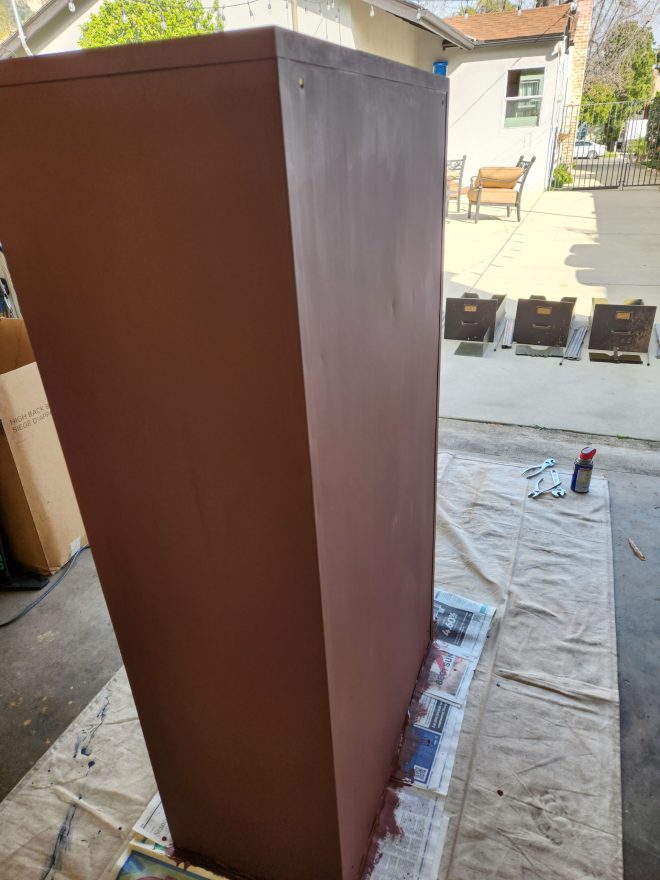
Oblique view of the back side of the filing cabinet with brown primer on. Generally in excellent shape though there are one or two small dings in the piece.

I got out all the drawers and cleaned and vacuumed them out. Then I removed all the hardware including the filing cabinet rods and file stops, the handles, the name plate frames, and the metal shield on the back of the drawer front that prevents files from coming into contact with the drawer handle bolts. It appears that none of the bolts have ever been removed, so it took some WD-40 and some elbow grease to remove them.

The four filing cabinet drawers and associated hardware including file stops, file rods, and roller assemblies.
A close up o one of the drawer fronts in bad shape. Someone appears to have spilled something on the front which has corroded the finish and rusted part of the corner.

Close up angle on the four drawers in the late afternoon sun.

View into a drawer as the bolts from the drawer handle are being removed.
A corroded drawer handle with signs of WD-40 on the threads of the handle attachment.

Drawer handle assembly fully removed with the drawer, the handle, the interior protection plate, and a glass with the nuts and washers.
View of the drawer tipped with it’s face to the ground to show where the protection plate was inserted into the drawer.
The heavily black tarnished drawer label frames and the drawer handles arranged in a grid.
View of the four drawers fully disassembled with all the hardware arranged around them.
View of the back of one of the worst drawers which is showing signs of rusting through its green paint. I’ll probably strip and refinish this portion of the drawer, but the rest will be left in original condition after a thorough cleaning.
The bottom drawer with the drawer face on the ground showing the extent of the rust damage on the back and bottom of the drawer.
Close up of some of the rusting as well as the corroded metal lock stop mechanism on the right rear bottom of the drawer.

I’ll end up sanding, priming, and painting only the front and edges of each of the drawers, though one or two of the bottom drawers will need some rehabilitation work due to rusting.

Finally I spent a part of the early evening removing the heavy tarnish from the metal fittings. A quick magnet test indicates that they’re all ferrous but they appear to be brass plated. So I mixed up a batch of vinegar, salt, and flour paste (~6:1:4) to scrub off the grime and tarnish. After a quick test on one to confirm the results, I spent some serious scrubbing and polishing to get one set of handle, frame, and rod cleaned up. I finished them off with a polishing cloth and the results aren’t half bad, particularly considering their original condition.

Kitchen station set up with vinegar, a tub of flour, a salt cellar, some measuring spoons, a toothbrush and newspaper for removing the corrosion from one of the file rods, a label frame, and one of the drawer pulls. A magnet test indicates that these are steel cores with what is likely brass plating.
Side by side comparison of two file rods. One has been treated and had most of its tarnish removed to reveal a coppery shine and the other is untreated and grimy and brown with hinds of yellow and green.
A before and after of the tarnish on two file name plate frames. Even the prettier of the two still needs some more work.
Before and after comparisons of name plate frames and file rods.

It took some serious work this morning, but I’ve managed to clean off most of the rest of the tarnish on the remaining handles, frames, and filing rods. They look quite nice, though still show some signs of tarnish and patina. I finally gave up on the backs of the handles as they’re so heavily tarnished I’m not sure it’ll ever come off.

Yesterday’s progress on the 4 drawer Shaw-Walker filing cabinet. I’ve emptied the drawers and removed them along with the rollers and hardware. I’ve also stripped all the original paint and a significant amount of rust, though I still have all of the bottom panel left, which is the worst of the rust. I’m still hoping that I can salvage the bottom.

An oblique view of a 4 drawer Shaw-Walker filing cabinet with the drawers removed. The original paint and rust has been stripped off the sides.

Acquisition: Shaw-Walker Furniture Company 4 drawer vintage filing cabinet

On February 7th, I picked up a Shaw-Walker 4 drawer filing cabinet that someone had decided to leave for scrap. Despite some serious rust and a few physical holes on the bottom, most of the cabinet is in reasonable shape and functional. The locking mechanism is still mostly in place, though the piece is missing the locks and keys. Each of the drawers has one or more file stops, of a few different styles.

It contained a handful of paperclips, some sewing patterns, and some check stubs from 1976. I suspect it’s likely from the late 40s to early 60s, but it’ll require some research to track down a more specific manufacturing date as the interior has no immediate clues.

Given the general condition and rust, I think I’m going to fast track it for refinishing this month before I tackle the monster, which portends quite a bit more work and effort.

S.D. Goitein’s Card Index (or Zettelkasten)

Abstract

Scholar and historian S.D. Goitein built and maintained a significant collection of over 27,000 notes in the form of a card index (or zettelkasten1) which he used to fuel his research and academic writing output in the mid to late twentieth century. The collection was arranged broadly by topical categories and followed in the commonplace book tradition though it was maintained on index cards. Uncommon to the space, his card index file was used by subsequent scholars for their own research and was ultimately digitized by the Princeton Geniza Project.

Introduction to S.D. Goitein and his work

Shelomo Dov Goitein (1900-1985) was a German-Jewish historian, ethnographer, educator, linguist, Orientalist, and Arabist who is best known for his research and work on the documents and fragments from the Cairo Geniza, a fragmented collection of some 400,000 manuscript fragments written between the 6th and 19th centuries.

Born in Burgkunstadt, Germany in 1900 to a line of rabbis, he received both a secular and a Talmudic education. At the University of Frankfurt he studied both Arabic and Islam from 1918-1923 under Josef Horovitz and ultimately produced a dissertation on prayer in Islam. An early Zionist activist, he immigrated to Palestine where he spent 34 years lecturing and teaching in what is now Israel. In order to focus his work on the Cairo Geniza, he moved to Philadelphia in 1957 where he lived until he died on February 6, 1985.

After becoming aware of the Cairo Geniza’s contents, S.D. Goitein ultimately devoted the last part of his life to its study. The Geniza, or storeroom, at the Ben Ezra Synagogue was discovered to hold manuscript fragments made of vellum, paper, papyrus, and cloth and written in Hebrew, Arabic, and Aramaic covering a wide period of Middle Eastern, North African, and Andalusian Jewish history. One of the most diverse collections of medieval manuscripts in the world, we now know it provides a spectacular picture of cultural, legal, and economic life in the Mediterranean particularly between the 10th and the 13th centuries. Ultimately the collection was removed from the Synagogue and large portions are now held by a handful of major research universities and academic institutes as well as some in private hands. It was the richness and diversity of the collection which drew Goitein to study it for over three decades.

Research Areas

Goitein’s early work was in Arabic and Islamic studies and he did a fair amount of work with respect to the Yemeni Jews before focusing on the Geniza.

As a classically trained German historian, he assuredly would have been aware of the extant and growing popularity of the historical method and historiography delineated by the influential works of Ernst Bernheim (1899) and Charles Victor Langlois and Charles Seignobos (1898) which had heavily permeated the areas of history, sociology, anthropology, and the humanities by the late teens and early 1920s when Goitein was at university.

Perhaps as all young writers must, in the 1920s Goitein published his one and only play Pulcellina about a Jewish woman who was burned at the stake in France in 1171. [@NationalLibraryofIsrael2021] # It is unknown if he may have used a card index method to compose it in the way that Vladimir Nabokov wrote his fiction.

Following his move to America, Goitein’s Mediterranean Society project spanned from 1967-1988 with the last volume published three years after his death. The entirety of the project was undertaken at the University of Pennsylvania and the Institute for Advanced Study to which he was attached. # As an indicator for its influence on the area of Geniza studies, historian Oded Zinger clearly states in his primer on research material for the field:

The first place to start any search for Geniza documents is A Mediterranean Society by S. D. Goitein. [@Zinger2019] #

Further gilding his influence as a historian is a quote from one of his students:

You know very well the verse on Tabari that says: ‘You wrote history with such zeal that you have become history yourself.’ Although in your modesty you would deny it, we suggest that his couplet applies to yourself as well.”
—Norman Stillman to S.D. Goitein in letter dated 1977-07-20 [@NationalLibraryofIsrael2021] #

In the early days of his Mediterranean Society project, he was funded by the great French Historian Fernand Braudel (1902-1985) who also specialized on the Mediterranean. Braudel had created a center in Paris which was often referred to as a laboratoire de recherches historiques. Goitein adopted this “lab” concept for his own work in American, and it ultimately spawned what is now called the Princeton Geniza Lab. [@PrincetonGenizaLab] #

The Card Index

Basics

In addition to the primary fragment sources he used from the Geniza, Goitein’s primary work tool was his card index in which he ultimately accumulated more than 27,000 index cards in his research work over the span of 35 years. [@Rustow2022] # Goitein’s zettelkasten ultimately consisted of twenty-six drawers of material, which is now housed at the National Library of Israel. [@Zinger2019] #.

Goitein’s card index can broadly be broken up into two broad collections based on both their contents and card sizes:

  1. Approximately 20,000 3 x 5 inch index cards2 are notes covering individual topics generally making of the form of a commonplace book using index cards rather than books or notebooks.
  2. Over 7,000 5 x 8 inch index cards which contain descriptions of a fragment from the Cairo Geniza. [@Marina2022] [@Zinger2019] #

The smaller second section was broadly related to what is commonly referred to as the “India Book” # which became a collaboration between Goitein and M.A. Friedman which ultimately resulted in the (posthumous) book India Traders of the Middle Ages: Documents from the Cairo Geniza “India Book” (2007).

The cards were all written in a variety of Hebrew, English, and Arabic based on the needs of the notes and the original languages for the documents with which they deal.

In addition to writing on cards, Goitein also wrote notes on pieces of paper that he happened to have lying around. [@Zinger2019] # Zinger provides an example of this practice and quotes a particular card which also shows some of Goitein’s organizational practice:

 In some cases, not unlike his Geniza subjects, Goitein wrote his notes on pieces of paper that were lying around. To give but one example, a small note records the location of the index cards for “India Book: Names of Persons” from ‘ayn to tav: “in red \ or Gray \ box of geographical names etc. second (from above) drawer to the left of my desk 1980 in the left right steel cabinet in the small room 1972” is written on the back of a December 17, 1971, note thanking Goitein for a box of chocolate (roll 11, slide 503, drawer13 [2.1.1], 1191v). 

This note provides some indication of some of his arrangements for note taking and how he kept his boxes. They weren’t always necessarily in one location within his office and moved around as indicated by the strikethrough, according to his needs and interests. It also provides some evidence that he revisited and updated his notes over time.

In Zinger’s overview of the documents for the Cairo Geniza, he also provides a two page chart breakdown overview of the smaller portion of Goitein’s 7,000 cards relating to his study of the Geniza with a list of the subjects, subdivisions, microfilm rolls and slide numbers, and the actual card drawer numbers and card numbers. These cards were in drawers 1-15, 17, and 20-22. [@Zinger2019] #

Method

Zinger considers the collection of 27,000 cards “even more impressive when one realizes that both sides of many of the cards have been written on.” [@Zinger2019] Goitein obviously broke the frequent admonishment of many note takers (in both index card and notebook traditions) to “write only on one side” of his cards, slips, or papers. # This admonishment is seen frequently in the literature as part of the overall process of note taking for writing includes the ability to lay cards or slips out on a surface and rearrange them into logical orderings before copying them out into a finished work. One of the earliest versions of this advice can be seen in Konrad Gessner’s Pandectarum Sive Partitionum Universalium (1548).

Zinger doesn’t mention how many of his 27,000 index cards are double-sided, but one might presume that it is a large proportion. # Given that historian Keith Thomas mentions that without knowing the advice he evolved his own practice to only writing on one side [@Thomas2010], it might be interesting to see if Goitein evolved the same practice over his 35 year span of work. #

The double sided nature of many cards indicates that they could have certainly been a much larger collection if broken up into smaller pieces. In general, they don’t have the shorter atomicity of content suggested by some note takers. Goitein seems to have used his cards in a database-like fashion, similar to that expressed by Beatrice Webb [@Webb1926], though in his case his database method doesn’t appear to be as simplified or as atomic as hers. #

Card Index Output

As the ultimate goal of many note taking processes is to create some sort of output, as was certainly the case for Goitein’s work, let’s take a quick look at the result of his academic research career.

S.D. Goitein’s academic output stands at 737 titles based on a revised bibliography compiled by Robert Attal in 2000, which spans 93 pages. [@Attal2000] # # A compiled academia.edu profile of Goitein lists 800 articles and reviews, 68 books, and 3 Festschriften which tracks with Robert Atta’s bibliography. #. Goitein’s biographer Hanan Harif also indicates a total bibliography of around 800 publications. [@NationalLibraryofIsrael2021] #. The careful observer will see that Attal’s list from 2000 doesn’t include the results of S.D. Goitein’s India book work which weren’t published in book form until 2007.

Perhaps foremost within his massive bibliography is his influential and magisterial six volume A Mediterranean Society: The Jewish communities of the Arab World as Portrayed in the Documents of the Cairo Geniza (1967–1993), a six volume series about aspects of Jewish life in the Middle Ages which is comprised of 2,388 pages. # When studying his card collection, one will notice that a large number of cards in the topically arranged or commonplace book-like portion were used in the production of this magnum opus. # Zinger says that they served as the skeleton of the series and indicates as an example:

 …in roll 26 we have the index cards for Mediterranean Society, chap. 3, B, 1, “Friendship” and “Informal Cooperation” (slides 375–99, drawer 24 [7D], 431–51), B, 2, “Partnership and Commenda” (slides 400–451, cards 452–83), and so forth. #

Given the rising popularity of the idea of using a zettelkasten (aka slip box or card index) as a personal knowledge management tool, some will certainly want to compare the size of Goitein’s output with that of his rough contemporary German sociologist Niklas Luhmann (1927-1990). Luhmann used his 90,000 slip zettelkasten collection to amass a prolific 550 articles and 50 books. [@Schmidt2016]. Given the disparity in the overall density of cards with respect to physical output between the two researchers one might suspect that a larger proportion of Goitein’s writing was not necessarily to be found within his card index, but the idiosyncrasies of each’s process will certainly be at play. More research on the direct correlation between their index cards and their writing output may reveal more detail about their direct research and writing processes.

Digital Archive

Following his death in February 1985, S.D. Goitein’s papers and materials, including his twenty-six drawer zettelkasten, were donated by his family to the Jewish National and University Library (now the National Library of Israel) in Jerusalem where they can still be accessed. [@Zinger2019] #

In an attempt to continue the work of Goitein’s Geniza lab, Mark R. Cohen and A. L. Udovitch made arrangements for copies of S.D. Goitein’s card index, transcriptions, and photocopies of fragments to be made and kept at Princeton before the originals were sent. This repository then became the kernel of the modern Princeton Geniza Lab. [@PrincetonGenizaLaba] # #

Continuing use as an active database and research resource

The original Princeton collection was compacted down to thirty rolls of microfilm from which digital copies in .pdf format have since been circulating among scholars of the documentary Geniza. [@Zinger2019] #

Goitein’s index cards provided a database not only for his own work, but for those who studied documentary Geniza after him. [@Zinger2019] # S.D. Goitein’s index cards have since been imaged and transcribed and added to the Princeton Geniza Lab as of May 2018. [@Zinger2019] Digital search and an index are also now available as a resource to researchers from anywhere in the word. #

Historically it has generally been the case that repositories of index cards like this have been left behind as “scrap heaps” which have meant little to researchers other than their originator. In Goitein’s case his repository has remained as a beating heart of the humanities-based lab he left behind after his death.

In Geniza studies the general rule of thumb has become to always consult the original of a document when referencing work by other scholars as new translations, understandings, context, history, and conditions regarding the original work of the scholar may have changed or have become better understood.[@Zinger2019] # In the case of the huge swaths of the Geniza that Goitein touched, one can not only reference the original fragments, but they can directly see Goitein’s notes, translations, and his published papers when attempting to rebuild the context and evolve translations.

Posthumous work

Similar to the pattern following Walter Benjamin’s death with The Arcades Project (1999) and Roland Barthes’ Mourning Diary (2010), Goitein’s card index and extant materials were rich enough for posthumous publications. Chief among these is India Traders of the Middle Ages: Documents from the Cairo Geniza “India Book.” (Brill, 2007) cowritten by Mordechai Friedman, who picked up the torch where Goitein left off. # # However, one must notice that the amount of additional work which was put into Goitein’s extant box of notes and the subsequent product was certainly done on a much grander scale than these two other efforts.

Notes per day comparison to other well-known practitioners

Given the idiosyncrasies of how individuals take their notes, the level of their atomicity, and a variety of other factors including areas of research, other technology available, slip size, handwriting size, etc. comparing people’s note taking output by cards per day can create false impressions and dramatically false equivalencies. This being said, the measure can be an interesting statistic when taken in combination with the totality of these other values. Sadly, the state of the art for these statistics on note taking corpora is woefully deficient, so a rough measure of notes per day will have to serve as an approximate temporary measure of what individuals’ historical practices looked like.

With these caveats firmly in mind, let’s take a look at Goitein’s output of roughly 27,000 cards over the span of a 35 year career: 27,000 cards / [35 years x 365 days/year] gives us a baseline of approximately 2.1 cards per day. #. Restructuring this baseline to single sided cards, as this has been the traditional advice and practice, if we presume that 3/4ths of his cards were double-sided we arrive at a new baseline of 3.7 cards per day.

Gotthard Deutch produced about 70,000 cards over the span of about 17 years giving him an output of about 11 cards per day. [@Lustig2019] #

Niklas Luhmann’s collection was approximately 90,000 cards kept over about 41 years giving him about 6 cards per day. [@Ahrens2017] #

Hans Blumenberg’s zettelkasten had 30,000 notes which he collected over 55 years averages out to 545 notes per year or roughly (presuming he worked every day) 1.5 notes per day. [@Kaube2013] #

Roland Barthes’ fichier boîte spanned about 37 years and at 12,250 cards means that he was producing on average 0.907 cards per day. [@Wilken2010] If we don’t include weekends, then he produced 1.27 cards per day on average. #

Finally, let’s recall again that it’s not how many thoughts one has, but their quality and even more importantly, what one does with them which matter in the long run. # Beyond this it’s interesting to see how influential they may be, how many they reach, and the impact they have on the world. There are so many variables hiding in this process that a fuller analysis of the statistical mechanics of thought with respect to note taking and its ultimate impact are beyond our present purpose.

Further Research

Based on a cursory search, no one seems to have picked up any deep research into Goitein’s card collection as a tool the way Johannes F.K. Schmidt has for Niklas Luhmann’s archive or the Jonathan Edwards Center at Yale has for Jonathan Edwards’ Miscellanies Index.

Goitein wrote My Life as a Scholar in 1970, which may have some methodological clues about his work and method with respect to his card index. He also left his diaries to the National Library of Israel as well and these may also have some additional clues. # Beyond this, it also stands to reason that the researchers who succeeded him, having seen the value of his card index, followed in his footsteps and created their own. What form and shape do those have? Did he specifically train researchers in his lab these same methods? Will Hanan Harif’s forthcoming comprehensive biography of Goitein have additional material and details about his research method which helped to make him so influential in the space of Geniza studies? Then there are hundreds of small details like how many of his cards were written on both sides? # Or how might we compare and contrast his note corpus to others of his time period? Did he, like Roland Barthes or Gotthard Deutch, use his card index for teaching in his earlier years or was it only begun later in his career?

Other potential directions might include the influence of Braudel’s lab and their research materials and methods on Goitein’s own. Surely Braudel would have had a zettelkasten or fichier boîte practice himself?

References

Footnotes

  1. In my preliminary literature search here, I have not found any direct references to indicate that Goitein specifically called his note collection a “Zettekasten”. References to it have remained restricted to English generally as a collection of index cards or a card index.↩︎
  2. While not directly confirmed (yet), due to the seeming correspondence of the number of cards and their corpus descriptions with respect to the sizes, it’s likely that the 20,000 3 x 5″ cards were his notes covering individual topics while the 7,000 5 x 8″ cards were his notes and descriptions of a single fragment from the Cairo Geniza. #↩︎

A Note on the Cargo Cult of Zettelkasten

Modern cargo cults can be seen in many technology and productivity spaces where people are pulled in by exaggerated (or sometimes even real claims) of productivity or the general “magic” of a technology or method.

An example is Niklas Luhmann’s use of his zettelkasten which has created a cargo cult of zettelkasten aspirants and users who read one or more of the short one page blog posts about his unreasonable productivity and try to mimic it without understanding the system, how it works, or how to make it work for them. They often spend several months collecting notes, and following the motions, but don’t realize the promised gains and may eventually give up, sometimes in shame (or as so-called “rubbish men”) while watching others still touting its use.

To prevent one’s indoctrination into the zettelkasten cult, I’ll make a few recommendations:

Distance yourself from the one or two page blog posts or the breathless YouTube delineations. Ask yourself very pointedly: what you hope to get out of such a process? What’s your goal? Does that goal align with others’ prior uses and their outcomes?

Be careful of the productivity gurus who are selling expensive courses and whose focus may not necessarily be on your particular goals. Some are selling very pointed courses, which is good, while others are selling products which may be so broad that they’ll be sure to have some success stories, but their hodge-podge mixture of methods won’t suit your particular purpose, or worse, you’ll have to experiment with pieces of their courses to discover what may suit your modes of working and hope they’ll suffice in the long run. Some are selling other productivity solutions for task management like getting things done (GTD) or bullet journals, which can be a whole other cargo cults in and of themselves. Don’t conflate these!1 The only thing worse than being in a cargo cult is being in multiple at the same time.

If you go the digital route, be extremely wary of shiny object syndrome. Everyone has a favorite tool and will advocate that it’s the one you should be using. (Often their method of use will dictate how much they love it potentially over and above the affordances of the tool itself.) All of these tools can be endlessly configured, tweaked, or extended with plugins or third party services. Everyone wants to show you their workflow and set up, lots of which is based on large amounts of work and experimentation. Ignore 99.999% of this. Most tools are converging to a similar feature set, so pick a reasonable one that seems like it’ll be around in 5 years (and which has export, just in case). Try out the very basic features for several months before you change anything. Don’t add endless plugins and widgets. You’re ultimately using a digital tool to recreate the functionality of index cards, a pencil, and a box. How complicated should this really be? Do you need to spend hundreds of hours tweaking your system to save yourself a few minutes a year? Be aware that far too many people touting the system and marketers talking about the tools are missing several thousands of years of uses of some of these basic literacy-based technologies. Don’t join their island cult, but instead figure out how the visiting culture has been doing this for ages.2 Recall Will Hunting’s admonition against cargo cults in education: “You wasted $150,000 on an education you coulda got for $1.50 in late fees at the public library.”3

Most people ultimately realize that the output of their own thinking is only as good as the inputs they’re consuming. Leverage this from the moment you begin and ignore the short bite-sized advice for longer form or older advice from those with experience. You’re much more likely to get more long term value out of reading Umberto Eco or Mortimer J. Adler & Charles van Doren4 than you are an equivalent amount of time reading blog posts, watching YouTube videos, or trolling social media like Reddit and Twitter.

Realize that reaching your goal is going to take honest-to-goodness actual work, though there is potential for fun. No matter how shiny or optimized your system, you’ve still got to do the daily work of reading, watching, listening and using it to create anything. Focus on this daily work and don’t get sidetracked by the minutiae of trying to shave off just a few more seconds.5 In short, don’t get caught up in the “productivity porn” of it all. Even the high priest at whose altar they worship once wrote on a slip he filed:

A ghost in the note card index? Spectators visit [my office to see my notes] and they get to see everything and nothing all at once. Ultimately, like having watched a porn movie, their disappointment is correspondingly high.
—Niklas Luhmann. “Geist im Kasten?”6

Choose only one of the following and remember you may not need to read the entire work:

Ahrens, Sönke. How to Take Smart Notes: One Simple Technique to Boost Writing, Learning and Thinking – for Students, Academics and Nonfiction Book Writers. Create Space, 2017.

Allosso, Dan, and S. F. Allosso. How to Make Notes and Write. Minnesota State Pressbooks, 2022. https://minnstate.pressbooks.pub/write/.

Bernstein, Mark. Tinderbox: The Tinderbox Way. 3rd ed. Watertown, MA: Eastgate Systems, Inc., 2017. http://www.eastgate.com/Tinderbox/TinderboxWay/index.html.

Dow, Earle Wilbur. Principles of a Note-System for Historical Studies. New York: Century Company, 1924.

Eco, Umberto. How to Write a Thesis. Translated by Caterina Mongiat Farina and Geoff Farina. 1977. Reprint, Cambridge, MA, USA: MIT Press, 2015. https://mitpress.mit.edu/books/how-write-thesis.

Gessner, Konrad. Pandectarum Sive Partitionum Universalium. 1st Edition. Zurich: Christoph Froschauer, 1548.

Goutor, Jacques. The Card-File System of Note-Taking. Approaching Ontario’s Past 3. Toronto: Ontario Historical Society, 1980. http://archive.org/details/cardfilesystemof0000gout.

Sertillanges, Antonin Gilbert, and Mary Ryan. The Intellectual Life: Its Spirit, Conditions, Methods. First English Edition, Fifth printing. 1921. Reprint, Westminster, MD: The Newman Press, 1960. http://archive.org/details/a.d.sertillangestheintellectuallife.

Webb, Sidney, and Beatrice Webb. Methods of Social Study. London; New York: Longmans, Green & Co., 1932. http://archive.org/details/b31357891.

Weinberg, Gerald M. Weinberg on Writing: The Fieldstone Method. New York, N.Y: Dorset House, 2005.


Footnotes

  1. Aldrich, Chris. “Zettelkasten Overreach.” BoffoSocko (blog), February 5, 2022. https://boffosocko.com/2022/02/05/zettelkasten-overreach/.↩︎
  2. Blair, Ann M. Too Much to Know: Managing Scholarly Information before the Modern Age. Yale University Press, 2010. https://yalebooks.yale.edu/book/9780300165395/too-much-know.↩︎
  3. Good Will Hunting. Miramax, Lawrence Bender Productions, 1998.↩︎
  4. Adler, Mortimer J., and Charles Van Doren. How to Read a Book: The Classic Guide to Intelligent Reading. Revised and Updated edition. 1940. Reprint, New York: Simon & Schuster, 1972.↩︎
  5. Munroe, Randall. “Is It Worth the Time?” Web comic. xkcd, April 29, 2013. https://xkcd.com/1205/.↩︎
  6. Luhmann, Niklas. ZKII 9/8,3. Niklas Luhmann-Archiv. Accessed December 10, 2021. https://niklas-luhmann-archiv.de/bestand/zettelkasten/zettel/ZK_2_NB_9-8-3_V. (Personal translation from German with context added.)↩︎
A or commonplace provides a catalytic surface to which ideas in the “solution of life” can more easily adhere to speed their reaction with ideas you’ve already seen and collected.
Once combined via linking, further thinking and writing, they can be released as novel ideas for everyone to use.
I suspect that it’s by design, but I’m noticing that there’s a well curated “Getting Started” tab on https://zettelkasten.de/, but there’s absolutely no sign of any documentation about “Finishing”. Would someone just slip me into a box when I’m done?
📖 A new incarnation of Dan Allosso’s Obsidian Book Club begins this coming weekend with David Graeber’s last book Pirate Enlightenment, or the Real Libertalia (2023). If you’re interested in history, anthropology, or our conceptualizations of freedom, racism, and erasure, this is sure to be your cup of tea. Come join us.

Read Top Ed-Tech Trends of 2015: Indie Ed-Tech by Audrey WattersAudrey Watters (Hack Education)
This is the ninth article in my series Top Ed-Tech Trends of 2015

And this resistance is happening… 

This link (on resistance) rotted, but can be found at https://web.archive.org/web/20160305223237/http://www.elearnspace.org/blog/2015/09/09/adios-ed-tech-hola-something-else/
Annotated on May 16, 2020 at 11:49AM

Here’s what I wrote last year when I chose “the Indie Web” as one of the “Top Ed-Tech Trends of 2014”

I want to go back and read this too.
Annotated on May 16, 2020 at 12:06PM

The Indie Web posits itself as an alternative to the corporate Web, but it is a powerful alternative to much of ed-tech as well, which as this series has once again highlighted, is quite committed to controlling and monetizing students’ and teachers’ connections, content, and data. 

Annotated on May 16, 2020 at 12:08PM

I mean, what does an alternative to ed-tech as data-extraction, control, surveillance, privatization, and profiteering look like? What does resistance to the buzzwords and the bullshit look like? I don’t have an answer. (There isn’t an answer.) But I think we can see a glimmer of possibility in the Indie Web Movement. It’s enough of a glimmer that I’m calling it a trend. 

For Audrey Watters (the self-described Cassandra of EdTech) to indicate even a glimmer of hope is rare! This ranks as a glowing recommendation as a result.
Annotated on May 16, 2020 at 12:08PM

Quantum mechanics anyone? Dozens have been disappointed by UCLA’s administration ineptly standing in the way of Dr. Mike Miller being able to offer his perennial Winter UCLA math class (Ring Theory this quarter), so a few friends and I are putting our informal math and physics group back together.

We’re mounting a study group on quantum mechanics based on Peter Woit‘s Introduction to Quantum Mechanics course from 2022. We’ll be using his textbook Quantum Theory, Groups and Representations:An Introduction (free, downloadable .pdf) and his lectures from YouTube.

Shortly, we’ll arrange a schedule and some zoom video calls to discuss the material. If you’d like to join us, send me your email or leave a comment so we can arrange meetings (likely via Zoom or similar video conferencing).

Our goal is to be informal, have some fun, but learn something along the way. The suggested mathematical background is some multi-variable calculus and linear algebra. Many of us already have some background in Lie groups, algebras, and representation theory and can hopefully provide some help for those who are interested in expanding their math and physics backgrounds.

Everyone is welcome! 

Yellow cover of Quantum Theory, Groups and Representations featuring some conic sections in the background