

Instagram filter used: Normal
Photo taken at: Gerrish Swim & Tennis Club
Instagram filter used: Normal
Photo taken at: Gerrish Swim & Tennis Club
I also believe a lady doesn’t discuss her age or her budget.
Innovate Pasadena presents Jacob Reitzin on: “Bootstrapping Technology and Great User Experience” at Cross Campus, Old Town Pasadena, 87 N Raymond Ave., Pasadena, CA 91103 on : –
Jacob gave a nice and humanizing presentation on some of the philosophy behind his startup. Though he didn’t get very deep into the topic indicated by the title of his talk, he was very engaging in exactly the manner you’d expect that a dude with a truck could be.

We met at Charlie’s Coffee House, 266 Monterey Road, Pasadena, CA.
The quiet writing hour started off quiet with Angelo holding down the fort while others were stuck in interminable traffic, but if the IRC channel is any indication, he got some productive work done.
Participants included:
Following introductions, I did a demo of the browser-based push notifications I enabled on this site about a week ago and discussed some pathways to help others explore options for doing so on theirs. Coincidentally, WordPress.com just unveiled some functionality like this yesterday that is more site-owner oriented than user oriented, so I’ll be looking into that functionality shortly.
Angelo showed off some impressive python code which he’s preparing to opensource, but just before the meeting had managed to completely bork his site, so everyone got a stunning example of a “502 Bad Gateway” notice.
At the break, we were so engaged we all completely forgot to either take a break or do the usual group photo. My 1 minute sketch gives a reasonable facsimile of what a photo would have looked like.
With a new group, we spent some time discussing some general Indieweb principles, outlining ideas, and example projects.
Since Michael was very new to the group, we helped him install the WordPress IndieWeb plugin and configure a few of the sub-plugins to get him started. We discussed some basic next steps and pointers to the WordPress documentation to provide him some direction for building until we meet again.
We spent a few minutes discussing the upcoming IndieWebCamp logistics as well as outreach to the broader Los Angeles area community.
For a new group, there’s enough enthusiasm to do at least two meetings a month, in keeping with the broader Homebrew movement, so we’re already committed to our next meeting on August 24. It’s tentatively at the same location unless a more suitable one comes along prior to then.
Thanks for coming everyone! We’ll see you next time.

Infuriatingly it usually involved having just spent 5 minutes reading something and then spending 10 minutes to hours writing a reasoned and thoughtful response. (Because every troll knows that’s what the internet was designed to encourage, right?)
After pressing the reply button (even scarier than hitting the “Publish” button because you don’t have the ability to edit it after-the-fact and someone else now “owns” your content), you see the dreaded notice that your comment is “AWAITING MODERATION…”
Will they approve it? Will they delete it? Is it gone forever? Did they really get it, or did it disappear into the ether? Oh #%@$!, I wish I’d made a back up copy because that took a bit of work, and I might like to refer to it again later. Are they going to censor my thoughts? Silence my voice?
I completely get the need for moderation on the web, particularly as almost no one is as kind, considerate, courteous, or civil as my friend P.M. Forni. (And who could be — he literally wrote the book(s) on the subject!)
On a daily basis, I’m spammed by sites desperate to sell or promote FIFA coins, Ray Bans, Christian Louboutin shoes, or even worse types of hateful blather, so I too gently moderate. I try to save my own readers from having to see such drivel, and don’t want to provide a platform or audience for them to shout from or at, respectively.
No longer can I be silenced by random moderators that I often don’t know.
Why, you ask?
I now post everything I write online onto a site I own first.
Because now, thanks to philosophies from the Indieweb movement and technologies like webmention, which growing numbers of websites are beginning to support, I now post everything I write online onto a site I own first. There it can be read in perpetuity by anyone who chooses to come read it, or from where I can syndicate it out to the myriad of social media sites for others to read en masse. (And maybe my voice has more reach than the site I’m posting to?)
Functionality like webmention (a more modern version of pingback or trackback) then allows my content to be sent to the website I was replying to in an elegant way for (eventual?) display. Or I can copy and paste it directly if they don’t support modern protocols.
Sure, they can choose to moderate me or choose not to feature my viewpoint on their own site if they wish, but at least I still own the work I put into those thoughts. I don’t have to worry about where they went or how I might be able to find them in the future. They will always be mine, and that is empowering.
Would you like to own your own data? Own your own domain? Free yourself from the restrictions of the social media silos like Facebook, Instagram, and Twitter? Visit Indieweb.org to see how you can do these things. Chat with like-minded individuals who can also help you out. Attend an upcoming IndieWebCamp or a local Homebrew Website Club in your area, or start one of your own!
Of course anyone who truly loves books buys more of them than he or she can hope to read in one fleeting lifetime. A good book, resting unopened in its slot on a shelf, full of majestic potentiality, is the most comforting sort of intellectual wallpaper.
A push notification (AKA client notification) is a notification that shows up on one or more of your client devices without you having to explicitly request it — it’s “pushed” to you, instead of you having to poll for it. –Source: IndieWeb.org
Today I came across a beta web service called Pushpad that provides easy-to-install push notifications. As a result, for people who spend a lot of time in front of their screens, they can now subscribe to updates on the site here via web browser push notifications. Subscribers will get a small toaster-like pop up notification in real time on their screen to indicate that new content was published.

The service was quick and simple to set up with lots of documentation. While geared at large corporations looking for a simple turnkey implementation for push notifications on most major web browsers, it’s also easily usable by smaller sites. Even better it’s free for providing less than 10,000 notifications a month, which covers most small sites.
They provide an “Express” version that requires no serious technical skills and sets up in just a few minutes and a separate “Pro” version which provides a lot of additional customization (including a white labeled version) for those with the development skills to implement it.
For those on WordPress, they also have an easy to use plugin.
Pushpad supports the Push API for Chrome and Firefox and APNs for Safari.
Pushpad also supports integration with Zapier (currently in beta), which means that any of the hundreds of applications that are integrated with Zapier can be used to create push notifications on the desktop. Hopefully they include IFTTT.com soon too. I’m already using Pushbullet with IFTTT for integration between my Android phone and my desktop, but additional integrations for personalized notifications could be cool.
But maybe you’re hard core? If you prefer not relying on outside services, you can always build your own push notifications! In particular, IndieWeb.org provides some thoughts and tips about how to implement these for yourself based on open web standards.
Now that we’ve been talking about them, would you like to try receiving them in the future? You can subscribe to push notifications for my blog by simply clicking on the icon below and then authenticating your subscription:

Not into push notifications? Maybe this isn’t your favorite way to find out about my content? If not, I offer a number of other ways to subscribe and consume my content.
We met at Starbucks, 575 South Lake Avenue, Pasadena, CA.
The quiet writing hour started off pretty well with three people which quickly grew to 6 at the official start of the meeting including what may be the youngest participants ever (at 6months and 5 1/2 years old).
#indieweb @ChrisAldrich: Quiet writing hours for the first Homebrew Website Club in Pasadena, CA are in full swing. 4 people already here.
— ChrisAldrich (@ChrisAldrich) July 28, 2016
Participants included:
Following introductions, I did a quick demo of the simple workflow I’ve been slowly perfecting for liking/retweeting posts from Twitter via mobile so that they post on my own site while simultaneously POSSEing to Twitter. Angelo showed a bit of his code and set-up for his custom-built site based on a Python framework and inspired by Aaron Schwartz’s early efforts. (He also has an interesting script for scraping other’s sites searching for microformats data with a mf2 parser that I’d personally like to see more of and hope he’ll open source it. It found a few issues with some redundant/malformed rel=”me” links in the header of my own site that I’ll need to sort out shortly).
Bryan showed some recent work he’s done on his photography blog, which he’s slowly but surely been managing to cobble together from a self-hosted version of WordPress with help from friends and the local WordPress Meetup. (Big kudos to him for his sheer tenacity in building his site up!) Jervey described some of what he’d like to build as it relates to a WordPress based site he’s putting together for a literary journal, while his daughter slept peacefully until someone mentioned a silo named Facebook. 5 year old Evie showed off some coding work she’d done during the quiet writing hour on the Scratch Platform on iOS that she hopes to post to her own blog shortly, so she can share with her grandparents.
At the break, we managed to squeeze everyone in for a group selfie.
Since many in the group were building with WordPress, we did a demo build on Evie’s (private) site by installing the IndieWeb Plugin and activating and configuring a few of the basic sub-plugins. We then built a small social links menu to demonstrate the ease of adding rel-me to an Instagram link as an example. We also showed a quick example of IndieAuth, followed by a quick build for doing PESOS from Instagram with proper microformats2 markup. Bryan had a few questions about his site from the first half of the meeting, so we wrapped up by working our way through a portion of those so he can proceed with some additional work before our next meeting.
In all, not a bad showing for what I expected to be a group of 5 less people than what we ultimately got! I can’t wait until the next meetup on either 8/10 or 8/24 (at the very worst) pending some scheduling. I hope to do every two weeks, but we’ll definitely commit to do at least once a month going forward.
Course Description
Complex analysis is one of the most beautiful and useful disciplines of mathematics, with applications in engineering, physics, and astronomy, as well as other branches of mathematics. This introductory course reviews the basic algebra and geometry of complex numbers; develops the theory of complex differential and integral calculus; and concludes by discussing a number of elegant theorems, including many–the fundamental theorem of algebra is one example–that are consequences of Cauchy’s integral formula. Other topics include De Moivre’s theorem, Euler’s formula, Riemann surfaces, Cauchy-Riemann equations, harmonic functions, residues, and meromorphic functions. The course should appeal to those whose work involves the application of mathematics to engineering problems as well as individuals who are interested in how complex analysis helps explain the structure and behavior of the more familiar real number system and real-variable calculus.
Prerequisites
Basic calculus or familiarity with differentiation and integration of real-valued functions.
Details
MATH X 451.37 – 268651 Introduction to Complex Analysis
Fall 2016
Time 7:00PM to 10:00PM
Dates Tuesdays, Sep 20, 2016 to Dec 06, 2016
Contact Hours 33.00
Location: UCLA, Math Sciences Building
Standard credit (3.9 units) $453.00
Instructor: Michael Miller
Register Now at UCLA
For many who will register, this certainly won’t be their first course with Dr. Miller — yes, he’s that good! But for the newcomers, I’ve written some thoughts and tips to help them more easily and quickly settle in and adjust:
Dr. Michael Miller Math Class Hints and Tips | UCLA Extension
I often recommend people to join in Mike’s classes and more often hear the refrain: “I’ve been away from math too long”, or “I don’t have the prerequisites to even begin to think about taking that course.” For people in those categories, you’re in luck! If you’ve even had a soupcon of calculus, you’ll be able to keep up here. In fact, it was a similar class exactly a decade ago by Mike Miller that got me back into mathematics. (Happy 10th math anniversary to me!)
I look forward to seeing everyone in the Fall!
Dr. Miller is back from summer vacation and emailed me this morning to say that he’s chosen the textbook for the class. We’ll be using Complex Analysis with Applications by Richard A. Silverman. [1]

(Note that there’s another introductory complex analysis textbook from Silverman that’s offered through Dover, so be sure to choose the correct one.)
As always in Dr. Miller’s classes, the text is just recommended (read: not required) and in-class notes are more than adequate. To quote him directly, “We will be using as a basic guide, but, as always, supplemented by additional material and alternate ways of looking at things.”
The bonus surprise of his email: He’s doing two quarters of Complex Analysis! So we’ll be doing both the Fall and Winter Quarters to really get some depth in the subject!
If you’re like me, you’ll probably take a look at some of the other common (and some more advanced) textbooks in the area. Since I’ve already compiled a list, I’ll share it:

Instagram filter used: Juno
[recipe title=”Slow Cooker Turkey Chili” servings=”15-20″ time=”8hr total; 1hr prep” difficulty=”easy” image=”http://i1.wp.com/boffosocko.com/wp-content/uploads/2016/07/1468784678.jpg” description=”A modifiable crock pot chili recipe”]
I always prefer a chili recipe with a higher proportion of meat, so this recipe goes much heaver in that department than most. Naturally, high quality ground beef can be substituted for the somewhat healthier turkey if preferred. The beans can be cooked in with the chili simultaneously, but I typically prefer to cook them separately for better doneness and quality as well as well as closer control of the overall soupiness of the chili.
[recipe-ingredients]
– 3 tablespoons of olive oil or vegetable oil
– 6 oz tomato paste
– 6 tablespoons chili powder
– 2 tablespoon ground cumin
– 3/4 – 1.5 teaspoon cayenne pepper (depending on one’s tolerance for heat)
– 3 pounds ground turkey (preferably dark meat), (could substitute ground beef)
– 1 teaspoon of Kosher salt
– ground pepper
– Two 28-ounce cans of (fire-roasted) diced tomatoes
– 1/4 – 1/2 cup unsweetened cocoa powder
– 3 tablespoons red wine vinegar
– 2 tablespoon dried oregano
– 1 medium to large onion, diced
– 1 red bell pepper, diced
– 2 green peppers, diced
– 2 cups crushed corn tortilla chips
– 3 cloves garlic, finely minced
– 4 stalks of celery, finely diced
– 4 carrots, finely diced
[/recipe-ingredients]
[recipe-ingredients title=”Ingredients for pinto beans”]
– 3.5 cups of pinto beans
– 1/2 onion chopped
– 1 clove of garlic
– 1.5 teaspoon of bouillon (or 3 cups of chicken broth)
– 1/2 teaspoon Kosher salt
[/recipe-ingredients]
[recipe-ingredients title=”Optional ingredients for toppings and serving”]
– sliced scallions or 1/2 raw onion chopped
– shredded/grated sharp cheddar cheese
– sour cream
– chopped (pickled) jalapeno
– corn tortilla chips (or cornbread or white rice)
[/recipe-ingredients]
[recipe-directions]
– Bring the pinto beans, onion, garlic, and bouillon in a large pot with an equal amount of salted water to a low boil. Then reduce the heat and cook on low for 3-4 hours until done. Add additional water if necessary during coooking, but don’t allow the beans to become too soupy. Stir regularly to prevent burning to the bottom of the pan.
– Put the tomatoes, celery, carrots, onions, peppers, cocoa powder, vinegar, oregano, garlic, crushed tortilla chips, and a teaspoon salt into a covered 6+ quart slow cooker over low heat for 6 hours.
– While the above are beginning to cook, heat the oil in a large nonstick pan over medium-high heat with the tomato paste, chili powder, cumin and cayenne and cook for about 2-3 minutes, stirring regularly, until the mixture is dark red and dry in texture. Add the ground turkey, previously seasoned with 1 teaspoon salt, and cook while stirring and breaking up into smaller pieces, until mixture is thoroughly combined. (The turkey doesn’t need to be cooked all the way through but should ideally be browned for better maillard reaction and subsequent flavor).
– When the oil, paste, and turkey mixture is done, mix it in with the tomatoes, celery, carrots, et al, and finish cooking. Stir occasionally.
– As the turkey/vegetable portion and the beans are done, mix them together in equal measure, and season with salt and pepper to taste.
– Serve with scallions, cheddar, sour cream, and pickled jalapeno over tortilla chips. (One could also substitute cornbread or even rice for the tortilla chips for alternate variations.)
[/recipe-directions]
[recipe-notes]
Optional cocoa powder may seem a bit out of place in most chilies, but it can serve two functions here: it adds some depth of flavor (without being chocolaty as one may expect) while simultaneously thickening the sauce in the chili.
The celery, carrots, onions, and peppers are all also optional: they can be used to enhance/modify taste, but also add to not only the overall heartiness, but make the dish more veggie friendly for children without detriment to flavor or presentation.
I suggest serving the chili on a bed of tortilla chips (which can also function as a makeshift spoon or eating implement), but it can also be great with cornbread or even served over rice as additional options.
Leftovers can be refrigerated or even frozen (for several weeks) if necessary.
[/recipe-notes]
[/recipe]
Indeed, libraries are meant to store, protect, and help disseminate information. These functions alone should make them ground zero for the philosophies of owning your own data and making one more connected to their community which underpin the IndieWeb. Shouldn’t they? It almost makes me suspicious that all libraries aren’t part of the IndieWeb movement.
Now sadly, this particular library is ridiculously small, but that doesn’t make it any less important or special. If anything, it’s even more special now because Little Free Library #8424 (Adams Hill) is a proud member of the IndieWeb.
(And yes, for those interested, the library definitely also accepts Indie Book donations!)
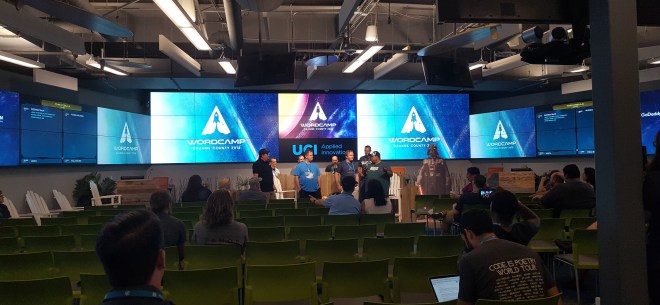
The camp sold out in just hours a month and change ago, in part because it was limited to about 200 people given the fantastic space provided by UC Irvine’s Advanced Innovation. There aren’t many spaces one could go with such spectacular amenities and support in addition to a huge plethora of screens, recording equipment, and audio/visual supplements. Thanks for hosting us Applied Innovation!
Sadly the limited space meant that some people missed out, and the most unrepresented group was likely new users who may not have heard about it in time to get tickets. However, this didn’t mean that anyone else was underrepresented: there were attendees of every ability, age (10 months to over 90), race, sex and creed. I was honestly astounded by the diversity of people in attendance.

One of the best programming decisions was having food trucks show up to cater lunch, which kept everyone close and socially engaged rather than dispersing everyone to the wind by means of forcing outside food options.
Sadly, even knowing that Sundays are always slower than Saturdays, there were 2-3 empty rooms with no sessions at all on Sunday afternoon. I wish there had been some type of offering to assist in putting together impromptu sessions or BoF sessions in these empty rooms. Alternately doing a beginner build track on Sunday and releasing “Sunday only” tickets might have been interesting and also better utilized the space.
Below are some thoughts on the individual sessions I attended. Most should be on WordPress.TV shortly and nearly everyone was posting slides.
This was a great quick introduction to most of the basics of WP Core and at just about the right time as I’ve been wanting to delve more directly into portions for a few projects. I’d definitely recommend the slide deck once it’s posted. This was one of my favorite sessions of the weekend.
This was one of the more entertaining sessions and had more conversation back and forth than any camp session I’ve ever attended. Sadly it stayed to the basics and in a room which seemed to have some more advanced participants, I wish it had gone further.
This was mostly what I expected, but included some additional tips that I didn’t know existed. In particular, knowing that I can provide formatting for others when they oEmbed my site is something I’ll have to look into.
I’ve played a bit with SVG’s but hadn’t delved into them very significantly. This was a good overview/crash course on some of the particulars.
This was a nice start to some intro information on talking about design patterns, but I would have preferred something at the intermediate or advanced level. In particular, it made me consider some quirky potential new visual grammars for mobile use (particularly in advertising). It also inspired me to think about creating a disorenting experience built on the visual/time grammar of the movie Inception.
Aaron was a fun and very dynamic speaker who obviously truly loves his topic. This was by far the best session I attended over the weekend. I want to try to get Elastic Search and ElasticPress set up on my site soon as it looks like what modern search should be on a website.
I’m somewhat shocked I’d never thought of doing this myself before, but just knowing the concept exists is more than half the battle. The sad part is that it sounds like for half the stuff you get for free, one needs to rebuild or re-engineer something else to get it working.
Andy is a practicing physician and a great WordPress “hobby-ist” who drove in from Palm Springs to give a great overview of the philosophy of Open Source and a broad range of tools used to help further that goal. One can’t help but be affected by his enthusiasm.
For a session meant to be primarily entertainment, I was actually surprised to learn about coding/development by hearing a panel of others critique four plugins. Condensed down, this could have been a session on the intangible things one would want to think about before building a plugin.
Everyone can be put into a better mindset to help others. This was a great presentation for just that.

Because one just can’t get enough, I can’t wait to attend WordCamp LA on September 10th & 11th at Cal State University Los Angeles.
Since they’ve already made a Call for Speakers for the LA camp, I’ve already submitted the following talk application which focuses on the IndieWeb:
The IndieWeb is a people-focused alternative to the “corporate web” which has recently been covered in Wired, Fast Company, The Atlantic, The New Republic, Newsweek, and Slate. It encourages everyone to own their own data/content, be better connected to engage with everyone, and provide users with more control of their content and identity online. With the rise of social media silos everyone is seemingly incentivized to split up their online identity to participate in multiple various communities and a variety of platforms which are often bought out, shut down, or simply disappear, very often taking users’ data with them.
Why not allow your own WordPress site to truly be your primary hub online? Post your content on your own site/server so that you not only own it, but then, if you choose, syndicate it out to social media networks in a native and simpler fashion to take advantage of their network effects and engagement. Even better, new web specs like WebMention from the W3C (essentially a universal/internet-wide method of @mention) allow you to easily bring back comments, likes, and similar data back to your original post as native comments. You can now truly own all of the data and subsequent related data (comments) you place on most major social networks.
In this session we’ll briefly cover the basic history and philosophy of the IndieWeb movement before moving into more advanced topics like microformats, WebMention, IndieAuth, micropub, and a growing wealth of related tools which will be of interest to developers and designers alike. While primarily geared at individual users, these philosophies and techniques can be of huge value to writers/authors, bloggers, podcasters, and even businesses for drastically improving their reach and marketing efforts online while simultaneously saving them time and effort.
I spoke to a number of people over the weekend about some IndieWeb concepts and basics, but for those who can’t wait for more details, I’m happy to discuss more of the specifics at anyone’s leisure. If you’re really chomping at the bit, I’ll be at the WordPress Pasadena Meetup tonight and hopefully be setting up a Homebrew Website Club meeting in the LA area sometime in the next few weeks in anticipation of IndieWeb Camp Los Angeles in November.
About the Course:
In this course you’ll gain an introduction to the modern study of dynamical systems, the interdisciplinary field of applied mathematics that studies systems that change over time.
Topics to be covered include: phase space, bifurcations, chaos, the butterfly effect, strange attractors, and pattern formation. The course will focus on some of the realizations from the study of dynamical systems that are of particular relevance to complex systems:
- Dynamical systems undergo bifurcations, where a small change in a system parameter such as the temperature or the harvest rate in a fishery leads to a large and qualitative change in the system’s
behavior.- Deterministic dynamical systems can behave randomly. This property, known as sensitive dependence or the butterfly effect, places strong limits on our ability to predict some phenomena.
- Disordered behavior can be stable. Non-periodic systems with the butterfly effect can have stable average properties. So the average or statistical properties of a system can be predictable, even if its details are not.
- Complex behavior can arise from simple rules. Simple dynamical systems do not necessarily lead to simple results. In particular, we will see that simple rules can produce patterns and structures of surprising complexity.
About the Instructor:
David Feldman is Professor of Physics and Mathematics at College of the Atlantic. From 2004-2009 he was a faculty member in the Santa Fe Institute’s Complex Systems Summer School in Beijing, China. He served as the school’s co-director from 2006-2009. Dave is the author of Chaos and Fractals: An Elementary Introduction (Oxford University Press, 2012), a textbook on chaos and fractals for students with a background in high school algebra. Dave was a U.S. Fulbright Lecturer in Rwanda in 2011-12.
Course dates:
5 Jul 2016 9am PDT to
20 Sep 2016 3pm PDTPrerequisites:
A familiarity with basic high school algebra. There will be optional lessons for those with stronger math backgrounds.
Syllabus
- Introduction I: Iterated Functions
- Introduction II: Differential Equations
- Chaos and the Butterfly Effect
- Bifurcations: Part I (Differential Equations)
- Bifurcations: Part II (Logistic Map)
- Universality
- Phase Space
- Strange Attractors
- Pattern Formation
- Summary and Conclusions
Source: Complexity Explorer
https://www.youtube.com/watch?v=li_YSEvdvvg&feature=youtu.be
“News content posted by publishers will show up less prominently, resulting in less traffic to companies that have come to rely on Facebook audiences.” — Facebook to Change News Feed to Focus on Friends and Family in New York Times
After reading this article, I can only think that Facebook wrongly thinks that my family is so interesting (and believe me, I don’t think I’m any better, most of my posts–much like my face–are ones which only a mother could “like”/”love” and my feed will bear that out! BTW I love you mom.) The majority of posts I see there are rehashes of so-called “news” sites I really don’t care about or invitations to participate in games like Candy Crush Saga.
While I love keeping up with friends and family on Facebook, I’ve had to very heavily modify how I organize my Facebook feed to get what I want out of it because the algorithms don’t always do a very good job. Sadly, I’m probably in the top 0.0001% of people who take advantage of any of these features.
It really kills me that although publishers see quite a lot of traffic from social media silos (and particularly Facebook), they’re still losing some sight of the power of owning your own website and posting there directly. Apparently the past history littered with examples like Zynga and social reader tools hasn’t taught them the lesson to continue to iterate on their own platforms. One day the rug will be completely pulled out from underneath them and real trouble will result. They’ll wish they’d put all their work and effort into improving their own product rather than allowing Facebook, Twitter, et al. to siphon off a lot of their resources. If there’s one lesson that we’ve learned from media over the years, it’s that owning your own means of distribution is a major key to success. Sharecropping one’s content out to social platforms is probably not a good idea while under pressure to change for the future.
Psst… With all this in mind, if you’re a family member or close friend who wants to
I’ll offer to build you a simple one and host it at cost.


